Showing posts with label outdoor. Show all posts

Thursday, February 15, 2018

Sight & Sound


Surrounded by mylar and paper, every movement makes a sound.

This year, we are exploring SOUND throughout our center as our umbrella project. This has, of course, taken different forms in different classrooms. In the infant rooms, the emphasis has been on offering materials that make sounds when manipulated – crinkly mylar and paper, drums, shakers, etc. The teachers have also been paying attention to the sounds that the babies make, as well as the specific sounds (both in the classroom environment and elsewhere) that the babies seem to notice and investigate. Many of the toddler rooms have been thinking about sound in relation to instruments, singing, and performing in one way or another – from an interest in the Beatles that developed from a love of “Yellow Submarine,” to trying to identify musical instruments and artists from sound alone, to being in a band themselves, to creating their own instruments. One group of toddler teachers, noticing the ways in which the sounds animals make were an important signifier for their children (who love animals), have begun to listen to animal sounds with the children as a way of continuing this thread.  Another group has been thinking about the way sound relates to cause and effect – when something happens (a ball rolling through a tube, a toy dropped on the ground, a shovel of sand dumped into a bowl), there is often a sound that accompanies it. The preschoolers’ investigations included exploring the different sounds that paper can make when it is manipulated in different ways during some visits to the Studio, as well as games with trying to match different sounds and experiments with how sound travels and changes through different materials.
Paper becomes an instrument.

Recently, I have been thinking about the way that sight and sound are linked. This first popped into my head back in December when I went on a nighttime river walk with a group of children and their teacher. It was dark (daylight savings style), and we brought flashlights with us to light our way. Part of our discussion as we walked along was about looking for animals who might be hiding or nesting nearby. As we made our way down to the riverbank, we shined our flashlights back and forth into the trees and grasses, looking for creatures. Did we see any? No. But something else happened – the children began to hear things. Rather than the usual process of pointing at things to ask “What is that?,” the children were cocking their heads and asking, “What is that sound?” They were noticing noises that weren’t necessarily new (cars rushing by on the road, branches knocking together in the wind, water lapping at the shore, geese honking in the distance), but that had gone unremarked in the light of day. This brought to mind that idea that “losing” or dampening one sense causes the others to be sharpened. With less visibility, the children were relying more on their hearing to explore and “see” the world around them.

Shining a light to try to identify a sound in the bushes.
This idea of “seeing” with your ears rather than your eyes actually goes much deeper than this. The research of Lore Thaler, Stephen Arnott, and Melvyn Goodale has found that the use of echolocation by some blind people actually activates their visual cortex, essentially helping them to create a sort of image in their brain through the use of sound. The artist Neil Harbisson, transformed the different colors of the spectrum (and some that are even beyond human vision) into audible frequencies, allowing him to effectively “listen” to them. There have actually been studies that show a consistent correlation between music, emotion, and color for listeners, suggesting that these associations are culturally significant in the US and Mexico, and, perhaps, with time may be found to be universal.  This, for me, connects to a provocation that I have often offered to children over the years: listening to music and thinking about it visually. What sorts of lines or movements would you make with a paintbrush on paper to capture this song? What colors would you choose for this music?

One of the things that I value about an umbrella project is that it offers us a unique lens through which to look at (and listen to!) children's play. Because of our emphasis on sound this year, I have found myself picking up on the ways in which this topic has surfaced in children's play and conversations, and I know many other teachers have as well. It also has led me to make connections between the things that happen day to day at school and my understanding of sound in the broader world, much in the same way that our curriculum for children strives to relate to their lives beyond our walls. I think the next step for many of us this year and in years to come is to take these individual moments and conversations and build upon them, deepening our exploration of sound into something beyond noticing and questioning and into hypothesizing, experimenting, and theorizing.

What possible "next steps" could you imagine for the children who went on the night walk? For children who are interested in different instruments and performance? For infants who are encountering many materials for the first time? 

Thursday, October 12, 2017

Our first Umbrella Project!


Investigating Together:

Exploring the Charles River as a Center

“Learning and teaching should not stand on opposite banks and just watch the river flow by; instead, they should embark together on a journey down the water. Through an active, reciprocal exchange, teaching can strengthen learning how to learn.”
-       Loris Malaguzzi


The idea of embarking on an umbrella project came from work that is done in both Reggio Emilia, Italy and in the Sabot School at Stony Point in Richmond, Virginia. It is a center-wide investigation undertaken by children & teachers that continues throughout the year, in various forms both big and small. Together as a center, we defined what the topic of an umbrella project might be:

“A compelling, enticing, accessible, physical thing, event, place or idea (a noun) that elicits a emotional and metaphysical response between people. A catalyst with opportunities for investment in deep, dynamic connections, new ideas (growth).”

 For our first umbrella project (which we investigated during our 2016-2017 school year), we chose the subject of the Charles River – a unique and beautiful piece of nature in the midst of our urban surroundings. The river has always been a part of our school’s landscape – it can be seen through the Studio and T2North windows, and it is a location for occasional walks – and this year we sought to strengthen our relationship with and understanding of it through this investigation. For many classrooms, even the act of allowing children to get out of the buggy by the river was a revelation in itself. For others, the process of returning again and again led children to ask for and recognize just what a “river walk” meant. In addition, our attention and consciousness of the river opened our eyes to the way in which it changed over the course of the year – from the blooming flowers in summer, to the falling of the leaves in autumn, to the freezing of the water in winter, to the appearance of goslings in the spring. 


In order to share just a fragment about what I found to be a powerful center-wide experience, I used some of the headings from Ann Pelo’s book, TheGoodness of Rain: Developing an Ecological Identity in Young Children : walk the land, learn the names, embrace sensuality, explore new perspectives, create stories, and create rituals. Pelo describes these as ways in which we can foster children’s relationship with and stewardship of the natural world, and I believe they were all present in our investigation this past year. 

Walk the Land ------------------
Returning again and again to the river throughout the year allowed us to broaden our knowledge of its terrain. We learned the best places for children to throw rocks and sticks, or to look out over the river, to collect, to watch boats, or to gather flowers. Children grew familiar with the landmarks they would pass on the walk to and from the Charles. Teachers marked the evolution of children’s ability to traverse the challenges of uneven ground, long grass, mud, and tree roots.

At the beginning of the year, the prospect of walking along the river was a bit daunting for some. Many classrooms began with buggy and stroller rides, not yet venturing to let the children down to explore. However, over time, both teachers and children became more comfortable with the river and its banks, finding places where they felt safe to investigate beyond the buggy. Even our youngest infants spent time sitting, laying down, or crawling near the river. Building a relationship with this place allowed us to broaden our comfort zones  and place more trust and autonomy in children.

Create Rituals --------------------

Over our year of visiting and revisiting the river, many classrooms developed rituals to help build community and to strengthen children’s connections with place. In some cases, this took the form of finding a “spot” that a group would visit during each trip to the river. A gated ledge that allowed children to view the river up close without fear of actually entering the water became a favorite place for many to search for sticks to throw in on each walk. One classroom always stopped to look at the “turtle stone” that they passed on the walk to and from the river. For some children, it was important that everyone have a turn to push the crosswalk button as we waited a the juncture of memorial drive and DeWolfe street.

Embrace Sensuality --------------------
The sound of waves lapping after a boat has passed… the honking of geese… the feel of wind against your face or the sun on your back… the smell of autumn leaves, of chamomile buds, of daffodils… the softness of milkweed seeds… the prickle of burdock and sweet gum pods....  the sour taste of sorrel … the spicy taste of wild chives…

The river invited us to explore with all of our senses. We opened our ears to the sounds(after hearing a jet ski zoom back and forth, one child remarked, “It’s like a motorcycle!), and our skin to the feel of the  river’s offerings. Our eyes took in the many delights on display – the colors of autumn and spring, the ice and snow of the winter. We searched out opportunities to smell and taste where we could. Each visit became so much more than a walk – it was a full-body experience.

Explore new Perspectives ---------------
Our commitment to the Charles River led us to witness its beauty through a variety of lenses and from a variety of places. We watched it through windows, through the pillars of the John Weeks footbridge, and up close on its banks. We represented it in multiple media, and we took note of the ways the river itself changed through the seasons.

Visiting the river also offered teachers an opportunity to take on a child’s point of view. Infant teachers wondered at the view of the trees a baby might see lying on their back. Toddler teachers noticed how a seemingly small hill provided a real challenge to children still learning to walk. Preschool teachers shared the joy of being able to gather flowers without the restrictions of more manicured environments. The sight of a goose on its nest or a snail on the path brought as much excitement and interest to the adults as to the children.

Learn the Names ---------------------
As we move beyond the generic names of nature – bird, flower, leaf – into the specific, we are building our relationship with the natural word, just as we would a person. Over the course of the year, children and teachers across our center developed a greater intimacy with many of the things we encountered near the river.

Young toddlers came to know the difference between a goose and a swan, while older children (and teachers!) grew knowledgeable about some of the plants that grow on the riverbanks (“Watch out for burdock – it’s so sticky!”). We revisited these things in a variety of ways – not only on the walks themselves, but by bringing remnants into our rooms through photographs, collections, drawings, and field guides.

Create Stories ----------------------------
As we build relationships with a place, we begin to collect stories about it. We remember the things that we have seen, the special encounters we have had, and the changes we have noticed as a result of our kinship with this landscape. Through our documentation, teachers remind children of these stories and share them with those who were not present.

One example of the development of a story came early on in the year. Many children spent time painting under a large oak tree near the footbridge. Then, one day, some other children discovered that part of the tree had cracked and fallen. Over the next few days, children from many different classrooms encountered the tree in various stages of removal –from branches being cut to a stump in the ground, to an empty patch of dirt. This is a story that many preschoolers still remember and will reminisce about as we cross Memorial Drive.

----------------------------------------
This year, we are exploring sound as a center. Stay tuned - I'm sure there will be posts about it as the year progresses!

- Katie 

Thursday, December 11, 2014

Conversations with Nature: Preschool One Explores Natural Materials

“We often forget that WE ARE NATURE. Nature is not something separate from us. So when we say that we have lost our connection to nature, we’ve lost our connection to ourselves.”
                                                                                   ― Andy Goldsworthy

Autumn in New England is full of natural beauty – from golden leaves floating to the ground to acorns nestled in the grass to branches blown free by the winds.  These objects call out to be touched, gathered, collected, and children often do just that. Pockets that were empty before the trip to the playground return crammed full of bark and twigs and stones. Long sticks are brandished like swords and left unwillingly beside the door until they can be used again. These things entice us, draw us in, and call to our creativity. They are one of the hundred languages, and, if we make space, we can speak through them. This is Preschool One’s story.  

Rivers and Tides
We began our work with natural materials in the Studio by watching pieces of the documentary, Rivers and Tides.  This documentary features the work of artist Andy Goldsworthy, who creates beautiful installations – some in museums, but many of them outside – using entirely natural materials. I love this documentary because it not only showcases Goldsworthy’s breathtaking creations, it also shows his process. You can see his attention to detail in finding the perfect piece to add to his creation, as well as his frustration when one of his projects collapses midway.

I projected the video on the wall without sound, occasionally prompting children’s conversation with questions, such as “What does that remind you of?” or “What do you think he is using?” Here are some of their thoughts about what they witnessed*:


Alisa – It’s a snake.
Y. – Did you know there’s paths like that?
N. – Maybe it’s a drawing.
Justin – Maybe it’s lava.


E. – Hey all those are blowing away from the snake.
Justin – There’s something inside them – a sea snake.


A. – We see ice.
F. – His hands are cold.
Y. – What is he making? He’s eating it. Ew.
E. – It’s cuz all the other pieces are just like it and he can stick the pieces to the pieces.
All – BRAVO (when he finally sticks his last piece of ice).
N. – It’s a snake tree.


Justin – Maybe he’s making a nest.
Arnaud – Maybe he’s making a nest out of trees.


A. – I think he is making a house for him. He’s using stone.
Justin – Looks like a pile of rocks.
Gus – Maybe it’s melting – now.


Alisa – It’s a web.
Y. – You know why it’s not a web, because there’s a hole on a stop sign.
F. – Why is there a hole there?
Y. – Maybe so it can be a stop sign.

The Building Process
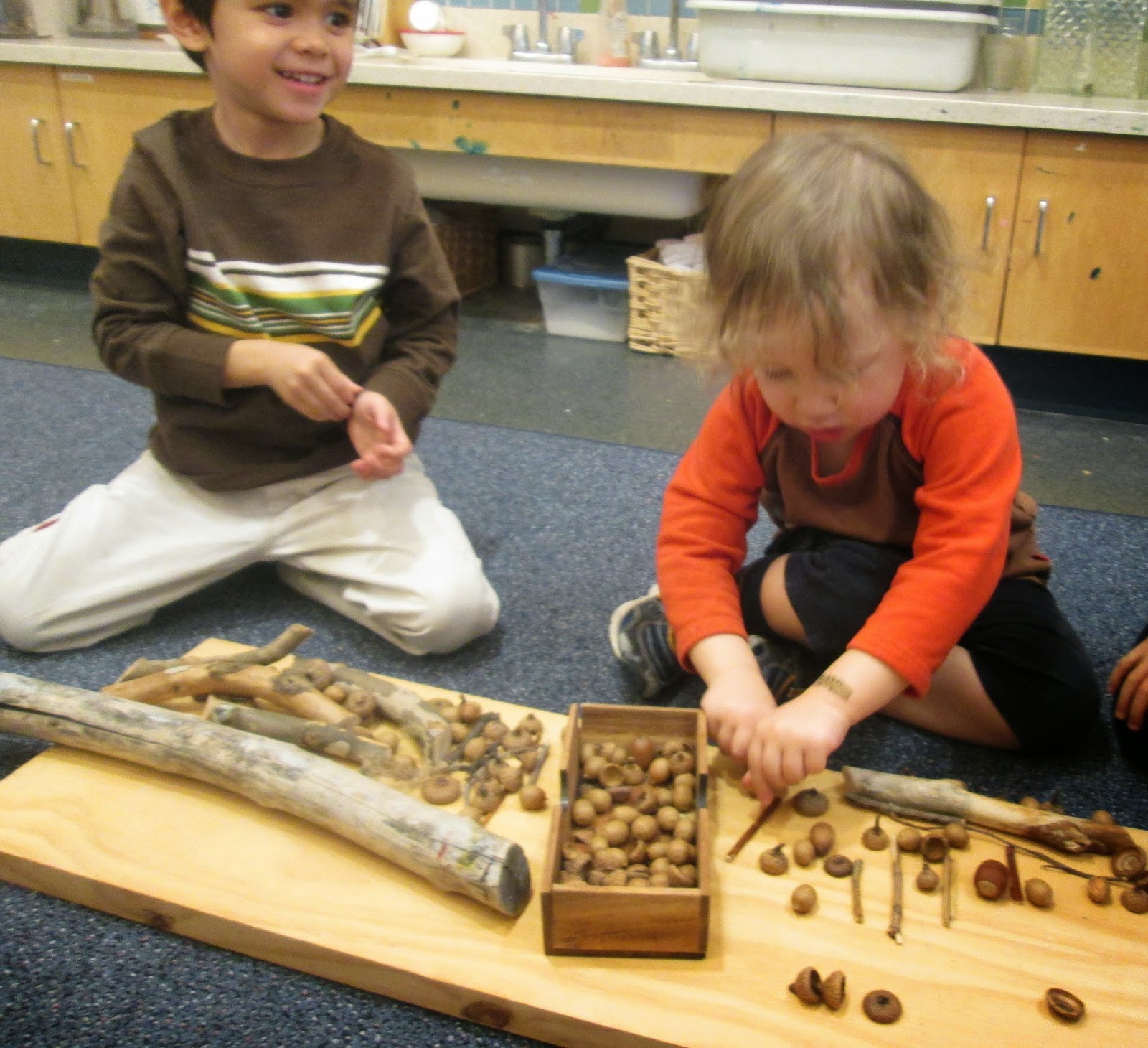
Following the video clips, I moved away the projector, spreading out several work surfaces on the floor, as well as baskets filled with many of the same materials that the artist had used. As children began building, I could see ways in which Goldsworthy’s work directly influenced their designs and their methods. Their great care in building creations using sticks, rocks, pine cones, acorns, and leaves seemed to echo the deliberation and concentration we had witnessed in the video.


As Gus surveyed the materials, he asked, “Can I make like he did?” beginning to collect sticks for a “nest.” Later, when he wanted to make one of the sticks stand up, “like a tree,” he made use of a glass jar as a stabilizing device. When A. laid out a small circle of rocks, she said, “I made what he made. I saw he made a hole with rocks, so I made a hole with rocks.” El. created a long line using all of the rough-edged rocks available. Arnaud and Justin built intricate traps, where each acorn cap or stick had a job to do.  N. enjoyed making matching stacks of things, such as a series of tree ring towers. Phineas overlapped a series of sticks, which he described as “just a design.”  E. worked to cover the entire surface of the different squares of wood set out alongside the materials. She would search for the perfect rock to fill each space, creating an orderly mosaic of materials.

Questions of Scarcity
I noticed that order and space became very important for many children over the course of the visit – lining up a series of sticks that were big enough to stretch across two other sticks like a bridge, filling a small square with only smooth stones… This meant that many conversations arose around the issues of scarcity – not having enough to finish a project you had begun – and stockpiling – holding on to many things in order to use them for future projects. Such conversations are part of the preschool milieu – how do you share space and resources with 15 (or, in this case, 4) other kids? The unique piece of this Studio experience was that this was a space dedicated to using just these particular materials, leaving more room for these discussions to happen. In many cases, the children discovered that their worries about someone else taking “all” or “too many” of something were unfounded, or that they really did not need all of the pieces they had been fighting to keep. For instance, when Gus was working to create his “tree,” the glass jar he wanted was full of sticks. He quietly sat down by the jar and began to empty it out. A. and E., who were working nearby, watched him.

A.: Oh no, he’s taking everything!
E.: Oh no, and I need sticks!
At this point, Gus left with the jar, leaving a pile of sticks on the floor.
E.: Oh, he just took that jar.
Katie: Did he take everything?
A.: No, he left those.
Katie: All he needed was the jar, so he left the sticks for you.
E.: That was nice of him. I guess I only need a few sticks.

Where the River Meets the Sea: The Big Picture
Through this experience, the children gained practice in appreciating, using, and re-using these natural materials. Treated as loose parts, the possibilities of sticks, rocks, and leaves multiplied, while children’s concerns over quantity and ownership gradually diminished. My wish is that this way of being can extend beyond the classroom into the greater natural world, where we can recognize forests, mountains, rivers, and more as treasures held in common, worth defending to be appreciated again and again by generations, rather than used up for the sake of one. We are the stewards of the earth, and we are charged with the task of passing that stewardship on. The best way I can think to do this is to help children engage with nature, cherish it, and not merely preserve, but share it in good faith. 

*The pictures featuring Goldsworthy's work are screenshots from Rivers and Tides.

Friday, June 6, 2014

Searching for Workers, Finding our Community

As many teachers at our center have embarked upon project work this year, they have sought ways to delve deeper into children's shared interests and to provide them with new perspectives through which to view such things as sea monsters, paper airplanes, ramps, and birds, to name a few. As with most new things, this has involved moving beyond our comfort zones, literally as well as figuratively. "Going deeper" has often included straying beyond the familiar walls and playgrounds of our school and into the city around us. These experiences have added a new dimension to the projects - the opportunity to get to know our community.

One example of what I mean occurred just over a week ago. As a part of their project work around the people at work in our community, a group of older toddlers, their teacher, Kerry, and I ventured out on a walk around our school's neighborhood, to "look for workers."  

As we started walking - 

Yoshi: Look! A delivery worker!
F: What’s your name?
Katie: I wonder if any of those packages are for our school.
Yoshi: (seeing a big diaper box) Those are for babies.
F: (points to the packages piled all the way to the handle of his cart) That’s too many!
A: Can we take your picture?
The delivery worker apologized for being too busy to stop and talk to us right then. As we continued our walk…
A: Look at that delivery truck.
Katie: This reminds me of when you guys did deliveries, too.
Kerry: Yeah! What was the name of the thing you guys used to make deliveries?
Yoshi: Some boxes were heavy and some weren’t.
Turning the corner, we noticed that a courtyard by some nearby apartments had been torn up.

Tracks in the dirt. What made them?
Yoshi: Maybe there’s construction there. Don’t go on there!
S: There was a tractor here.
Kerry: You think there was a tractor? How do you know?
S: See the tracks?
Yoshi: I don’t think it was a tractor. (sees a ladder nearby) There’s a ladder! That’s what the tracks are.
We walked down the street, hoping to see some people at work. We saw a lot of cones – traces of construction work – and the children pointed out drivers of big landscaping and contracting trucks that passed. A. noticed a fire hydrant, saying, “A fireman.” Yoshi noticed a tree that had been cut down.  “What happened to that tree? It’s just a stump.” I noticed some really full recycling bins, which led us to talk about the trash truck that the children watch every day from their window.

As we neared the MLK School construction site, the children saw something very exciting…

Yoshi: A street sweeper! It cleans a dirty dirty dirty dirty…
The street sweeper hard at work. 
A: Street!
Yoshi: Yeah, street!
The children looked closely for the man inside the sweeper. At one point, F. said, “Oh, there! See the orange shirt!” A. also pointed out two mailboxes on the street corner nearby, and the children peeked through the fence at the construction in progress, although the workers had all gone home for the day.

What struck me about this walk was that, although we didn’t see as many workers as we were hoping, we saw many signs of different types of work done in our city every day. From ladders to fire hydrants to mail boxes to construction cones, our city is full of objects representing the workers who help it function. When I think about the work that this group has done for our school (such as making and delivering moon sand to other classrooms), I can identify particular objects that hold meaning for them in a similar way. For instance, they are always eager to pick out a smock to wear before making moon sand, and it is only after their smocks are on that they declare, “We are workers.” For these children, these objects are important symbols, essential to the identity of workers and their jobs. One of the things that has been truly wonderful about this project is the way in which it has opened up children’s eyes to the multiple meanings of the word “worker” – it no longer just means a construction worker, but also a delivery person, a gardener, a baker, a moon sand maker… the list goes on and on. The many things they identified as belonging to workers illustrated this very idea. We don’t just need builders to build a community… we need lots of other people, too! 
A peek into the construction zone.

This process of reaching beyond our classroom walls and into the greater Cambridge community has been one of the most amazing parts of our first venture into project work. Many groups have been venturing beyond our school's walls - even if it is just a little way - in order to expand their perspectives and bring their work into the "real" world. One of our preschool groups is intent on educating the public about the dangerous sea monsters they believe live in the Charles River, whether that means yelling out at passers-by "Beware the sea monsters! They will eat you up!" or posting signs along the riverbank. Another group, who is interested in performance, is planning to visit a local repertory theater in order to learn more about all of the work that goes in to putting on a play. 

In addition to expanding our sense of community through these trips outside our school, many projects have also offered opportunities for children to build and strengthen relationships within our center's walls. The worker group's experience making and delivering moon sand to other classrooms is one example - the children were able to visit and get to know classrooms, children, and teachers they rarely see. Children whose groups shared a similar interest - ramps - shared a Studio visit together in order to learn from each other. For one group, whose interest lies in gardening and plants, their understanding of our school community expanded rather accidentally on a trip to the garden to observe and draw some plants. When they arrived, our school's garden plot was being carefully tended by a different classroom. As we made our way to a spot to draw, one child asked, "What they doing in our garden?" As I explained that the garden belonged to our whole school and that many children helped to care for it, I could see her brow furrow in thought. "We take care of it, too," she said at last, before turning back to her clipboard. 


A "Beware of Sea Monsters" sign tied to a tree.
The educators of Reggio Emilia often discuss the rights and respect that children as active citizens of this world. As the town's mayor, Graziano Delrio, wrote in his contribution to the Hundred Languages of Children,"In this period of our history, the idea of citizenship has had a strong influence on the identity of the infant-toddler centers and preschools - the sense of belonging, the willingness to take care of one another, the wish to participate, and the desire to be an active part of a process of change toward greater prosperity for the world community." These experiences within our school and our city are a means of building this good citizenship, not only by introducing children to their community, but by giving them a sense of place and power within it. They may not be the only gardeners at work in this place, but their contribution is still important and necessary. I hope this is an understanding they carry with them as a result of this work we are doing together. 


How did you understand your community when you were young? 

How about now?

Thursday, May 29, 2014

Building Relationships with Our Local Ecology; Our Early Release Day 2014

Friday was our second Early Release Day of this academic year. These days are precious opportunities for our entire  staff to come together for professional development. We spent our time thinking about how we can ground more of our learning in the natural world that surrounds us. 

“Naturalist Intelligence” is one of Howard Gardner's Multiple Intelligences, and it's one that we don't teach to as much as the others. We also know that most adults who are stewards of the planet were children who learned to love a special outdoor place through unstructured play and the mentorship of an adult who loved the land. Here in an urban environment, it can be challenging to think about our local ecosystem, so we spent time considering how we can bring children outdoors more often and more thoughtfully. 

Ann Pelo’s excellent book for teachers and families, The Goodness of Rain, provided structure for our time together. While Pelo cared for a toddler for one year,  she cultivated practices that can help any child develop “ecological literacy”. We spent some time with each of these practices on Friday: “Walk the Land, Practice Silence, Embrace Sensuality, Learn the Names, Explore New Perspectives, Create Stories, Make Rituals.”  Teachers worked together to learn these practices, and planned to make them a regular part of their classroom life.

Starting with Our Senses
In my research for this workshop, I found a list of smells that made people nostalgic. It was divided into people born in the 1920’s, 30’s and 40’s, and people born in the 1960’s and 1970’s. (The book was written in the early 1990’s, so folks born in the 1980’s weren’t old enough to be very nostalgic yet, and we’re not sure why those born in the 1950’s were left out.) 
The two lists were very different in part because the list from an earlier generation included natural smells like “Cinnamon, ocean breeze, rose petals” and the list from younger people included “vinyl, children’s aspirin, gasoline.”  I was curious to see if our intergenerational staff would break down similarly, and wanted to ground our work in our own childhood memories and in our senses.

I asked everyone “What is a smell that makes you feel nostalgic?” 

People born Before 1970:
Lilac, a new Barbie case, opening a Play-doh can, Chanel #5, Garcia Vega cigars, ironed linen, manure, the inside of a barn, cloves, lobster juice, shoe polish, food deep fried in oil.

People born in the 1970’s:
Cedar, new crayons, plastic Halloween mask, gasoline, “vanilla” scented baby doll, horses, cut grass, pine needles, dirt, mulch, orange bubble gum, garlic, basement, chlorine, red dirt, orange slices, McDonalds.

People born in the 1980’s:
Dirt, pine cones, a cat who’s been outside, warm pine needles, old cars, chewing tobacco, bazooka gum, MFA (feed) store, city grates, garbage, human filth, “chocolate”-scented dolls, White Shoulders, Play-doh, mom’s chocolate cookies, clean sheets, cigars, mechanic shop, lasagna cooking, Drakkar Noir, cucumber melon perfume, watermelon or strawberry airheads, campfires, puppy ears, bonfire smell in my hair the next morning, old cans, peanuts roasting, mulch, newborn babies’ heads, sidewalk chalk, coffee beans, tobacoo, pigs in mud, fabric softener, orange and bananas together, a certain perfume all teenagers wore, ocean.

People born in the 1990’s : 
cherry blow pops, thunder storms, dead leaves, rotted apples, grapes and blueberries; bubbly tar, big trees in the playground sun, bird seed, fruit by the foot.
All of the groups had manufactured and natural smells in our repertoire. Given the urban environment we inhabit, the children in our care likely will have a similar breakdown. It’s helpful for us to remember that we are participating in precious years of children’s life, and we have some input on which smells (and tastes, and sunsets, and sounds) they associate with growing up.

Next we started on the practices described in Ann’s book.

Walk the Land:

When we walk around the community, children have opportunities that they don’t have when we carry them, or put them in a vehicle. When babies are wheeled around our community, they get to know it in more depth than when they are looking through a window. When we visit the same places over time, children develop relationships with their own sorts of landmarks (that huge dandelion, the good puddle, the purple car, the really high curb). They notice growth and decay when they are able to walk by the same places again and again.

I invited our staff to take some time walking around Peabody Terrace, with nowhere to go, paying attention to their surroundings.

Practice Silence:

As a community we are constantly discussing how we know when to “teach” and when to “step back”. Teachers are often extroverts, and we know that it can be helpful for us to narrate to children what we see. 

However, silence makes space for children and teachers to take their time, watching a worm in the garden, or a red-tailed hawk making a circle over our towers. As we walked, I asked folks to stay silent and to stop when they were ready and spend some time silently observing and enjoying their surroundings.

Teachers watched insects in the lawn, sat in the crotch of one of the sweet gum trees, looked out over the Charles river, drew flowers and poked at mushrooms. 

When we all came back together, I asked teachers to reflect on their comfort level with the outdoors, and to figure out a way to push their own boundary, to give children a little more time and space outdoors. 

Teachers shared that they had noticed some new things during our short period of silent exploration:

Brae: Today I learned that doves exist outside of magic shows!

Elayne: Birds hop on the ground instead of using alternating feet like we do.

Irene: I noticed that it smells so sweet here today, and that the constant din of traffic is almost unavoidable here.

Seana: I sat in the seat of one of the trees because I see kids do it all the time. It buffers that sound in a way. It was comforting in the way it sort of squeezed my body. It wasn’t as hard as I thought, had more give than I would have guessed. There’s this super soft moss, and my feet were in the dirt for a whole other sensory experience on top of the seat. It was a nice place to sit and observe you guys.

Embrace Sensuality

Next we had a snack to fuel the rest of our work. Our teachers spend much of our time considering the “sensory diet” of the children in our care, so this practice wasn't as far outside of our experience. 

We had some beautiful, seasonal and rich food; fresh sugar snap peas, strawberries and warm, fresh bread and butter to enjoy. Bringing experiences like this snack to children helps them develop their sense of aesthetics and beauty, and their understanding of the kinds of beauty that we find in the natural world. Taking time to feel the ferns brush our legs as we walk in the garden, eating some of our harvest or appreciating the smell of the wet grass after a rain are ways that we can directly experience the natural world and enjoy it.

Learn the Names

I introduced a variety of field guides as a helpful resource and a great addition to any bookshelf in the center. Field guides give children opportunities to practice literacy, taxonomy, and organization but they also put us on a first-name basis with the organisms that surround us. Pelo writes:

“The Earth is not an anonymous place. We speak of it in generalities, using categorical names to describe what we encounter: ‘a bird,’ ‘a bug,’ ‘a rock.’ In our seeing and our speaking, we are willing to make do with broad, indistinct groupings that contain a wide range of individuals, unacknowledged in their particularities. The absence of names becomes a barrier to intimacy: a bird is a bird is any bird, not this cliff sparrow, not this crag martin. When we don’t know what we see, who we hear, where we walk, we don’t know, really where we are. Names are integral to relationship.” (p 105).
When I arrived at my new classroom many years ago in Seattle, I was stunned that the kids in my urban class could name all the different types of salmon, and would ask me “May I pick those juniper berries for our game?” I’ve seen the kind of intimacy with the land and its inhabitants that Ann describes. So I handed over the field guides and sent the teachers on a scavenger hunt in teams. They ranged all over, from the garden to the river, watching the trees for chickadees and blue jays, and searching the field guides for collected leaves.

Explore New Perspectives

In centers with a Reggio Emilia approach, we often discuss “perspective taking” as a skill necessary for life and for working with, caring for and enjoying other humans. I invited teachers to think about the perspectives of the creatures and even the plants that are in our community. It can be a challenge to do this in a not anthropocentric way, but any attempt to “walk in the shoes” of an ant, or a pigeon, or a seedling, helps us deepen our understanding of that organism, and see ourselves more clearly in comparison. If you haven’t, please check out the work of the children and teachers in Infant and Toddler 1 South. These very young children are thinking about the lives of birds in order to watch them.

As a group, we each sat down and considered the point of view of an organism that might live within five miles of here. We thought about that creature’s sounds and sights, the activities and preferences.

These practices are all intended for children and their care-givers to do together, and when teachers and children imagine the perspectives of the inhabitants of our local ecology, we grow closer to this place. When we remembered the smells of our childhood, we also recognized that we help determine the smells (and sights and sounds and tastes and feelings) that will represent their early childhood. Helping the children to feel grounded here, to really know the squirrels and pigeons (rock doves!) who share our play spaces will help them to feel connected to future ecosystems they encounter in the future.

Create Stories

The stories that engage children are not always the most dramatic, or interesting. Children enjoy hearing the simple story of meeting a moose on a trail in Maine, quietly stepping out of the way, and watching it wander off, chewing on some moss as it walked. Debbie shared that her son tells simple stories that  Sammie has shared about encounters with living things in great detail.  We don’t have to make up complicated tales about princesses or dragons, we can tell about the time that there were hundreds of ladybugs in the field. And then we can tell it again and again and again. Teachers practiced this by telling the story of the creature whose perspective they considered. The room was filled with laughter and warm story-telling.

Make Rituals

Rituals always help children transition from one thought, feeling or activity to another. They help us describe our community to itself. Rituals in a child care center are very simple, and usually brief. Erin mentioned the traditions of hollering into the parking garage to hear echoes on the way to the garden and taking some time examining the map of Peabody Terrace on the way back to the classroom each time. It can be difficult to incorporate new practices into our teaching because our days pass so quickly, and we have much to do. This time was provided for teams to take some time to consider what rituals might support, mark or celebrate their time outdoors together. I especially recommended visiting a place weekly or regularly, whether the garden or a library or a more distant playground so that children had access to the same views, the same plants, sidewalk and sky over time, to develop relationships with one corner of the world.

Here are some of the rituals teachers will bring to their classrooms:

·       Asking guiding questions before outings and revisiting them on the way back
·         Starting a journal in the garden, to facilitate communication about the work we do and the things we see there
·         Eating some more meals outside
·         Visiting the farmer’s market weekly once it opens in June for a yummy, local snack
·         An infant room will make a practice of telling the story of “what happened last time” as they put children into the strollers


We also collaborated on a list of local destinations for walks or bus trips. Katie and I will work to put these places on a map that we can all use to guide our outings. I am excited to see what kind of curriculum emerges from our work and play outside this spring and summer. 

It’s transformative for individuals to commit to knowing more about the living things outside our door, and I wonder what could happen over time in a community of learners who all walk the land, practice silence, embrace sensuality, learn the names, explore new perspectives, create stories and make rituals.