Showing posts with label environment. Show all posts

Thursday, October 12, 2017

Our first Umbrella Project!


Investigating Together:

Exploring the Charles River as a Center

“Learning and teaching should not stand on opposite banks and just watch the river flow by; instead, they should embark together on a journey down the water. Through an active, reciprocal exchange, teaching can strengthen learning how to learn.”
-       Loris Malaguzzi


The idea of embarking on an umbrella project came from work that is done in both Reggio Emilia, Italy and in the Sabot School at Stony Point in Richmond, Virginia. It is a center-wide investigation undertaken by children & teachers that continues throughout the year, in various forms both big and small. Together as a center, we defined what the topic of an umbrella project might be:

“A compelling, enticing, accessible, physical thing, event, place or idea (a noun) that elicits a emotional and metaphysical response between people. A catalyst with opportunities for investment in deep, dynamic connections, new ideas (growth).”

 For our first umbrella project (which we investigated during our 2016-2017 school year), we chose the subject of the Charles River – a unique and beautiful piece of nature in the midst of our urban surroundings. The river has always been a part of our school’s landscape – it can be seen through the Studio and T2North windows, and it is a location for occasional walks – and this year we sought to strengthen our relationship with and understanding of it through this investigation. For many classrooms, even the act of allowing children to get out of the buggy by the river was a revelation in itself. For others, the process of returning again and again led children to ask for and recognize just what a “river walk” meant. In addition, our attention and consciousness of the river opened our eyes to the way in which it changed over the course of the year – from the blooming flowers in summer, to the falling of the leaves in autumn, to the freezing of the water in winter, to the appearance of goslings in the spring. 


In order to share just a fragment about what I found to be a powerful center-wide experience, I used some of the headings from Ann Pelo’s book, TheGoodness of Rain: Developing an Ecological Identity in Young Children : walk the land, learn the names, embrace sensuality, explore new perspectives, create stories, and create rituals. Pelo describes these as ways in which we can foster children’s relationship with and stewardship of the natural world, and I believe they were all present in our investigation this past year. 

Walk the Land ------------------
Returning again and again to the river throughout the year allowed us to broaden our knowledge of its terrain. We learned the best places for children to throw rocks and sticks, or to look out over the river, to collect, to watch boats, or to gather flowers. Children grew familiar with the landmarks they would pass on the walk to and from the Charles. Teachers marked the evolution of children’s ability to traverse the challenges of uneven ground, long grass, mud, and tree roots.

At the beginning of the year, the prospect of walking along the river was a bit daunting for some. Many classrooms began with buggy and stroller rides, not yet venturing to let the children down to explore. However, over time, both teachers and children became more comfortable with the river and its banks, finding places where they felt safe to investigate beyond the buggy. Even our youngest infants spent time sitting, laying down, or crawling near the river. Building a relationship with this place allowed us to broaden our comfort zones  and place more trust and autonomy in children.

Create Rituals --------------------

Over our year of visiting and revisiting the river, many classrooms developed rituals to help build community and to strengthen children’s connections with place. In some cases, this took the form of finding a “spot” that a group would visit during each trip to the river. A gated ledge that allowed children to view the river up close without fear of actually entering the water became a favorite place for many to search for sticks to throw in on each walk. One classroom always stopped to look at the “turtle stone” that they passed on the walk to and from the river. For some children, it was important that everyone have a turn to push the crosswalk button as we waited a the juncture of memorial drive and DeWolfe street.

Embrace Sensuality --------------------
The sound of waves lapping after a boat has passed… the honking of geese… the feel of wind against your face or the sun on your back… the smell of autumn leaves, of chamomile buds, of daffodils… the softness of milkweed seeds… the prickle of burdock and sweet gum pods....  the sour taste of sorrel … the spicy taste of wild chives…

The river invited us to explore with all of our senses. We opened our ears to the sounds(after hearing a jet ski zoom back and forth, one child remarked, “It’s like a motorcycle!), and our skin to the feel of the  river’s offerings. Our eyes took in the many delights on display – the colors of autumn and spring, the ice and snow of the winter. We searched out opportunities to smell and taste where we could. Each visit became so much more than a walk – it was a full-body experience.

Explore new Perspectives ---------------
Our commitment to the Charles River led us to witness its beauty through a variety of lenses and from a variety of places. We watched it through windows, through the pillars of the John Weeks footbridge, and up close on its banks. We represented it in multiple media, and we took note of the ways the river itself changed through the seasons.

Visiting the river also offered teachers an opportunity to take on a child’s point of view. Infant teachers wondered at the view of the trees a baby might see lying on their back. Toddler teachers noticed how a seemingly small hill provided a real challenge to children still learning to walk. Preschool teachers shared the joy of being able to gather flowers without the restrictions of more manicured environments. The sight of a goose on its nest or a snail on the path brought as much excitement and interest to the adults as to the children.

Learn the Names ---------------------
As we move beyond the generic names of nature – bird, flower, leaf – into the specific, we are building our relationship with the natural word, just as we would a person. Over the course of the year, children and teachers across our center developed a greater intimacy with many of the things we encountered near the river.

Young toddlers came to know the difference between a goose and a swan, while older children (and teachers!) grew knowledgeable about some of the plants that grow on the riverbanks (“Watch out for burdock – it’s so sticky!”). We revisited these things in a variety of ways – not only on the walks themselves, but by bringing remnants into our rooms through photographs, collections, drawings, and field guides.

Create Stories ----------------------------
As we build relationships with a place, we begin to collect stories about it. We remember the things that we have seen, the special encounters we have had, and the changes we have noticed as a result of our kinship with this landscape. Through our documentation, teachers remind children of these stories and share them with those who were not present.

One example of the development of a story came early on in the year. Many children spent time painting under a large oak tree near the footbridge. Then, one day, some other children discovered that part of the tree had cracked and fallen. Over the next few days, children from many different classrooms encountered the tree in various stages of removal –from branches being cut to a stump in the ground, to an empty patch of dirt. This is a story that many preschoolers still remember and will reminisce about as we cross Memorial Drive.

----------------------------------------
This year, we are exploring sound as a center. Stay tuned - I'm sure there will be posts about it as the year progresses!

- Katie 

Monday, December 19, 2016

The Power of Loose Parts

What is a “loose part”?
Loose parts are essentially materials that can be moved around and manipulated in many ways, and which don’t necessarily have a single assigned “job” or use.

Why should we play with them?
In the 1970s, the Theory of Loose Parts was developed by architect Simon Nicholson in response to what he saw as a lack of opportunity for children (and adults outside the realms of architecture) to play around with concepts of building and construction in their daily lives. The principle of the theory is as follows:

“In any environment, both the degree of inventiveness and creativity, and the possibility of discovery, are directly proportional to the number and kind of variables in it.”[1]

In other words, when people interact in a given space, the more options they are offered, and the more the available options can be combined and recombined, the more interesting and diverse the results. The repercussions of this idea for the early childhood classroom are clear – when we offer children more materials that are unscripted, hold multiple possibilities, and can be put together and taken apart in numerous ways we see more creativity, engagement, and discovery on the part of students (and I would argue on the part of the teachers and parents as well!). And these benefits are not limited to the realm of building and spatial thinking, but can extend far beyond, into the realms of dramatic play, artistic expression, literacy , and mathematical thinking… to name a few.

Below are just a few instances of children at work with loose parts in our center. Where do you see inventiveness and creativity at work through these materials?


Tubes of varying sizes inspire Alec and Grace to investigate stacking them and trying to fit them inside each other. Grace tried to cover one long tube with several smaller ones, while Alec tried to see if he could nest two tubes of the same size. 


Atom discovers that these small plastic containers stack one on top of the other very nicely. He builds a tower, taller, taller, taller, until it begins to wobble. When it falls down - crash! - he picks up the pieces and begins to build again. 


J and F investigate the structural integrity of this "house" made of carpet squares. It was able to hold several heavy blocks for its "roof" before it finally collapsed. 


Julius and Quinn examine a tube stuffed with mylar together. The mylar is crinkly, sparkly, and noisy, and the tube is tricky for small hands to manipulate. It rolls and tips as they try to angle it just so, searching for the best way to look in and pull out the mylar. 


Leon and Cathy found some pieces of sheer fabric in the movement studio while they watched a projection of some Riverdance performers. They used the fabric as costumes, as something to hide behind, and, finally, as something to hold behind their backs, the same way some of the dancers held their hands behind their backs. 


Jihye and Emmett discovered a wooden place-mat and a piece of bumpy, translucent plastic in the Studio. Looking through them, they noticed that their view of the world changed! The other children in the Studio also noticed that it changed the way Jihye and Emmett looked, making it hard to see all of Jihye's face, and making Emmett look "foggy." 


[1]Nicholson, S (1972). The Theory of Loose Parts: An important principle for design methodology. Studies in Design EducationCraft & Technology 4, (2), 6. 

Thursday, December 11, 2014

Conversations with Nature: Preschool One Explores Natural Materials

“We often forget that WE ARE NATURE. Nature is not something separate from us. So when we say that we have lost our connection to nature, we’ve lost our connection to ourselves.”
                                                                                   ― Andy Goldsworthy

Autumn in New England is full of natural beauty – from golden leaves floating to the ground to acorns nestled in the grass to branches blown free by the winds.  These objects call out to be touched, gathered, collected, and children often do just that. Pockets that were empty before the trip to the playground return crammed full of bark and twigs and stones. Long sticks are brandished like swords and left unwillingly beside the door until they can be used again. These things entice us, draw us in, and call to our creativity. They are one of the hundred languages, and, if we make space, we can speak through them. This is Preschool One’s story.  

Rivers and Tides
We began our work with natural materials in the Studio by watching pieces of the documentary, Rivers and Tides.  This documentary features the work of artist Andy Goldsworthy, who creates beautiful installations – some in museums, but many of them outside – using entirely natural materials. I love this documentary because it not only showcases Goldsworthy’s breathtaking creations, it also shows his process. You can see his attention to detail in finding the perfect piece to add to his creation, as well as his frustration when one of his projects collapses midway.

I projected the video on the wall without sound, occasionally prompting children’s conversation with questions, such as “What does that remind you of?” or “What do you think he is using?” Here are some of their thoughts about what they witnessed*:


Alisa – It’s a snake.
Y. – Did you know there’s paths like that?
N. – Maybe it’s a drawing.
Justin – Maybe it’s lava.


E. – Hey all those are blowing away from the snake.
Justin – There’s something inside them – a sea snake.


A. – We see ice.
F. – His hands are cold.
Y. – What is he making? He’s eating it. Ew.
E. – It’s cuz all the other pieces are just like it and he can stick the pieces to the pieces.
All – BRAVO (when he finally sticks his last piece of ice).
N. – It’s a snake tree.


Justin – Maybe he’s making a nest.
Arnaud – Maybe he’s making a nest out of trees.


A. – I think he is making a house for him. He’s using stone.
Justin – Looks like a pile of rocks.
Gus – Maybe it’s melting – now.


Alisa – It’s a web.
Y. – You know why it’s not a web, because there’s a hole on a stop sign.
F. – Why is there a hole there?
Y. – Maybe so it can be a stop sign.

The Building Process
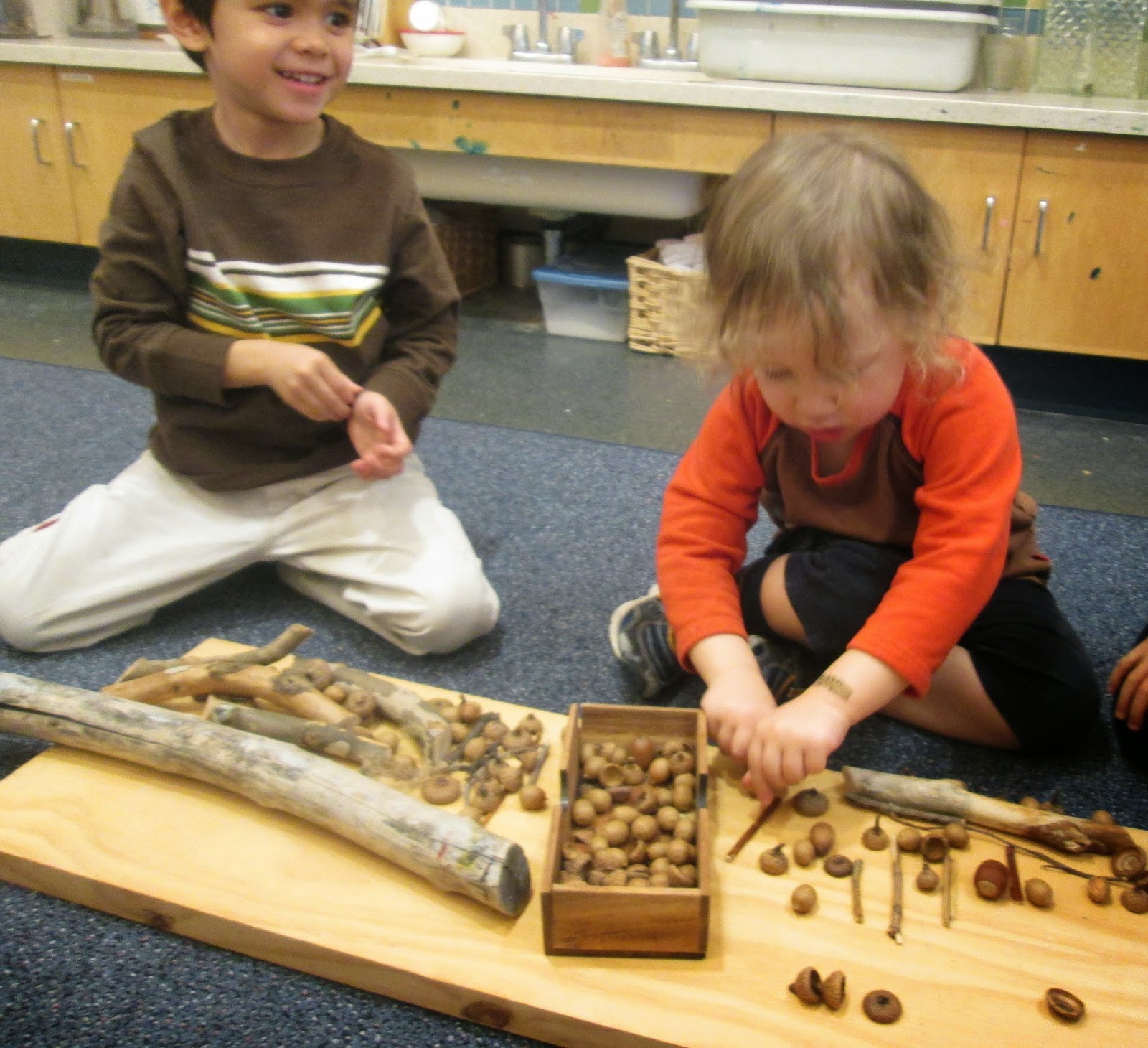
Following the video clips, I moved away the projector, spreading out several work surfaces on the floor, as well as baskets filled with many of the same materials that the artist had used. As children began building, I could see ways in which Goldsworthy’s work directly influenced their designs and their methods. Their great care in building creations using sticks, rocks, pine cones, acorns, and leaves seemed to echo the deliberation and concentration we had witnessed in the video.


As Gus surveyed the materials, he asked, “Can I make like he did?” beginning to collect sticks for a “nest.” Later, when he wanted to make one of the sticks stand up, “like a tree,” he made use of a glass jar as a stabilizing device. When A. laid out a small circle of rocks, she said, “I made what he made. I saw he made a hole with rocks, so I made a hole with rocks.” El. created a long line using all of the rough-edged rocks available. Arnaud and Justin built intricate traps, where each acorn cap or stick had a job to do.  N. enjoyed making matching stacks of things, such as a series of tree ring towers. Phineas overlapped a series of sticks, which he described as “just a design.”  E. worked to cover the entire surface of the different squares of wood set out alongside the materials. She would search for the perfect rock to fill each space, creating an orderly mosaic of materials.

Questions of Scarcity
I noticed that order and space became very important for many children over the course of the visit – lining up a series of sticks that were big enough to stretch across two other sticks like a bridge, filling a small square with only smooth stones… This meant that many conversations arose around the issues of scarcity – not having enough to finish a project you had begun – and stockpiling – holding on to many things in order to use them for future projects. Such conversations are part of the preschool milieu – how do you share space and resources with 15 (or, in this case, 4) other kids? The unique piece of this Studio experience was that this was a space dedicated to using just these particular materials, leaving more room for these discussions to happen. In many cases, the children discovered that their worries about someone else taking “all” or “too many” of something were unfounded, or that they really did not need all of the pieces they had been fighting to keep. For instance, when Gus was working to create his “tree,” the glass jar he wanted was full of sticks. He quietly sat down by the jar and began to empty it out. A. and E., who were working nearby, watched him.

A.: Oh no, he’s taking everything!
E.: Oh no, and I need sticks!
At this point, Gus left with the jar, leaving a pile of sticks on the floor.
E.: Oh, he just took that jar.
Katie: Did he take everything?
A.: No, he left those.
Katie: All he needed was the jar, so he left the sticks for you.
E.: That was nice of him. I guess I only need a few sticks.

Where the River Meets the Sea: The Big Picture
Through this experience, the children gained practice in appreciating, using, and re-using these natural materials. Treated as loose parts, the possibilities of sticks, rocks, and leaves multiplied, while children’s concerns over quantity and ownership gradually diminished. My wish is that this way of being can extend beyond the classroom into the greater natural world, where we can recognize forests, mountains, rivers, and more as treasures held in common, worth defending to be appreciated again and again by generations, rather than used up for the sake of one. We are the stewards of the earth, and we are charged with the task of passing that stewardship on. The best way I can think to do this is to help children engage with nature, cherish it, and not merely preserve, but share it in good faith. 

*The pictures featuring Goldsworthy's work are screenshots from Rivers and Tides.

Thursday, March 27, 2014

Creating Spaces for Art Materials in Classrooms

Over the past several years, art materials have become increasingly available to children in our classrooms. We have now reached the point where 5 of our 8 classrooms have dedicated mini-ateliers where a mix of different media are always out and open for children to use. Of course, like any piece of our environment, these spaces need to be revisited, reviewed, and revised as the year progresses.

After our school's break in January, I returned ready to help classrooms take a second (and third, and fourth) look at the structure of these spaces, as well as their systems for displaying children's work. In some cases, such as our Preschool One classroom, new life was breathed in merely by the addition of new and exciting materials. Restocking depleted shelves with items like cardboard tubes, popsicle sticks, string and rope, and various recycled objects opened up new possibilities for construction and collage. Although these items are commonly seen around our center, they had not been out in this classroom for some time. Adding them back into the mix gave children some wonderful materials to create props for dramatic play (a big theme for these children) and offered great opportunities for teachers to introduce the idea of making plans before building and choosing materials to match.

In other cases, more extensive (and ongoing) restructuring was set in motion in order to bring the lived reality of these spaces in line with our intention understanding of their purpose. As I worked with teachers to think about their mini-ateliers, we saw the need for a distinct, cohesive space that children recognize. All of the materials available must be close to each other (in order to invite the potential for multiple media to be explore within a single project), and the tools needed to manipulate these materials must also be near at hand in order for work to continue uninterrupted. This became clear in one classroom where materials and tools were spread across two different areas of the classroom (there was a separate area for writing). Teachers noticed sharpie caps, scissors, and paper scraps abandoned on the floor from children's journeys from one part of the classroom to another. Moving the two shelves close together in the front of the room created a central mini-atelier, where children had all of the necessary supplies within sight and reach.

This space - even if it is a single shelf - must be visually unified in this purpose. In their experiments with their mini-atelier this year, our Toddler 1 North team first placed materials on the bottom two shelves under their parent check-in table. During significant parts of the morning and afternoon these materials were inaccessible as parents checked their children in and out, wrote notes, and read documentation posted above. The children also conflated the adults' pens and check-in sheet on the top shelf with the small clipboards and other materials set beneath them, and would use the adult materials as often as those set out for their specific benefit.

In light of these differences, the teachers changed both the check-in system and the mini-atelier's location. Families now check-in using a clipboard that hangs up on the wall; large unit blocks taped together created a lower system of shelves that children could access more easily. These shelves are also set apart in their own nook close to the sink -visually a separate, special space - and materials are more available than before.
This group of teachers also found themselves asking the question - how can we make more materials open and available in a way that does not require constant policing on our part? They looked to a system they had already employed in a different area of the classroom where hanging baskets are labeled using a sample toy that is attached on the outside. For instance, a basket of trains would have a small train dangling over the edge, showing children what the basket holds. The labeling system gives children more power to ask for these additional toys when they are interested, while also giving teachers a chance to size up the atmosphere of the room before adding a new element. The teachers decided to try a similar system in their mini-atelier, creating a space for buckets of art materials to hang in sight of the children and within easy reach of the teachers. Thanks to the help of a parent who hung the rod for the buckets, messier materials, like glue and paint, are now within sight and within mind for children and adults alike, ready to be brought down as needed for the task at hand.

One piece of our mini-ateliers that many teachers are still thinking about is how to create holding spaces for children's work. We love to encourage children to take a second look, add a new layer, or seek out more details for their creations in order to deepen their thinking about them, but this can be difficult to do without a place for these creations to live in the interim. Our Toddler 2 North classroom rearranged their classroom in order to make space for a holding area for children's building projects. A long-forgotten shelf in one of our storage areas was the perfect size, and the children helped to clean it off and fix it up with a new paint job. This shelf now stands ready for three-dimensional work - from Lego creations to wooden sculptures - to be "saved" and revisited.
A Toddler 1 North Teacher shared this picture of a child at work
at their mini-atelier.Not only are the materials within arm's reach,
but the top of the shelf also acts as a convenient work space.

As a staff, we have been working with the book Designs for Living and Learning by Margie Carter and Deb Curtis in order to revisit our classroom environments together. Within this book, chapters are often broken down into the "living" piece (which are the more structural or macro changes to the environment) and the "learning" piece (which represents the materials and provocations that are set out). The ongoing process of reworking the mini-atelier spaces reminds me of the continuous give and take between these two elements -"macro" changes we might make to our environments and the intimate details of the materials we fill them with. Both are essential in helping us to build our underlying values into the physical spaces of our classrooms, and both deserve continual review and revision as our time together in that classroom unfolds.

How can we continue to build the practice of saving and revisiting children's work into our physical spaces and our daily practice with children and families?