Showing posts with label problem-solving. Show all posts

Wednesday, May 13, 2020

Teaching Tools: Child Development Resources for Families

- by Wheeler DeAngelis, Constanza Henderson, Myra O'Neal, and Mahoussie Pierre, Toddler 1 South Teachers


Dear Families,
With several more weeks at home stretching before us, we are choosing to see this time as an opportunity - an opportunity to offer you a peek behind the curtain of our work that most years we don’t have the time or venue to share. As child development experts, we have a wide range of knowledge that we draw upon in our work with and understanding of your children. We would like to share some of these with you. In this post, you will find information on the following topics:
  • Roles
  • Sensitive Observation
  • Scaffolding and the Zone of Proximal Development
  • Being an "Oppositional Partner"
  • Infant Directed Speech
  • Bloom's Taxonomy


We hope that these concepts, theories, and tips will help you to feel like you have more tools in the toolbox for optimizing this time together with your children. And as always questions and further discussion are highly encouraged.
Roles


Roles are really important to children. They help children to understand what they can expect of specific people. For your children, who have been attending childcare since before they can remember, there has always been a difference between parents and teachers. From the child's perspective, teachers spend the day with them and offer tests and provocations. When children are at school, it is their version of going to “work.” When children are at home, you engage in a less structured way  with  your child while still providing boundaries and limits.  


We want to acknowledge that the condensation of these two roles is really hard on everybody. And some of us may find it impossible. That is OK! Children are built to learn, regardless of circumstance. Whatever you are doing to be present for your child is enough for them. Don’t bend over backwards to try to fill a role you’re not comfortable being in. 


For those who feel like you can be more intentional in the materials and activities you provide in this new combined “parent-teacher” role, we encourage you to lean into it a little. Simply acknowledging to yourself what role your child is asking you to play can be a big stress reliever and can guide you and your child toward better outcomes.

Taking on the "parent-teacher" role can be scary and since it is a new role for some of you we wanted to put together a quick little guide to some "teacher skills" that might help you in your interactions. 

First and foremost always remember that teaching is as much art as it is science. A well laid plan can mitigate a lot of the natural chaos that comes with toddlerhood but never all of it. That is when intention, flexibility, and engagement come into play. Just because something isn’t going as planned doesn’t mean that the learning has stopped. It is great to have expectations for how activities will play out, but if your child has other safe and reasonable ideas for how they want to play, go with it! This is sometimes how provocations unfold even in the classroom. Sure a cooking project teaches a lot about math and chemistry, but hitting the side of the mixing bowl with a spoon teaches about acoustics and physics. And if that’s what your toddler wants to learn today, then steer into it! And always involve them in cleaning up their own messes afterwards!

Sensitive Observation

What is it?
Sensitive observation is the process of stepping back and observing, not engaging with a child who is focused on some activity. Taking careful note of the contexts in which your observation is taking place, and how those contexts are affecting the child.


Why does it matter at home?
If you can find the time, even just a few minutes of sensitive observation can make a huge difference in how you understand your child's world. The goal of any good observation is to synthesize what we see and create more clear questions for ourselves to answer. 


Is your child getting cranky around the same time everyday even though they’re fed and rested and clean? Well that’s where sensitive observation comes in. Is there something happening that your child can hear but not see? Are they anticipating something frightening that will happen soon or reacting late to something that happened earlier in the day?


Through observing a child in their environment we can begin discern the reasoning behind a child’s behavior rather than reacting to the behaviors themselves.

https://www.janetlansbury.com/2010/05/magda-gerbers-gift-to-grown-ups-parenting-that-engages-the-mind/

---
"Do less; observe more; enjoy most." - Magda Gerber


---


Scaffolding and Zone of Proximal Development 
What is it?
These two concepts are at the core of most of our work with your children. Zone of Proximal Development (ZPD), is a part of a theoretical framework that separates all potential activities into three categories:

1. Things a child can do on their own.
2. Things a child can't do. 
3. Things that they can do with help. 
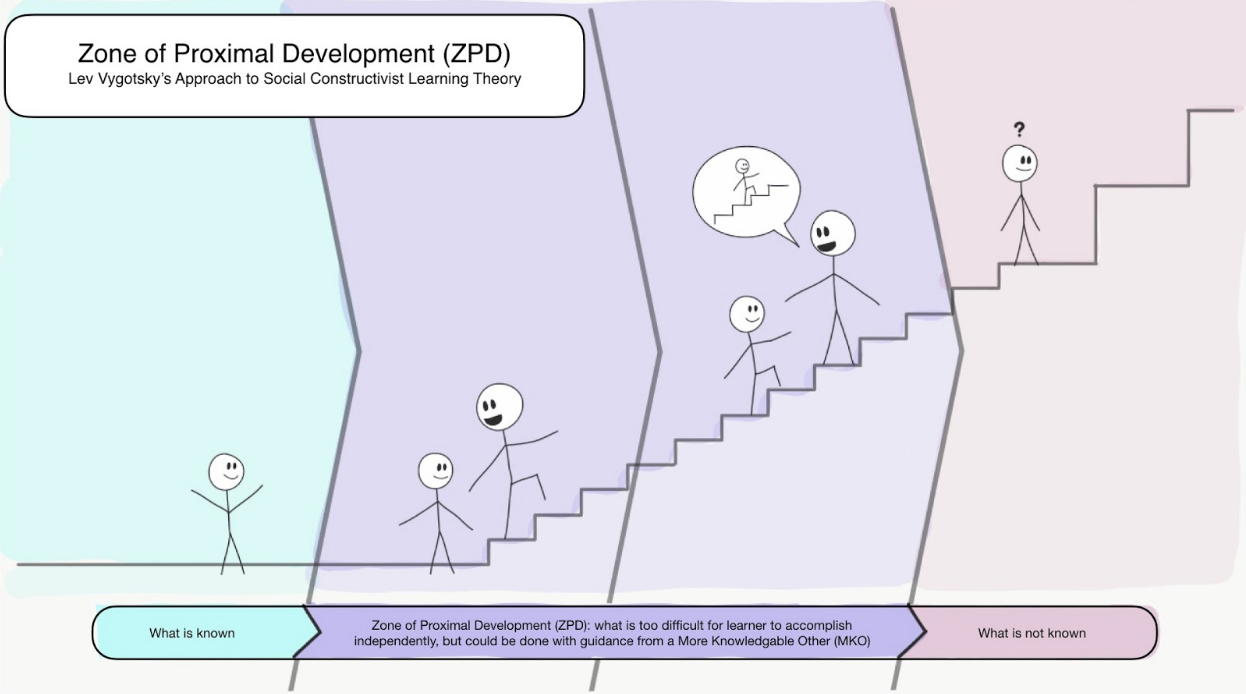

https://medium.com/applied-learning-theory/constructivism-29e8949330a
In this image the staircase and the adult illustrate the concept of scaffolding.


This third category is the child's ZPD. Scaffolding is simply a term for all the help offered by an adult to move an activity out of their "can't do" and into their Zone of Proximal Development.


Why does it matter at home?
An understanding of which category your child keeps each activity in, will help greatly with your activity selection. 

- Activities from their "things I can't do" category will lead to the shortest and most frustrated play sessions. 

- Offering your child an activity in their “things I can do” category, like a familiar book or puzzle, will lead to longer more focused play times. 

- Activities from their ZPD will lead to the longest play and highly meaningful interactions  but will  some require adult facilitation.

Being an “oppositional partner” 

What is it?
Occasionally when you play with your child, create your own play plan and stick to it. If your child asks you for the materials you are using, tell them that you are using them and make a plan for when they can have a turn.


Why does it matter at home?
Children learn a lot from playing with a partner. The give and take of these interactions are crucial for positive socio-emotional development but they are hard to replicate at home without another toddler. It is more than the practice of turn-taking, it also teaches patience and respect for the play needs of others. Creating a play plan of your own and sticking to it can help to replicate some of these interactions.

Infant Directed Speech
What is it?
Infant Directed Speech (IDS), is the way that adults alter their voice to speak to children. Basically it is a system of slowing and simplifying your speech patterns in order to give children more time to process what they are hearing. IDS is characterized by higher pitched voices and increased repetition. It's a reflexive process and you all do it everyday. It should not be confused with "Baby talk" which is the removal of informative words from a sentence and replacing them with gibberish. Baby talk does not provide the same developmental benefits of IDS.


Why does it matter at home?
Toddlerhood is a critical period for language development. In normal times, children develop their understanding of prosody, grammar and vocabulary by hearing how people around them speak and using what they hear to create a linguistic baseline. 


In quarantine times, children are exposed to fewer of these "in the wild" language encounters, so the linguistic model that you are providing for them takes on added weight. A good rule of thumb is that you should talk to children in the way that you hope they will, one day, be able to talk to you.

Bloom’s Taxonomy  

What is it?
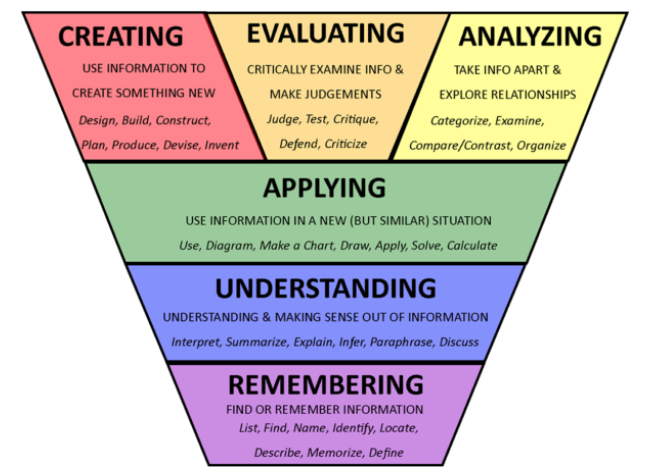
https://bokcenter.harvard.edu/taxonomies-learningBloom's Taxonomy is a hierarchical model that classified learning objectives/outcomes from least complicated to most complicated.

Why does it matter at home?
Bloom's Taxonomy is a great way to evaluate communication between yourself and a child. When adults play with children they tend to ask a lot of questions. This tendency is a common, and developmentally critical, piece of  IDS. 

Asking questions helps children reflect on their own actions but it also increases how much of their brain they are using during that interaction. And for this reason, the type of question we ask matters tremendously. 

For instance, answering the question "Is that a tiger?" requires less thought processing than answering the question "What is that?" Asking "where is it going?" or "how does it move?" require even further engagement. By steadily increasing the complexity of the types of questions you are asking (moving from the base of the pyramid up) you will increase the depth of your child’s engagement with the subject material. 

Don’t be afraid to ask questions that are “too complicated.” Toddler’s have a built-in failsafe for this scenario. If you ask them a question that they don’t have the underlying knowledge to answer, they will either not answer you at all or answer a completely different question instead. 


Thursday, April 9, 2020

Pathway Play: Creating a Marble Run

by Amanda Caulfield, Preschool 2 Teacher at PTCC

The Inspiration:  
Children in Preschool Two have been interested in creating and exploring pathways during their play.  This has ranged from building paths in the sand to constructing ramps and roads as a part of our work with mapping.  One of the ways that we have been observing children’s thinking related to pathways was through their construction and use of marble runs.  I have always been interested in observing the problem solving strategies that emerge when children work with marble runs.  

I chose to create this provocation offering because I felt it was something that could be easily executed and extended at home using everyday materials.  I also felt excited about the prospect of parents being able to get a window into their child’s thinking and problem-solving skills by watching them interact with this provocation.  And of course, I felt it would be fun to make and test my own marble run in order to connect with the children!  


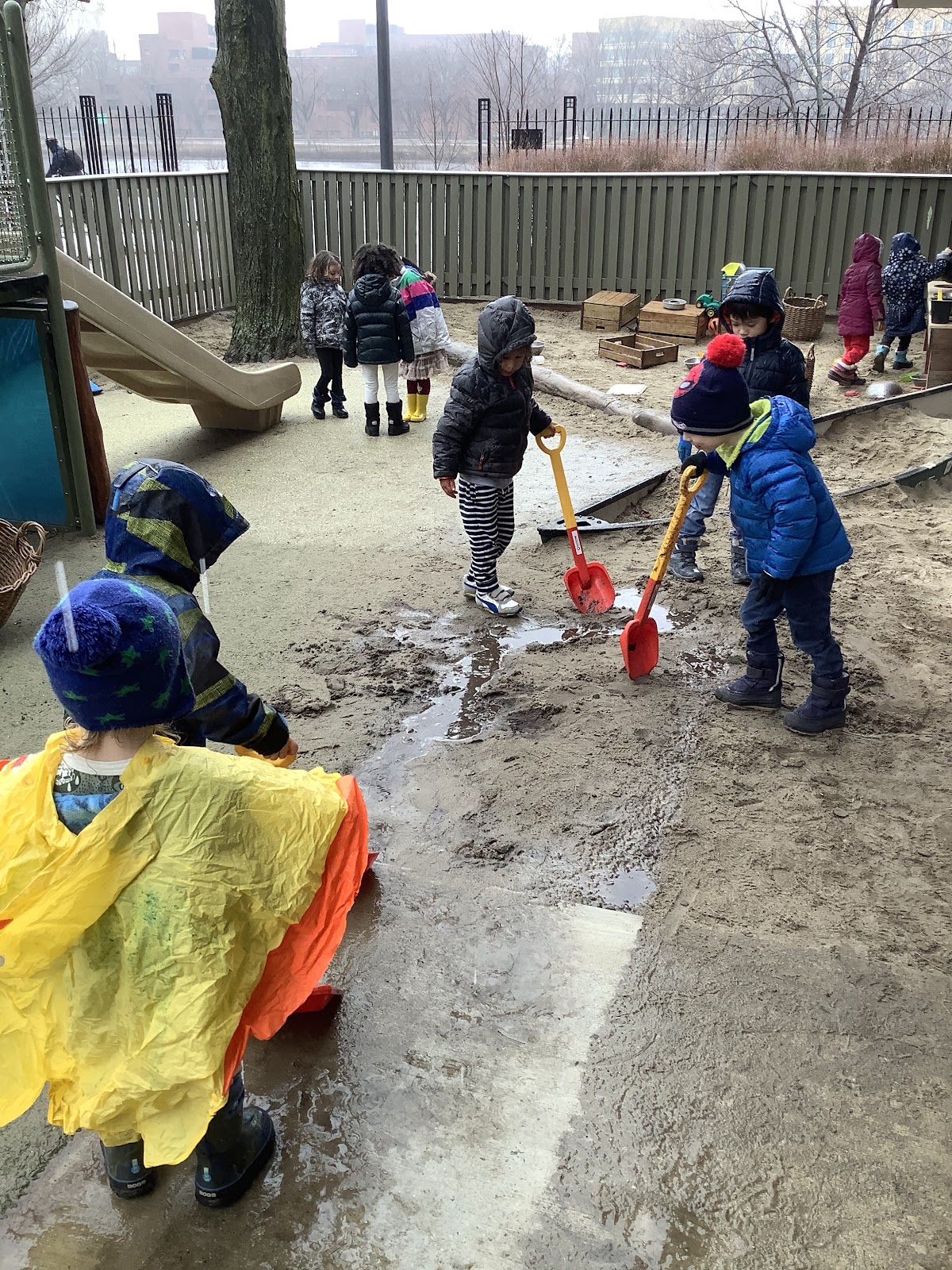
The children create a pathway for rainwater to flow through mud and sand on the playground.


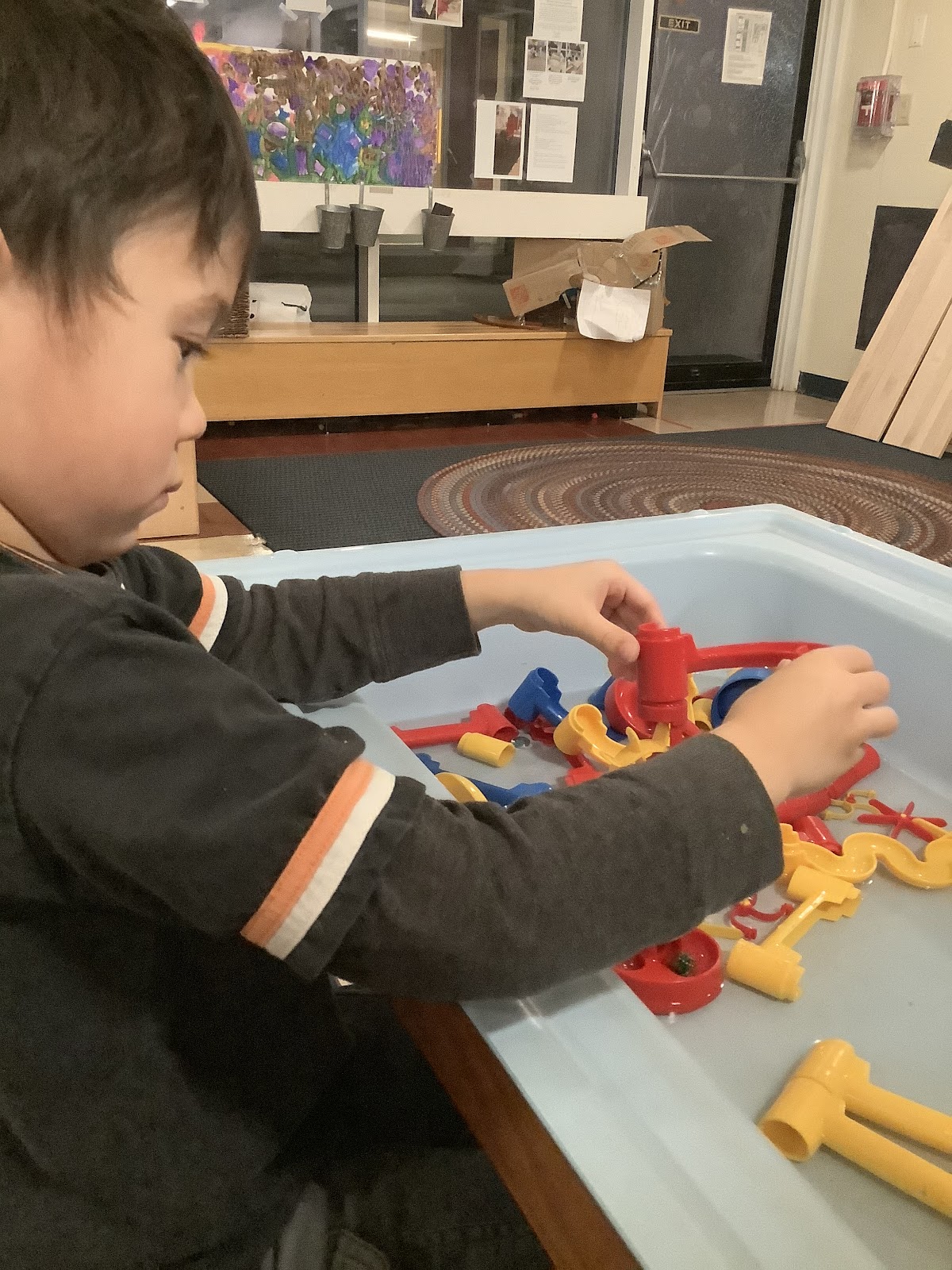
Nate lifts the marble run up at an angle to catalyze the marble and water to pass through in the classroom sensory table.


The Provocation:  
Create your own marble run using the materials you have at home! This is a great opportunity to explore concepts related to pathways, trajectory, and motion.  


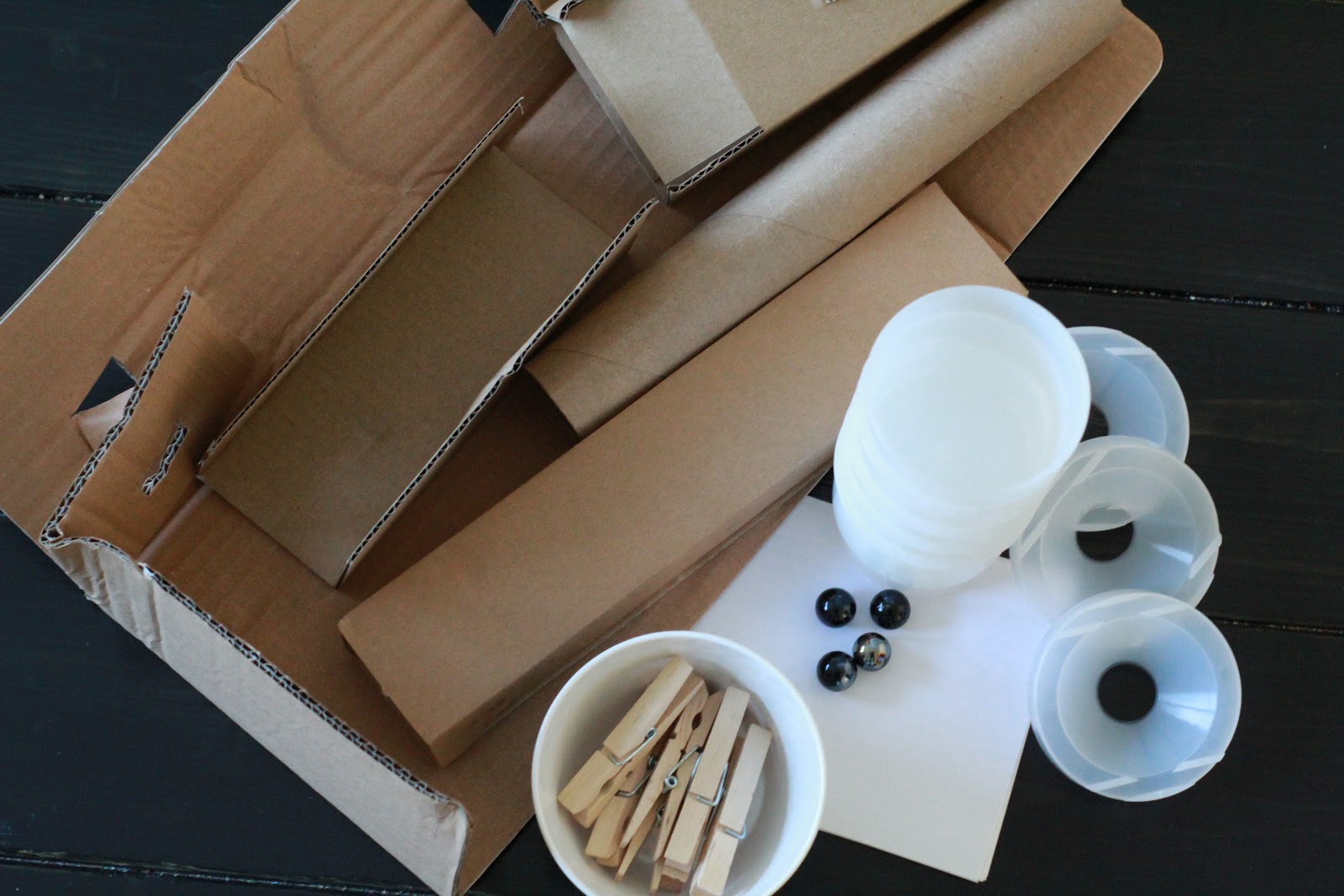
The materials that I found at home to use for this provocation were: 


Cardboard pieces
Clothespins
Plastic cups
Plastic lids to paint containers 
Paper towel roll
Index cards
Marbles 


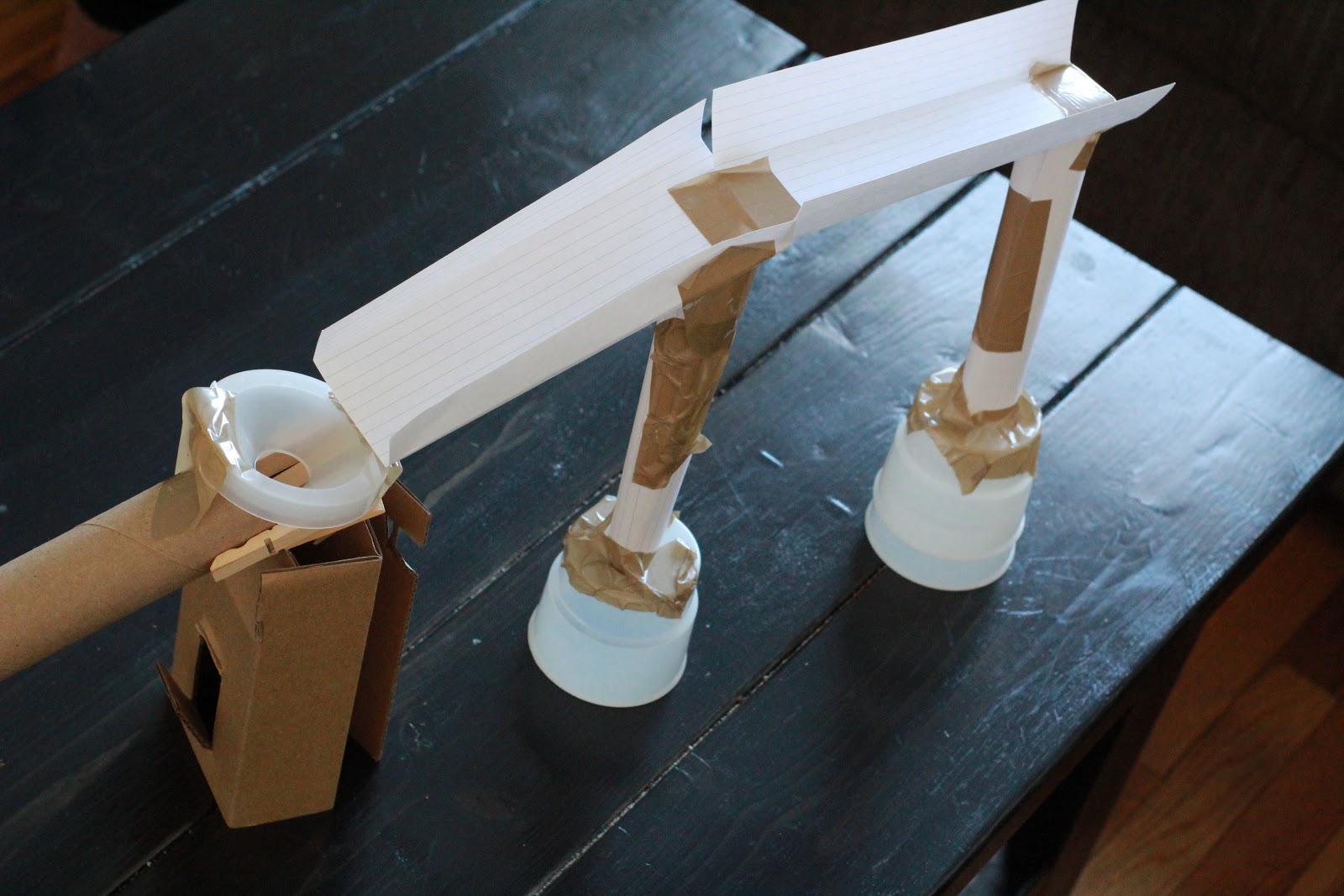
My husband, Kevin, and I worked together to create a marble run that would knock down clothespins at the end.


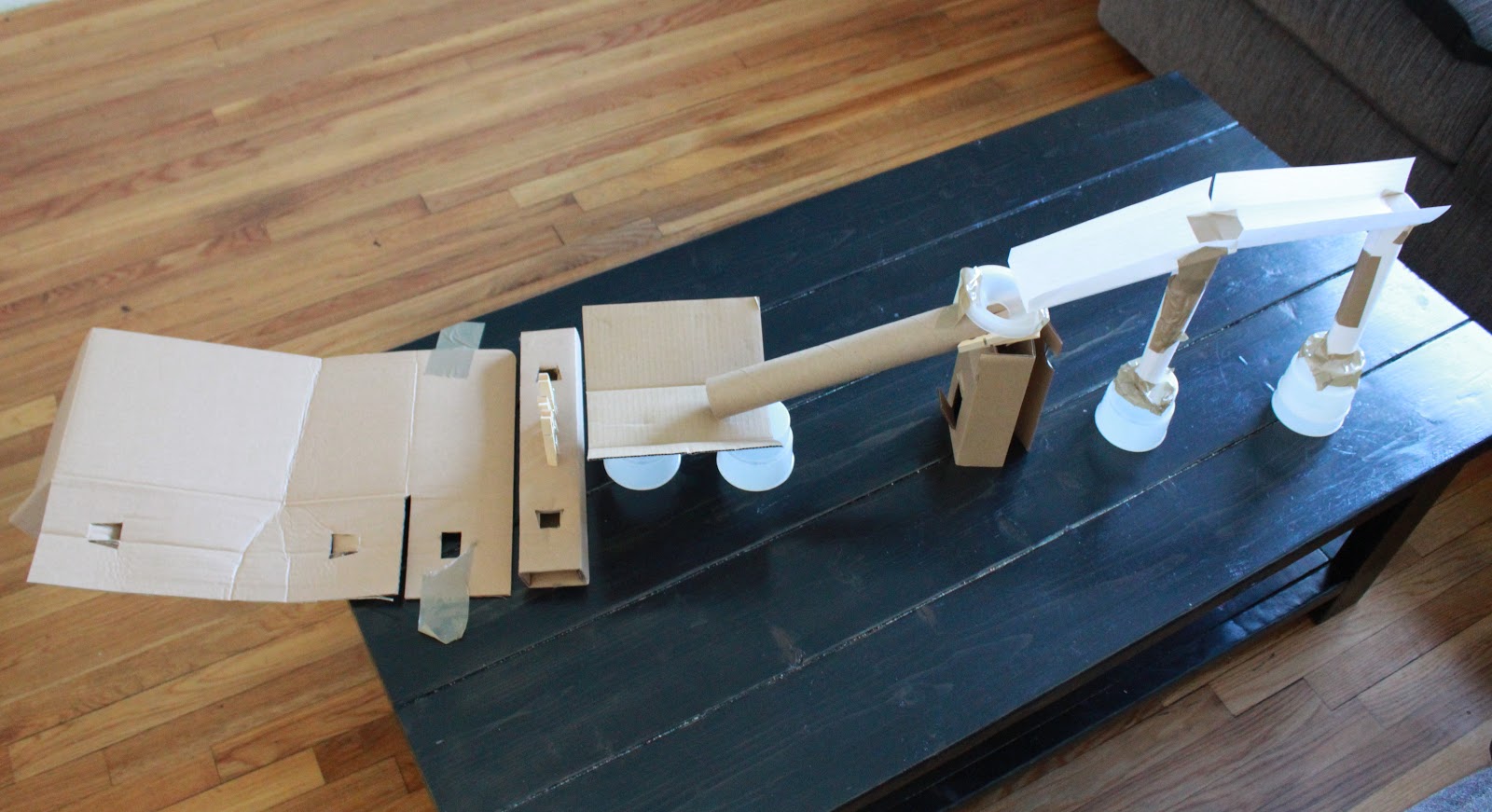
At first, a part of our marble run looked like this, but the marble kept bouncing off of the plastic funnel-shaped piece. 


We decided to use a clothespin as a wall to block the marble from bouncing out. 


Here is what we came up with!


Materials, Questions, Extensions 


Other material suggestions:
-Popsicle sticks 
-Scrap wood or metal
-Cans
-Wine corks
-Blocks
-PVC pipe
-Envelopes
-Wooden train tracks 
-Tape rolls
-Balls
-Water beads

Questions to ask while children are playing: 
-How will you get the marble to move?
-What do you notice about how the marble rolls through the marble run?  
-How can we change what happens?
-How could you make the marble move slower?  Faster?


Ways to extend this provocation: 
-Try to get the marble to hit a certain target (for example, land into a cup or knock something over).
-Create pathways for use with sensory materials such as sand or water. 
- Create several marble runs to race against each other.

Monday, November 28, 2016

Professional Development For Teachers/ By Teachers/About Teaching

At 9:00 AM, on our annual Day of Learning, 58 educators gazed around a circle expectantly, wondering about how they’d spend their day.
At 9:01 AM, a teacher stepped forward to write a question she wanted to discuss on a big piece of paper. Then another teacher stepped into the circle, then another, each sharing an issue that needed attention. Soon our agenda was full and teachers were off to their first session. No one told them what to do, where to be, or what to work on for the next three hours.

How did this come to be? First,  a little background:
For seven years, our teachers gather with educators from other centers for workshops and a keynote. We appreciate meeting and eating together, being inspired and celebrated. We’ve had some great workshops and a few incredible speakers. We’ve been satisfied, but we’ve also heard that teachers wish they had gotten more out of the day for a variety of reasons. Simultaneously, our directors are trusting teachers more to influence our shared pedagogy and share expertise with one another and others.

This year, we tried something different. We spent our morning in Open Space and our afternoon implementing the plans we’d made. We trusted teachers to co-create their learning the way that we trust children. We had already begun planning this Day of Learning, when I encountered Laurie Calvert's white paper "Moving From Compliance to Agency; What Teachers Need to Make Professional Learning Work." and I was encouraged by her words:
"constructivist theories are grounded in a body of research  that shows people
gain knowledge and meaning from the interaction between their experiences
and beliefs... for real learning to take place, the adult learners must be
both decision makers and the subjects — and agents — of their own learning. "

Harrison Owens invented Open Space Technology  by  to make workshops more like the coffee breaks in conferences, where he saw the most excitement. Open Space has facilitated whole school systems, corporations, unions, NGO’s, neighborhoods and other communities answering questions or solving problems that are big and urgent. Sometimes over a whole week! We sampled hour-long Open Space sessions at past Days of Learning with success and were ready to unleash the power of teacher’s hearts and minds making them the decision makers.
Generally, Open Space organizers propose a broad theme and then participants spontaneously co-create the agenda. Meetings are composed only of people who feel passionately about the topic, so conversations are energetic and lively, and the learning is deep.
Our theme was  “What Would Mr. Roger’s Do?”
In a world of learning standards, digital distractions and injustice…
How do we make room for play?
How do we nurture children's interior lives?
How can we model challenging bias and building a fairer world?
How can we offer children the compassion, humor, attention to detail and radical respect that Mr. Rogers did?”

We shared some of his work with attendees in advance, to whet appetites and educate some of our international staff's who were unfamiliar with Rogers. He and his work were our point of departure and inspiration for the day.

Here are a few of the sessions that teachers convened:
How can we advocate for peace in our classroom while honoring conflict and struggle?

How do we encourage self worth and positive body image in a world that’s constantly telling kids that they are cute?

How should we facilitate and make room for weapon play?

Given the bazillion necessary transitions in ECE classrooms how do we realize rich curriculum?

How can we become collaborators in children’s learning (rather than dictators, playmates, or silent observers) and still do everything we need to do everyday?

Sessions were filled with thoughtful teachers leaning across tables, talking quickly and excitedly or thoughtfully and deliberately, laughing, crying and creating new solutions and ideas. It was incredible to witness and it was facilitated by a very simple structure.

Open Space has One Law and Four Principles. Here's how they looked for us:
“The Law of Mobility” (AKA “The Rule of Two Feet”)
You can come and go at any time. You are obliged to move if you aren’t contributing or benefitting from the session. Pairing freedom and obligation has powerful results:
[In one session about racial justice, children and families] “I felt like I immediately messed up, and I really felt so raw and uncomfortable and I was like, ‘Oh my god, I have to leave because I don’t think I can challenge myself on this right now.’ But then I was like, ‘No no no, you’re staying.’ I could change my mind about that.”

“Usual PD, you have to sit there and keep your eyes open even when it’s boring.. The first session, was a hard topic to talk about. If I wanted to bail for any reason, I could leave and go somewhere else... but I didn’t, actually. I stayed.”

In a group of care-givers, this mandate to take care of oneself and one’s own learning was radical.

Whoever comes are the right people.
A preschool teacher and an infant teacher decided to bring their children together. Our center values cross-class collaboration, but a series of scheduling emails can’t generate the same level of excitement as an unstructured conversation. Instead of working to find commonality, two teachers wondered about the same question and shared inspiration which will inform their shared work.

Whatever happens is the only thing that could have.
Our Day of Learning was three days after the 2016 presidential election. Many teachers were worried about the outcomes for education, their health care, the safety of their bodies or the bodies of their loved ones. They’d been balancing their feelings with the crucial and absorbing work of care-giving. They needed to balance bringing their whole selves to work and leaving some of their strong emotions outside the classroom.

The group grieved, told stories,  shared worries and fears. They took turns witnessing and  supporting one another. When the hour long session was “over”, they knew that another group would be arriving to have a new session, but they were not even close to done. They trusted in the principles and moved their session outside for at least another thirty minutes. After exploring their feelings, the conversation became more solution-oriented.The group named ways to care for themselves and have a healthy boundary and then shared those with the larger group.

When it starts is the right time.
Only two teachers showed up for one session about how to ground curriculum in the natural world. Their talk ranged to a general discussion of the Reggio Emilia approach and both figured they wouldn’t get to the topic that brought them together. Three other teachers arrived twenty minutes later, and it was suddenly clear that the moment was right and their work was more powerful because it started when the conditions were right.

When it's over, it's over.
During our agenda creation, one teacher asked a great question, and others were interested. Later, those interested teachers must have chosen other conversations because the convening teacher stood by her question looking eagerly around. After about ten minutes, she left to find another session that interested her; and she brought the lens of her question with her to other discussions throughout the day. This flexibility comes naturally to many teachers who adapt throughout their work day.

Three hours after that first brave teacher stood up and picked up a marker to begin creating our agenda,  we heard from teachers about the day:
“This felt much more productive and thought provoking than other professional development.”

“This is the best day in my history of Day of Learning.”

“This validates what we do.”

“It felt great to navigate my own learning. There’s usually one agenda, and I could choose my learning today.”

“I really needed this today.”

“I’m grateful to be surrounded by so many people who are thinking critically, and reflecting and questioning and acting.”

After reflecting on our process and offering gratitude and appreciation for one another, we examined the next steps that each session offered. We indicated which we would be willing to spend our time and energy pursuing by adding checks and stars. (Each person got three checks and one star to “spend” to communicate their enthusiasm.) Some of the next steps were:

Creating a “family shelf” tradition to emphasize the idea that “Everyone has a culture.”

A new practice of “refreshing” morning provocations, or offering a new provocation in the middle of the morning.

Developing a habit of trying a few different approaches to offering materials to children.

Writing to legislators about our priorities for families, teachers and children.

Teachers from three different centers will create a blog whose audience will be the general public in order to raise awareness about the importance of social emotional learning in the early years.
Initiating a preemptive conversation about aggressive play styles and narratives with toddler families and teachers BEFORE their children enter preschool.

Each of these next steps COULD have been the outcome of a particularly moving workshop, but organizers would have to choose specifically the right presenters for the sixty teachers in attendance. Our humble, open-hearted director said “My question was “What do teachers really need?” and we answered it; You need time and space to process....” With Open Space, each teacher had the opportunity to grow and learn about whatever was most exciting (or upsetting, or curious...) to them. Staff alumni attended as collaborators and co-thinkers, not “presenters” . Everyone (directors too!) inhabited the roles of learner, witness and teacher flexibly. Teachers were given the afternoon to follow up on their initiatives in their teams, and they spent lunchtime sharing stories of their mornings together.
I recently had the pleasure of seeing James Noonan speak about his dissertation, and his words from a blog post entitled "Professional Development (and Teacher Agency) As We Know It" rang in my head as teachers departed at the end of the day:

"In my research, I asked teachers to tell me about their most powerful professional
learning experience and about a corresponding professional learning experience
that they “would like never to have again.” ... Among good and bad experiences I
found ones that were both expert-led lectures and decentralized learning communities,
school-based and external, content-focused and more cerebral, years-long and hours-long, pedagogically experiential and didactic.... I am increasingly convinced that agency is one
of the most salient distinguishing features of powerful professional learning. Indeed, of the
25 powerful learning experiences I studied, 21 involved some degree of teacher agency. Of
15 corresponding negative learning experiences, 13 were mandated. The contrast, while
certainly not conclusive, was striking and suggests to me that instead of carefully balancing
the scales between agency and compliance it is preferable to tip them toward agency."