Showing posts with label play-based. Show all posts

Thursday, April 9, 2020

Pathway Play: Creating a Marble Run

by Amanda Caulfield, Preschool 2 Teacher at PTCC

The Inspiration:  
Children in Preschool Two have been interested in creating and exploring pathways during their play.  This has ranged from building paths in the sand to constructing ramps and roads as a part of our work with mapping.  One of the ways that we have been observing children’s thinking related to pathways was through their construction and use of marble runs.  I have always been interested in observing the problem solving strategies that emerge when children work with marble runs.  

I chose to create this provocation offering because I felt it was something that could be easily executed and extended at home using everyday materials.  I also felt excited about the prospect of parents being able to get a window into their child’s thinking and problem-solving skills by watching them interact with this provocation.  And of course, I felt it would be fun to make and test my own marble run in order to connect with the children!  
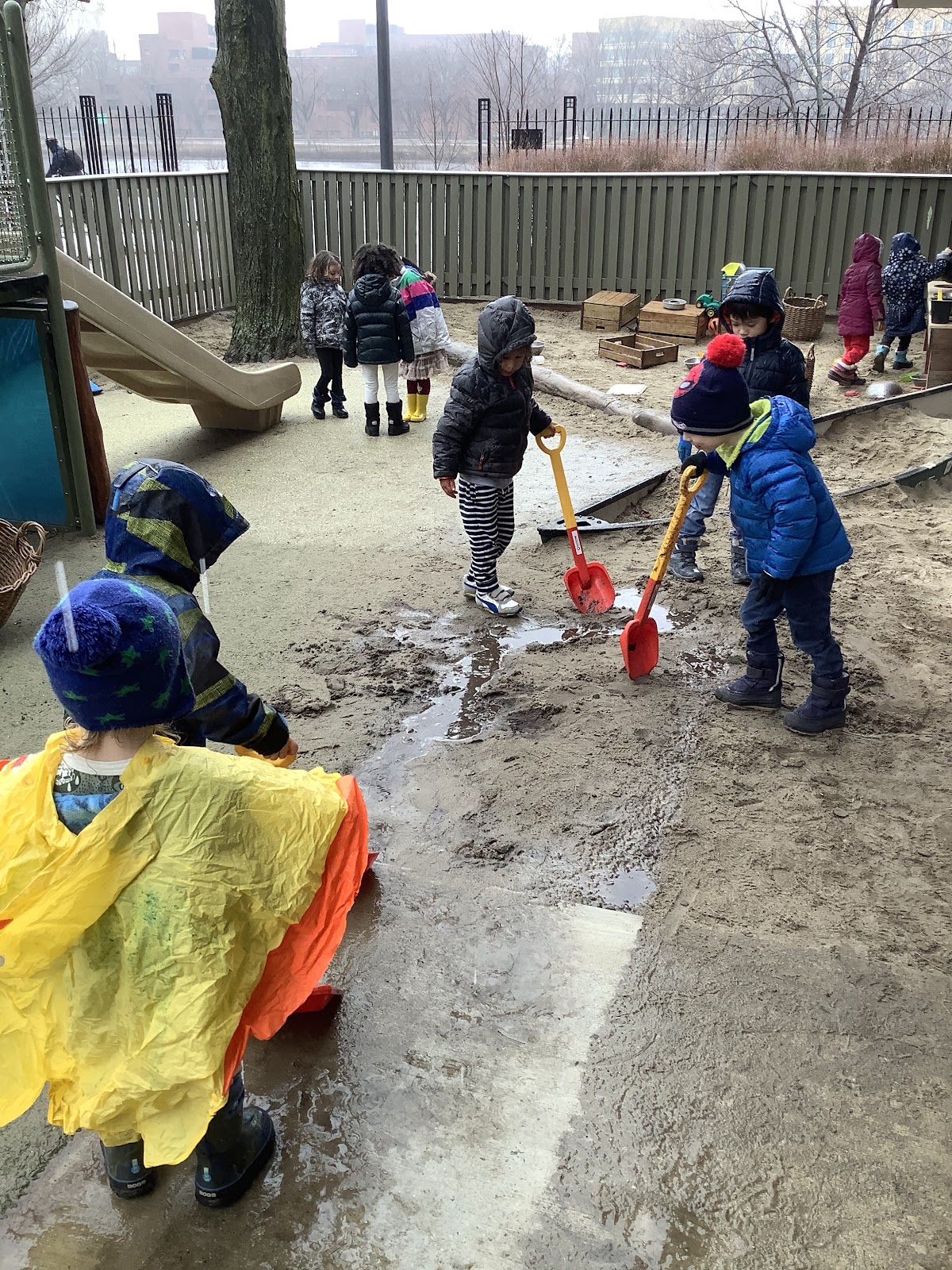


The children create a pathway for rainwater to flow through mud and sand on the playground.


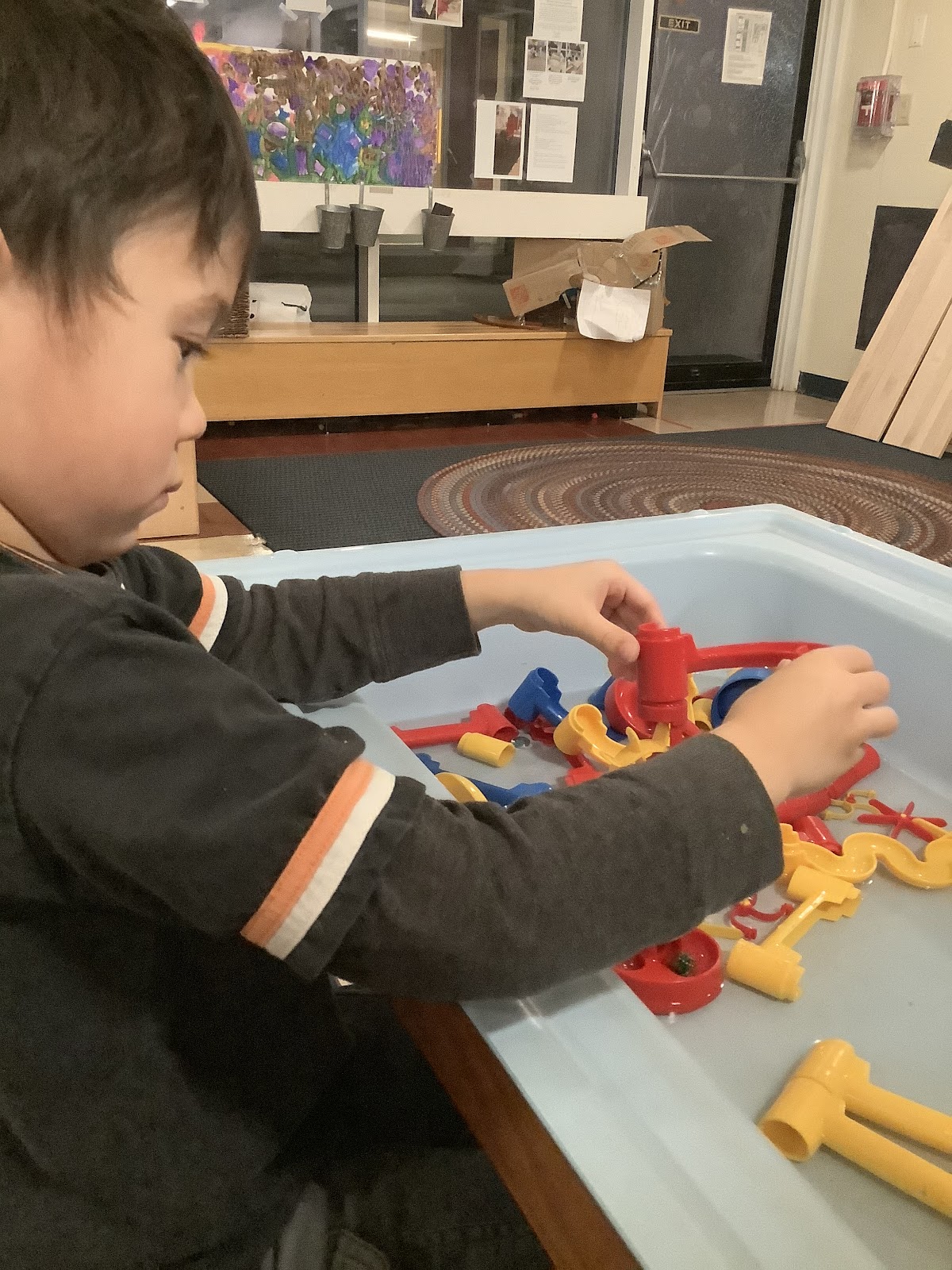
Nate lifts the marble run up at an angle to catalyze the marble and water to pass through in the classroom sensory table.


The Provocation:  
Create your own marble run using the materials you have at home! This is a great opportunity to explore concepts related to pathways, trajectory, and motion.  
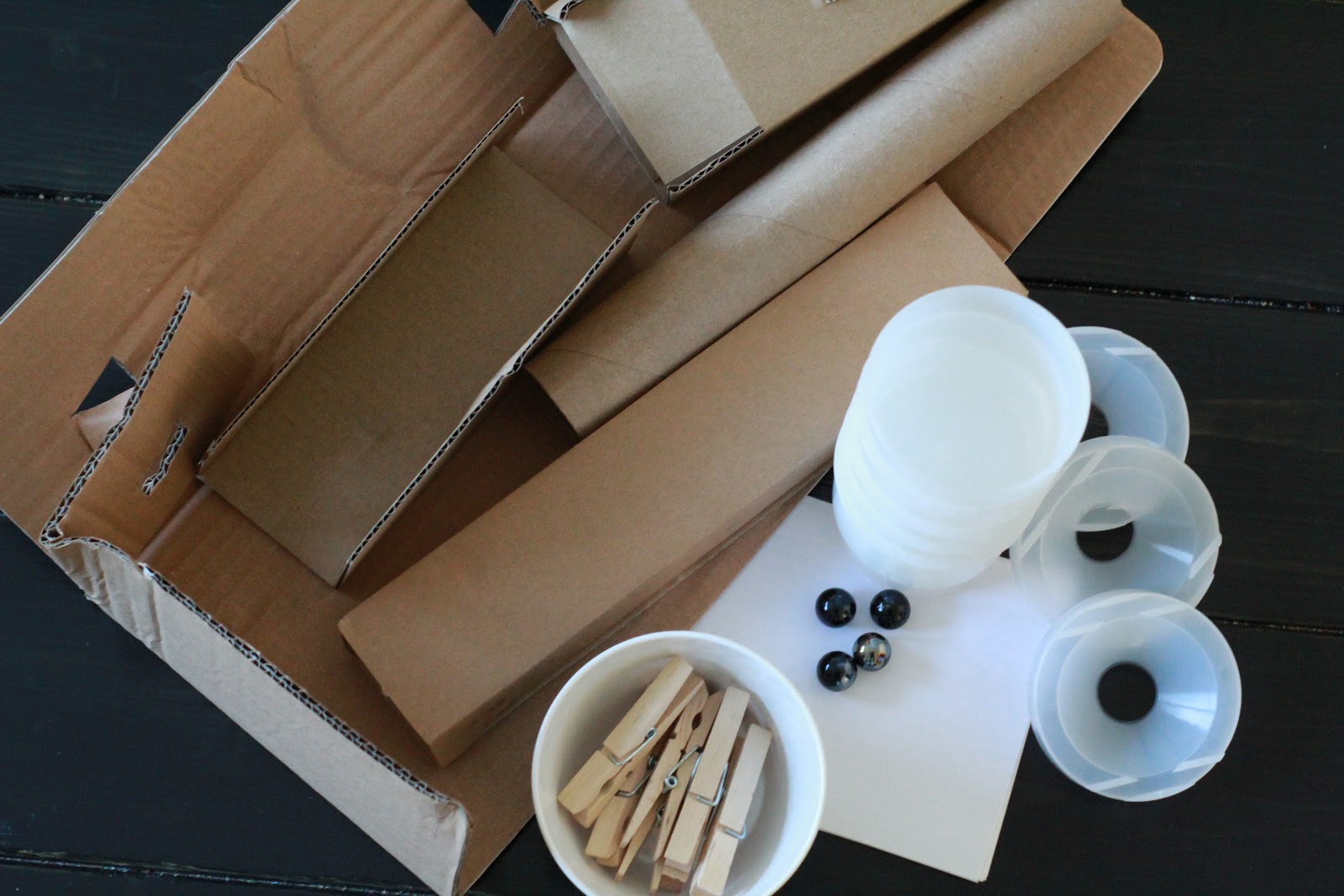

The materials that I found at home to use for this provocation were: 


Cardboard pieces
Clothespins
Plastic cups
Plastic lids to paint containers 
Paper towel roll
Index cards
Marbles 


My husband, Kevin, and I worked together to create a marble run that would knock down clothespins at the end.
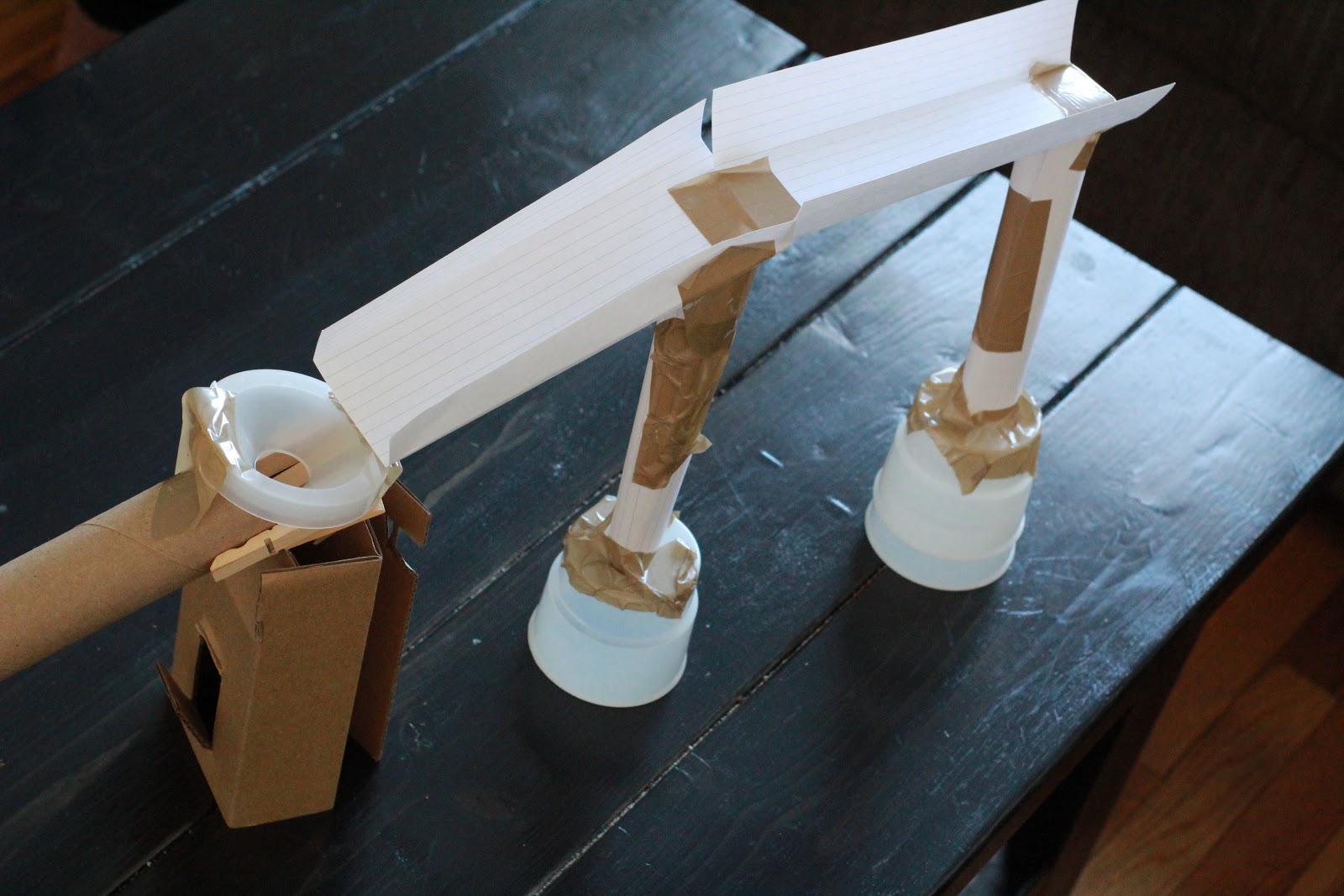


At first, a part of our marble run looked like this, but the marble kept bouncing off of the plastic funnel-shaped piece. 


We decided to use a clothespin as a wall to block the marble from bouncing out. 


Here is what we came up with!
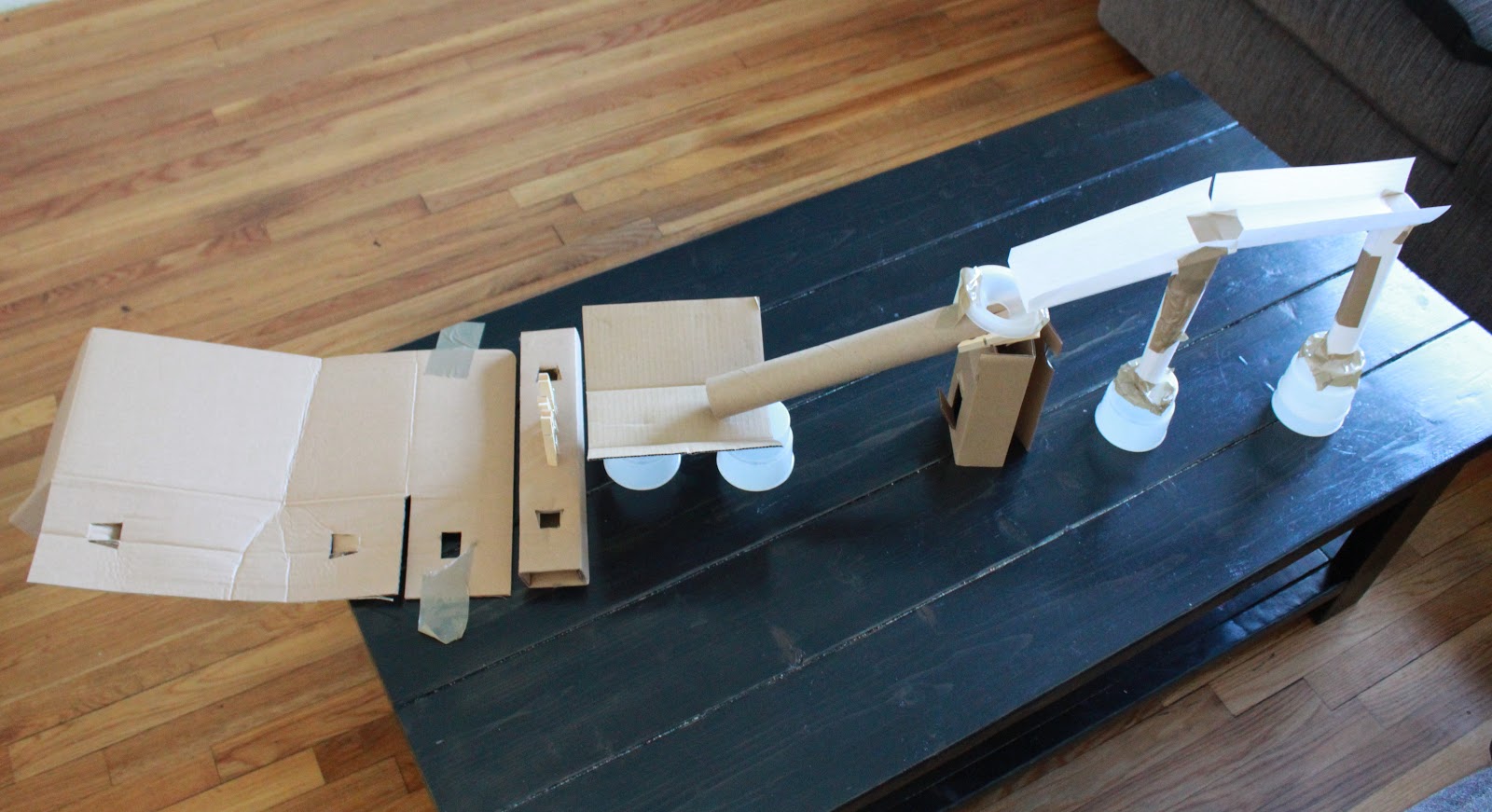


Materials, Questions, Extensions 


Other material suggestions:
-Popsicle sticks 
-Scrap wood or metal
-Cans
-Wine corks
-Blocks
-PVC pipe
-Envelopes
-Wooden train tracks 
-Tape rolls
-Balls
-Water beads

Questions to ask while children are playing: 
-How will you get the marble to move?
-What do you notice about how the marble rolls through the marble run?  
-How can we change what happens?
-How could you make the marble move slower?  Faster?


Ways to extend this provocation: 
-Try to get the marble to hit a certain target (for example, land into a cup or knock something over).
-Create pathways for use with sensory materials such as sand or water. 
- Create several marble runs to race against each other.

Tuesday, September 29, 2015

"It was delightful to play. I should do this more."

We just finished our first set of “teacher provocations” for the year. During these four weekly workshops, teachers
  • developed their own relationships with some of the more open-ended “loose parts” we’ve made available this year
  • gave and received immediate feedback on their work
  • practiced thinking about provocations and materials through the lens of our “Materials Values”
  • got an opportunity to play and take on different roles with one another

This year, our center-wide intention is to “explore our relationships with materials through research”. August’s teacher provocations provided opportunities for teachers to research through direct experience, observation and reflecting with a protocol. Our time together had four parts which relates to the cycle of inquiry that we use to drive our curriculum; provocation, play, reflection and provocation.

Provocation.


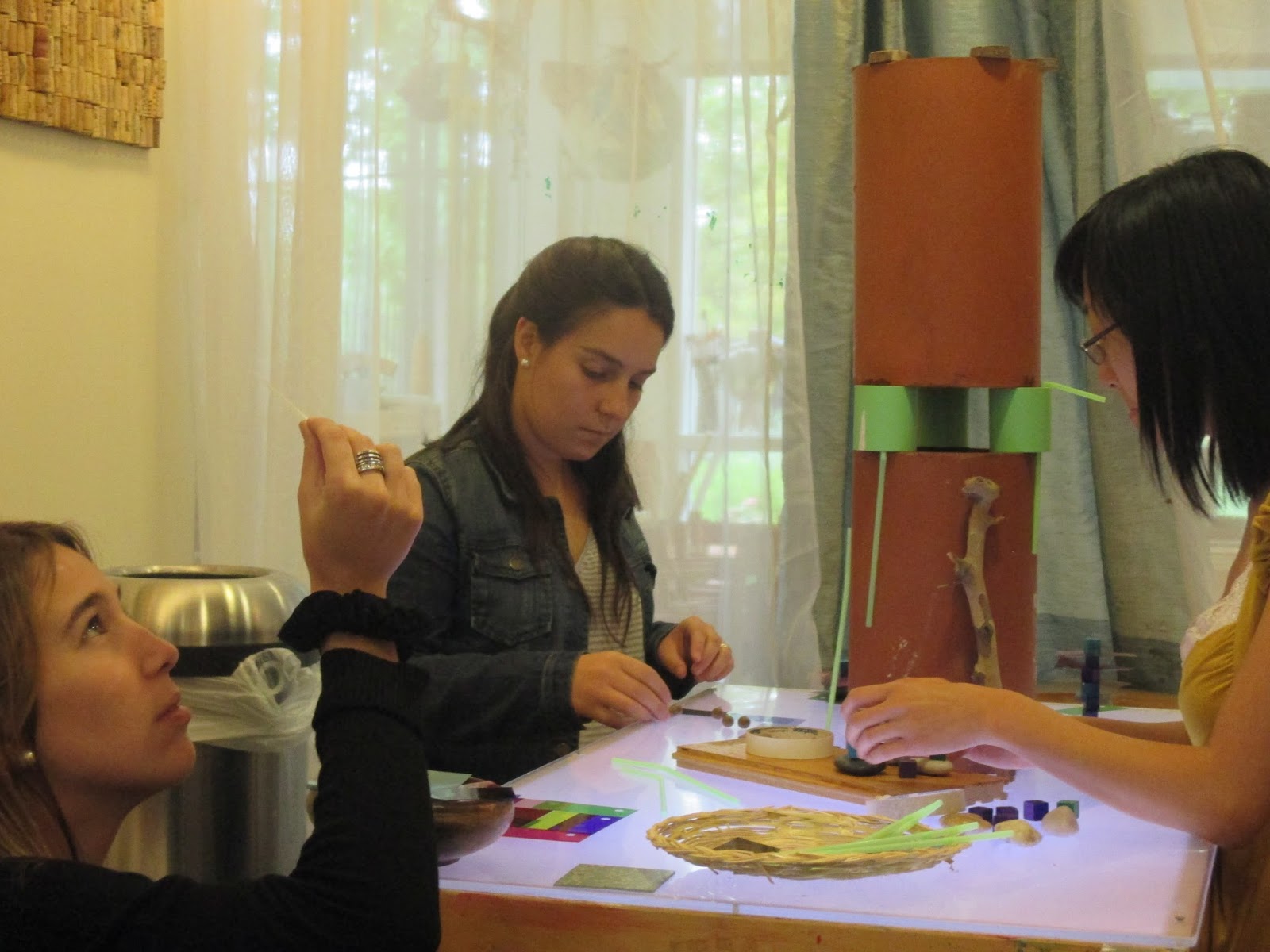
I invited the first three teachers who arrived to step behind a curtain and set up a provocation from an array of loose parts that were provided. Teachers at these provocations are from all over the center, so they had to decide what age(s) to design for, and often had multiple provocations to serve a variety of ages.

Later one of them told me; it was just like in the mornings at school: 
"I noticed my desire to quickly do it so we could get done and we could come and sit down with the rest of you."

Other teachers told us they felt inspired by setting up with one another. They improvised and then were inspired by one another. Many had to play with the materials a little bit as they set them out. "I had to construct and deconstruct a little bit before I could set things out."

While they worked, other teachers arrived and we reflected on our experiences with materials so far this year. We used “Rose, Thorn and Seed” to describe a positive observation, a challenging or painful observation and something that we’re looking forward to. These reflections are specific to the first few weeks of the year, and capture a moment of excitement and transition.

Rose:
Serena, a floater teacher "It's visible, the intention that went into choices of materials in each classroom...the simplicity in classrooms. It's refreshing and it puts the focus on relationships."


Cynthia: Our room represents everything we wanted it to, and it consistently looks cool and interesting. The materials are being used everyday.
Thorn:

Emma: We are still in the exploration phase, so there can be micromanaging to make sure things are used properly.


Kerry: Our napping schedules are making it hard to be in the classroom together and use materials on the light table for example.

Seed:
Carmel: I'm looking forward to incorporating the music and dance background these children have from [last school year] in what we're doing with materials.

When our “provocateurs” were through, they joined us. Three more teachers volunteered to...

Play!


The provocations and the play varied widely over the four weeks. Teachers explored with their senses, constructed two and three dimensional creations, created kinetic sculptures, catapults, ramps and devised collaborative and competitive games. While three teachers played, the rest of us observed and took notes.

Dolores: It was delightful to play. I should do this more.

One teacher noted that observation was easier in this setting, she had nothing else to track or do. We wondered how to make our time in classrooms feel this way. 

We also noticed that as observers in this contrived scenario we didn't interact at all. In a classroom with children we might offer materials as a way to reinforce our concept of the provocation, or pick up acorns rolling across the floor. In some ways this teacherly behavior may have helped the players, and in a lot of ways, it may have interrupted or subtly restricted the play. It was a good experiment for all.
We then sat together and used the "See, Think, Wonder" protocol to examine our observations. We this tool use often, and we considered what kind of learning and exploration was present in the play we witnessed, and planned to support it. 

We SAW 

  • blowing, dumping, crushing, throwing, building, balancing, shaking, examining, sucking an acorn through a tube
  • the irresistible draw of the light table. Even when the materials weren't specifically translucent, the table pulled players in
  • one group finishing their work before moving on to another part of the provocation, others  jumping back and forth
  • collaboration play a role in each group of players, but the amount and quality of the collaboration varied widely. (In one group, only when the action of moving something heavy REQUIRED cooperation did the group work together. In another, teachers competed with one another in a catapult game; and celebrated one another successes.)
  • teachers collect items from one table or offering and bring them to another table or part of the provocation. This is something that can sometimes frustrate preschool teachers, but they saw that even adults who create provocations were drawn to use materials in ways that appealed to them.
We THOUGHT
  • one teacher thought she recognized that the different players had play styles that related to what she knew of their personalities
  • it might be interesting to have kids play with the same materials in the same provocation that teachers did
  • one person's work influenced the next person who worked there
  • open-endedness led to creativity and collaboration
  • Katie records our thoughts.
  • teachers seemed most drawn to aesthetically pleasing materials
We WONDERED
  • how children's creativity impacts our planning; children will follow an acorn on the floor and next to the wall and start playing there; abandoning the project they were doing when the acorn dropped
  • how we can set up provocations cooperatively (teachers enjoyed doing this)
  • how the presence of authorities/observers impacts play

Finally, equipped with our observations, thoughts and questions, three more teachers stepped behind the curtain to create provocations based on our observations and intentions to extend the play we saw.

It was satisfying each week for the larger group to check out these "next step" provocations (unfortunately we didn't have time to play with them). They often solved a "problem" that came up during play, or they set up an experiment to test a theory, or answer a question. The second provocations were refined, clearly related to and inspired by the intial provocations, but with a new style and a different sense of purpose.

This time together allowed us to celebrate where we are right now, and to practice skills that support us as we help children "think what they need to think in order to learn what they want to learn" (Verbs, by Tom Hobson). Many teachers used this provocation with families at parent night in one way or another; to give them the opportunity to play, and to see first hand the cycle of inquiry we use to plan child-centered curriculum. They also helped us to get some new information about the loose parts and other open-ended materials that we've been using this year; the kind of information we can only get through direct experience, careful observation and collaborative reflection.

Where do you get direct experience that informs your work?

How often do you get to play?


Wednesday, May 29, 2013

Teasing Curricular Threads Out of the Fabric of Children's Play; or What's In a Metaphor?


Our curriculum is built by teachers around the interests we see in children’s play.

Lately we’ve been thinking about how to find children’s interests and questions in our observations, extend children’s learning over a longer time, and connect it to more fundamental questions, rather than staying on the surface of their learning. We often call these underlying questions, interests or themes “curricular threads.” 

Each week, a teacher from each classroom comes together at our center for professional development we call "weekly provocation". I often plan these mini-workshops with the admin team or with Katie. Today we came together today to practice finding these threads.

Thinking about threads… real threads.

The metaphors we choose tell us something important about what we are thinking. Why do we think of persistent questions or themes as “threads”? Our table was decorated with fabric and other examples of “threads” for us to consider as we entered. We spent some time describing thread together:

·        We use threads for some of the oldest human activities, it’s ancient.
·       We use thread for … practical things; baskets and fishing nets … across cultures.
·        It doesn't come to an end unless you cut it, it seems like it could go on and on.
·        There are many pieces to one piece of thread…intertwined.
·        You might add to it and make a knot.
·        Thread can be very orderly; the spools of thread in my sewing room are very orderly and they're all wrapped up, but if they're on the floor they're a mess and they are impossible to take apart.
·        Two weak, little threads can make a very strong seam.
·        Thread has a curved and windy journey in fabric.
·        Something so simple goes into something so big and meaningful. [When you hem shorts] something so little as a thread can make such a change in something big.
·        You can use different materials... but one thread can [bring them together].
·        They make connections that can hold things together. Small pieces can build upon each other and make something larger.

Next we looked at old notes and pictures about children who examined machines over four months. As we read, teachers hypothesized about possible curricular threads that may have been woven into the work. Throughout this conversation we differentiated between the content (the superficial, visible interest) and the curricular thread (the developmental struggle, big question, underlying theme), often with gestures signifying the surface, or the depth. 

I told about two different three year old classrooms (in two different centers and two different years) who were doing a lot of fire-fighter play (content). One group was so interested in fire; what it was, why it was scary, why it was so important for fire fighters to put it out. Another group was interested in the feeling of reunion, of rescue. They were all new to group care, and focused on the moment when the fire-fighter saved the person and brought them back to their family. You can see how this play might look the same on the surface; same props, running to get hoses and put out the fire, saving moms and dads and cats, but how children's interests are quite different. We all referred back to this example as we spoke. It was not easy, to identify the threads and we sometimes missed.

Some of the interesting details that we noticed that were probably not curricular threads were:
·        Color, size or other visual aspects of the machines
·        Wheels
·        Things that turn on and off
·        Chains

      These details or interests are meaningful to the children, but they are different from what we can pursue over months of curriculum. They are useful aspects of children's experience that we might include in provocations, but they're different from the curricular threads we're seeking today.

The curricular threads we identified were:

·        How do mechanical things work?
·        How can we keep one another and ourselves safe in unfamiliar situations?
·        What is the relationship between the function of the whole machine, and functions of the parts?
·        Names, labels, categorizing or taxonomy
·        Cause and effect
·        Finding ways to control things; making them stop and go
·        How do machines connect us to the adults who use them?
·        Wondering about and trying on “real” things, adult things
·        Making connections between bigger grown up machines and children's own things
·        Finding a new, more intimate relationship with everyday things

Pilar, Danielle, Tracy and Sarah looking for threads in the stories of children's work.
Finally, we looked at our own documentation over the last year and tried to identify curricular threads that children pursued over time.

We guessed that it was easier to find the threads in the collected documentation because it was already gathered together around a shared theme. We wondered together if it's easier to find curricular threads in children's work when looking back at what's already happened, rather than looking at curriculum that's still in process. Since our documentation process is always inviting us to look backward and forward, we have a unique tool to assist us in finding these threads. We also talked about how once we are following a thread, smaller moments that may have been ignored before stand out as we see children integrating their every day play into whatever theme they are working on in the moment.