Showing posts with label families. Show all posts

Wednesday, May 13, 2020

Teaching Tools: Child Development Resources for Families

- by Wheeler DeAngelis, Constanza Henderson, Myra O'Neal, and Mahoussie Pierre, Toddler 1 South Teachers


Dear Families,
With several more weeks at home stretching before us, we are choosing to see this time as an opportunity - an opportunity to offer you a peek behind the curtain of our work that most years we don’t have the time or venue to share. As child development experts, we have a wide range of knowledge that we draw upon in our work with and understanding of your children. We would like to share some of these with you. In this post, you will find information on the following topics:
  • Roles
  • Sensitive Observation
  • Scaffolding and the Zone of Proximal Development
  • Being an "Oppositional Partner"
  • Infant Directed Speech
  • Bloom's Taxonomy


We hope that these concepts, theories, and tips will help you to feel like you have more tools in the toolbox for optimizing this time together with your children. And as always questions and further discussion are highly encouraged.
Roles


Roles are really important to children. They help children to understand what they can expect of specific people. For your children, who have been attending childcare since before they can remember, there has always been a difference between parents and teachers. From the child's perspective, teachers spend the day with them and offer tests and provocations. When children are at school, it is their version of going to “work.” When children are at home, you engage in a less structured way  with  your child while still providing boundaries and limits.  


We want to acknowledge that the condensation of these two roles is really hard on everybody. And some of us may find it impossible. That is OK! Children are built to learn, regardless of circumstance. Whatever you are doing to be present for your child is enough for them. Don’t bend over backwards to try to fill a role you’re not comfortable being in. 


For those who feel like you can be more intentional in the materials and activities you provide in this new combined “parent-teacher” role, we encourage you to lean into it a little. Simply acknowledging to yourself what role your child is asking you to play can be a big stress reliever and can guide you and your child toward better outcomes.

Taking on the "parent-teacher" role can be scary and since it is a new role for some of you we wanted to put together a quick little guide to some "teacher skills" that might help you in your interactions. 

First and foremost always remember that teaching is as much art as it is science. A well laid plan can mitigate a lot of the natural chaos that comes with toddlerhood but never all of it. That is when intention, flexibility, and engagement come into play. Just because something isn’t going as planned doesn’t mean that the learning has stopped. It is great to have expectations for how activities will play out, but if your child has other safe and reasonable ideas for how they want to play, go with it! This is sometimes how provocations unfold even in the classroom. Sure a cooking project teaches a lot about math and chemistry, but hitting the side of the mixing bowl with a spoon teaches about acoustics and physics. And if that’s what your toddler wants to learn today, then steer into it! And always involve them in cleaning up their own messes afterwards!

Sensitive Observation

What is it?
Sensitive observation is the process of stepping back and observing, not engaging with a child who is focused on some activity. Taking careful note of the contexts in which your observation is taking place, and how those contexts are affecting the child.


Why does it matter at home?
If you can find the time, even just a few minutes of sensitive observation can make a huge difference in how you understand your child's world. The goal of any good observation is to synthesize what we see and create more clear questions for ourselves to answer. 


Is your child getting cranky around the same time everyday even though they’re fed and rested and clean? Well that’s where sensitive observation comes in. Is there something happening that your child can hear but not see? Are they anticipating something frightening that will happen soon or reacting late to something that happened earlier in the day?


Through observing a child in their environment we can begin discern the reasoning behind a child’s behavior rather than reacting to the behaviors themselves.

https://www.janetlansbury.com/2010/05/magda-gerbers-gift-to-grown-ups-parenting-that-engages-the-mind/

---
"Do less; observe more; enjoy most." - Magda Gerber


---


Scaffolding and Zone of Proximal Development 
What is it?
These two concepts are at the core of most of our work with your children. Zone of Proximal Development (ZPD), is a part of a theoretical framework that separates all potential activities into three categories:

1. Things a child can do on their own.
2. Things a child can't do. 
3. Things that they can do with help. 
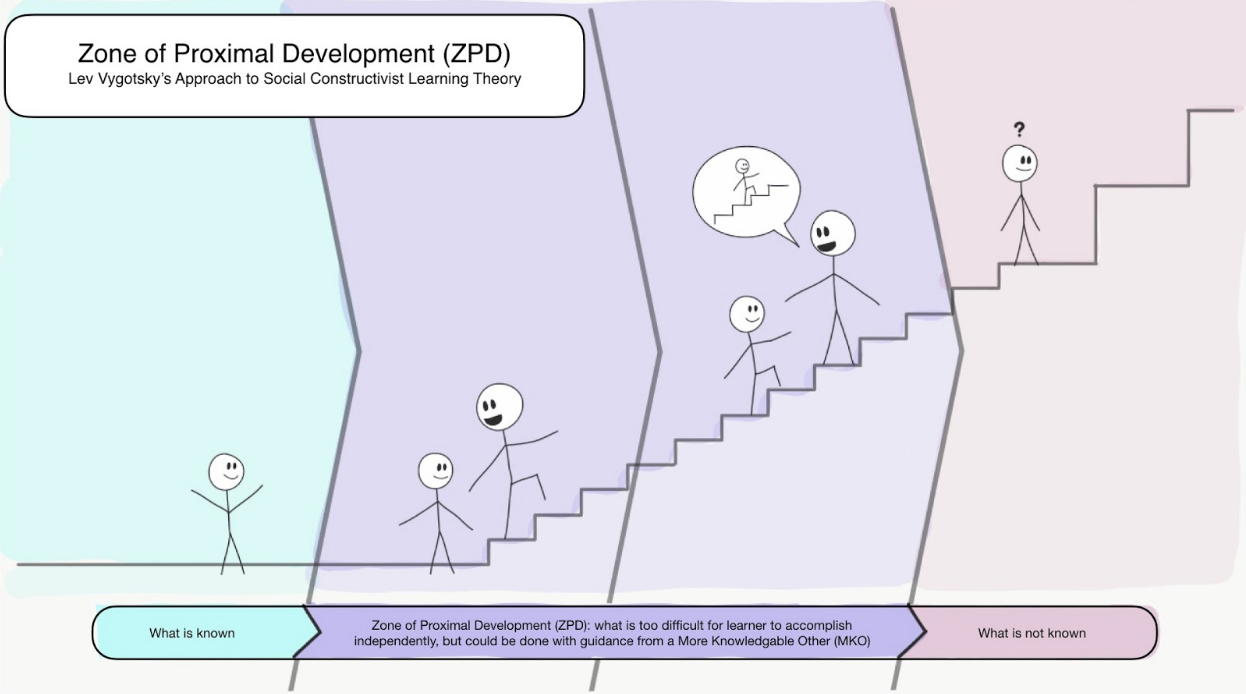

https://medium.com/applied-learning-theory/constructivism-29e8949330a
In this image the staircase and the adult illustrate the concept of scaffolding.


This third category is the child's ZPD. Scaffolding is simply a term for all the help offered by an adult to move an activity out of their "can't do" and into their Zone of Proximal Development.


Why does it matter at home?
An understanding of which category your child keeps each activity in, will help greatly with your activity selection. 

- Activities from their "things I can't do" category will lead to the shortest and most frustrated play sessions. 

- Offering your child an activity in their “things I can do” category, like a familiar book or puzzle, will lead to longer more focused play times. 

- Activities from their ZPD will lead to the longest play and highly meaningful interactions  but will  some require adult facilitation.

Being an “oppositional partner” 

What is it?
Occasionally when you play with your child, create your own play plan and stick to it. If your child asks you for the materials you are using, tell them that you are using them and make a plan for when they can have a turn.


Why does it matter at home?
Children learn a lot from playing with a partner. The give and take of these interactions are crucial for positive socio-emotional development but they are hard to replicate at home without another toddler. It is more than the practice of turn-taking, it also teaches patience and respect for the play needs of others. Creating a play plan of your own and sticking to it can help to replicate some of these interactions.

Infant Directed Speech
What is it?
Infant Directed Speech (IDS), is the way that adults alter their voice to speak to children. Basically it is a system of slowing and simplifying your speech patterns in order to give children more time to process what they are hearing. IDS is characterized by higher pitched voices and increased repetition. It's a reflexive process and you all do it everyday. It should not be confused with "Baby talk" which is the removal of informative words from a sentence and replacing them with gibberish. Baby talk does not provide the same developmental benefits of IDS.


Why does it matter at home?
Toddlerhood is a critical period for language development. In normal times, children develop their understanding of prosody, grammar and vocabulary by hearing how people around them speak and using what they hear to create a linguistic baseline. 


In quarantine times, children are exposed to fewer of these "in the wild" language encounters, so the linguistic model that you are providing for them takes on added weight. A good rule of thumb is that you should talk to children in the way that you hope they will, one day, be able to talk to you.

Bloom’s Taxonomy  

What is it?
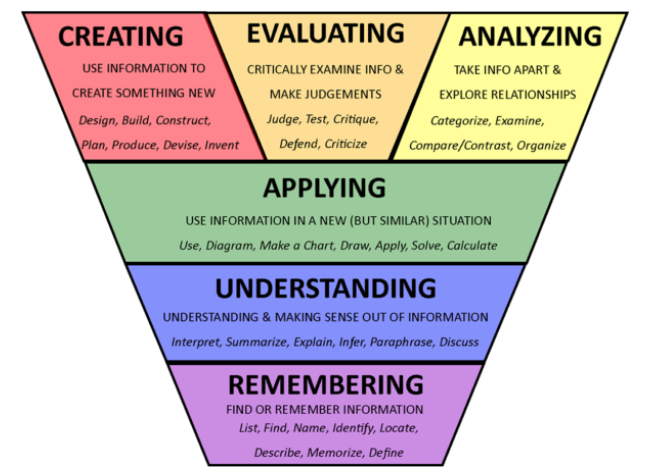
https://bokcenter.harvard.edu/taxonomies-learningBloom's Taxonomy is a hierarchical model that classified learning objectives/outcomes from least complicated to most complicated.

Why does it matter at home?
Bloom's Taxonomy is a great way to evaluate communication between yourself and a child. When adults play with children they tend to ask a lot of questions. This tendency is a common, and developmentally critical, piece of  IDS. 

Asking questions helps children reflect on their own actions but it also increases how much of their brain they are using during that interaction. And for this reason, the type of question we ask matters tremendously. 

For instance, answering the question "Is that a tiger?" requires less thought processing than answering the question "What is that?" Asking "where is it going?" or "how does it move?" require even further engagement. By steadily increasing the complexity of the types of questions you are asking (moving from the base of the pyramid up) you will increase the depth of your child’s engagement with the subject material. 

Don’t be afraid to ask questions that are “too complicated.” Toddler’s have a built-in failsafe for this scenario. If you ask them a question that they don’t have the underlying knowledge to answer, they will either not answer you at all or answer a completely different question instead. 


Wednesday, April 1, 2020

The Possibilities of Paint - Ideas for At Home


Let's talk about paint!


For some people, the idea of painting at home with their young child is exciting. For other people, it is intimidating. For almost everyone, the word "messy" probably comes to mind.

At the same time, part of what is wonderful about paint is its possibility for expression. The exploration of gesture, color, and (especially with thicker paints) texture is a beautiful outlet for anyone (not just children), and can be an excellent way to center ourselves in the moment. This can lead to messiness, but, to me, the value of what is at work behind the messiness far outweighs the momentary stress of having to clean up a painty child.

So how do you set up paint at home in a way that feels manageable while still allowing your child freedom to actually explore the material? What if you don't have a ton of art supplies lying around? How can I be a part of my child's paint experience without taking it over?

Let's talk about these things!


Minimizing Mess

What can I handle?
Before setting up, think a bit about how much "mess" you feel comfortable with. Are you willing to risk some paint getting on the floor or a cabinet? What about paint getting on your child/their clothes/your clothes? Answering these questions honestly can help you decide what sort of experience you want to curate.

Choosing a setting:
A few options for setting up include...
- seated at a table
- in a dedicated space on the floor 
- outside (if it is warm enough and an outdoor space is available)
- in the tub (for super easy clean-up)
- at an easel or upright space (if you don't have an easel, you can take paper onto the refrigerator, kitchen cabinet, or wall)

Selecting your wardrobe:
No matter what the set-up, I would suggest that you (the adult) wear clothes that you don't mind getting painty!
For your child, you can choose between stripping to a diaper or undies OR putting on some paint-friendly clothes (either their own clothes that you don't mind getting messy or - my personal fave - an oversized t-shirt).

Protecting surfaces: 
Whether you are using a table or the floor, it is helpful to have something underneath your painting area to both protect whatever surface your painting on AND to define the space visually. Some possible materials to use for covering your floor or table include:
- a canvas dropcloth
- a table cloth
- a tarp
- a sheet
- large sheets of newspaper or other paper
- a towel (less ideal for table due to the thickness)
- parchment paper or plastic wrap (for table)

Prepare for clean-up:
It is helpful to set up near a bathroom or kitchen in order to be close to the sink, but whether or not this is possible, you can still be ready for clean-up by keeping these things close by!
- damp washcloths (some children might want one nearby to use as they go)
- a bowl or bin to put paint supplies in when finished (add water and soap and you now have a water activity!)
- a towel (to wrap up a messy kiddo)


Collecting Supplies: Recipes, Inspiration, and More


Paints
If you have washable tempera paint or watercolor paints (either liquid watercolor or a palette of dry color), these are excellent options to use at home. If you don't have either of these, never fear - you can make your own paint! Both of these paints are thick and fun to use for textural explorations. They will last for a few weeks if refrigerated. Offer them in small cups or bowls, in an ice cube tray, or straight onto the paper!

No-cook Flour + Salt Paint
-Mix together 1/2 cup of flour and 1/2 cup of salt.
- Slowly mix in 1/2 cup of water.
- Once smooth, divide into containers and add food coloring or liquid watercolor for color.

Cooked Finger Paint
-Stir 1/2 cup of flour with 1 cup of water in a pot over medium heat until it becomes a paste-like consistency and begins to pull away from the pot.
- Add a pinch of salt.
- Add 1/4 cup (or more as needed) of cold water to get your desired consistency.
- Divide into containers and add food coloring or liquid watercolor.

Painting Tools
Although brushes are the traditional tool for painting, they are by no means the only thing you can use! Here are a few other ideas for things to set out with your paint:
- cups or jars, spoons, and popsicle sticks for mixing colors
- leaves, flowers, pinecones, rocks (to use as paint tools or be painted on!)
- chopsticks, q-tips, sticks, combs, and forks for making lines through thick paint
- lids, spools, and other loose parts to use as stamps
- toy vehicles to make tracks through paint
- cotton-balls
- coffee filters
- sponges (as is or cut into shapes)
- droppers
- squeeze bottles
- and fingers of course!

Parent as Partner
So your paint experience is all set... but what should YOU do as your child paints? Here are a few suggestions:
- Paint on your own paper or collaboratively (if your child is so inclined) while echoing your child's movements - let them be the teacher! 
- Paint nearby to offer simple suggestions for how to use the materials (such as how to drag a comb to make lines, press a painted flower onto paper to make a print, or create a pattern using different colors or shapes). 
- Assume the role of documentarian and prop master - focus on taking pictures (and even taking notes if you want to try it!) and having extra paint, tools, and paper at the ready.
- Start in the abstract rather than jumping in to representational paintings (this can easily distract children from their work as they become more invested in what you are doing).

A few tips if children want you to paint for them or get discouraged because "yours is better":
- Gently say that you are not going to paint for them, but would be happy to show them how you did a certain technique for them to try. Walk them through it, with lots of encouragement. Then find something that you would like them to teach you how to do.
- Remind them that you have lived a lot longer than them and have had a lot more opportunities to practice! This is a great opportunity for them to start practicing, too.

**Also, check out these posts for preschool, toddler, and infant parents!**

Be well and enjoy!
Katie & Nova


Tuesday, March 24, 2020

What to do with Water? - Ideas for At Home

Have you ever wished that you had a sensory table at home? Well here are a few ideas for how to set up a water exploration space! You can go as simple or as elaborate as you would like, and there are several ways you can tailor what you offer to fit your space and the interests and age of your child! Of course, you could always explore other sensory materials in similar set-ups, but since water is something we all have access to, that is what I will focus on here.


Style #1: Simple and Spontaneous
   
The basic idea: find a wide, open bin or container with a flat bottom, fill it with water, and put it on the floor on top of a towel. This is something that I've pulled out multiple times when Nova has decided that all she wants to do is play with the cat's water dish. When she was still a baby, I used a ceramic baking dish (see above), because it had lower sides that she could reach over easily, and it was a little heavier and harder for her to slide around or accidentally tip over (kudos to former teacher Seana Williamson for the original inspiration). Now that she is a toddler, I have been using a plastic bin that is deeper and less breakable. 


 Style #2: Water Exploration Station


The basic idea: take the container described in the section above, elevate it, and add more surface space for transferring water. Maybe you have a child-level table that will hold your water bin, or maybe (like me) you have a ton of cardboard boxes still hanging around from when you moved. Place your container on top of whatever surface you choose in order to bring it to a good height for your child to be able to scoop and dump. It is nice to have extra space along the side for other containers to be added or for setting down utensils that aren't in use. I put together the above set-up in a matter of minutes yesterday by taping the water bin to a cardboard box with packing tape (I probably didn't really need to do this, but I figured better safe than sorry), lining the leftover box surface with a kitchen towel, and adding another plastic bin with the lid still on as additional "counter space."

What goes with water? - Material Suggestions

Now that you have your "water table," here are a few ideas for different types of set-ups you can create.

Cooking and Mixing: bowls, whisks, measuring spoons, measuring cups, ladles, muffin tins... basically whatever you want to grab out of the kitchen

Fluid Dynamics: funnels, containers of different heights and sizes (preferably clear or translucent), scoops, droppers, basters

Paper Pulp: sheets of paper (ripped up or not) to submerge in the water; you can also offer surfaces to place the pulp to dry, such as plastic-wrap lined cooling racks or bowls to create dome sculptures. Just playing with the strange squishiness of wet paper can be pretty fun on its own, too.

Color Experiments: small containers of different colors with spoons or droppers (or squeeze bottles if you have them!) full of colored water (I like to use liquid watercolor paint, since it is washable); or freeze ice cubes with different colored water, then add them into the clear water to watch it change.

Bubbles: there are lots of tips for making bubble solution if you want to actually blow bubbles, but if you just want sudsy water, any dish soap will do. Combine with materials for stirring up more foam (whisks are great for this) and scooping and transferring it. If you are trying to blow actual bubbles, you can make some bubble blowing tools at home, too.

Nature's Gifts: Combining natural materials with water is always great fun. Rocks, shells, leaves, pinecones (watch what happens if you submerge dry pinecones in water for awhile - it's fascinating!), flowers, etc. can all lead to interesting games in the water table. If you have any large rocks, it can be interesting to try brushing water onto their surfaces and seeing how the color changes.

Mix and Match: And of course, any of the above ideas can be combined!


A few general tips:
- Put at least one towel on the floor AND have an extra on hand to wipe up additional spills. 

- Set up in the kitchen if possible - if not, try to be near the kitchen or bathroom so you have easy access to a sink for either getting more water or pouring water out, as well as materials for clean up.

- It's okay to set limits, AND it's fun to look for possibilities! For instance, one day Nova started to transport water across the kitchen to her pretend cooking area, leaving a trail of drips across the floor. I ushered her back over to the water-play zone, while also bringing some of her play pots and pans back with us so she could include them in her water experience.

- You can decide how "permanent" you would like it to be. Maybe you create a set-up that you leave out for a few days or more. Maybe you keep your materials tucked in a corner to pull out as needed. Maybe you set something out, then put it all away when you are done because the last thing you need is more piles cluttering up the house. Do what works for you!


- Start out simple - you can always add more later! Both at home and at work, I often have an extra element set aside to bring out when interest starts to wane (such as the colored ice cubes seen above). This helps to extend the experience!

I hope this offers you some ideas for your days at home!

Be well,
Katie (and Nova)

Thursday, May 12, 2016

Our Neighbors, The Robins Have Some Eggs!


 We have watched as a pair of robins built and then rebuilt their nest.   
Now the mama is sitting on her eggs each day, and in a week or so, there will be babies!

This nest is outside the piazza window of the building where our youngest children spend their time. After a toddler built herself a step out of large box to better see the nests, I put a sturdy stepping stool beside the huge window and now anyone who can walk and climb a ladder can get a little closer to see the robins care for their eggs. 
Watching animals in their natural habitat helps us build empathy, curiosity and our powers of attention. We learn about natural systems and that humans are only one species among millions of others. These dispositions of naturalists will serve children over their whole lives.


“Our work as teachers is to give children a sense of place — to invite children to braid their identities together with the place where they live by calling their attention to the air, the sky, the cracks in the sidewalk where the earth busts out of its cement cage….


When we talk about the natural world, we often speak in generalities, using categorical names to describe what we see: "a bird," "a butterfly," "a tree." We are unpracticed observers, clumsy in our seeing, quick to lump a wide range of individuals into broad, indistinct groups. These generalities are a barrier to intimacy: a bird is a bird is any bird, not this redwing blackbird, here on the dogwood branch, singing its unique song.”
(Ann Pelo, A Pedagogy for Ecology. Rethinking Schools, Summer 2009)


Tuesday, September 29, 2015

"It was delightful to play. I should do this more."

We just finished our first set of “teacher provocations” for the year. During these four weekly workshops, teachers
  • developed their own relationships with some of the more open-ended “loose parts” we’ve made available this year
  • gave and received immediate feedback on their work
  • practiced thinking about provocations and materials through the lens of our “Materials Values”
  • got an opportunity to play and take on different roles with one another

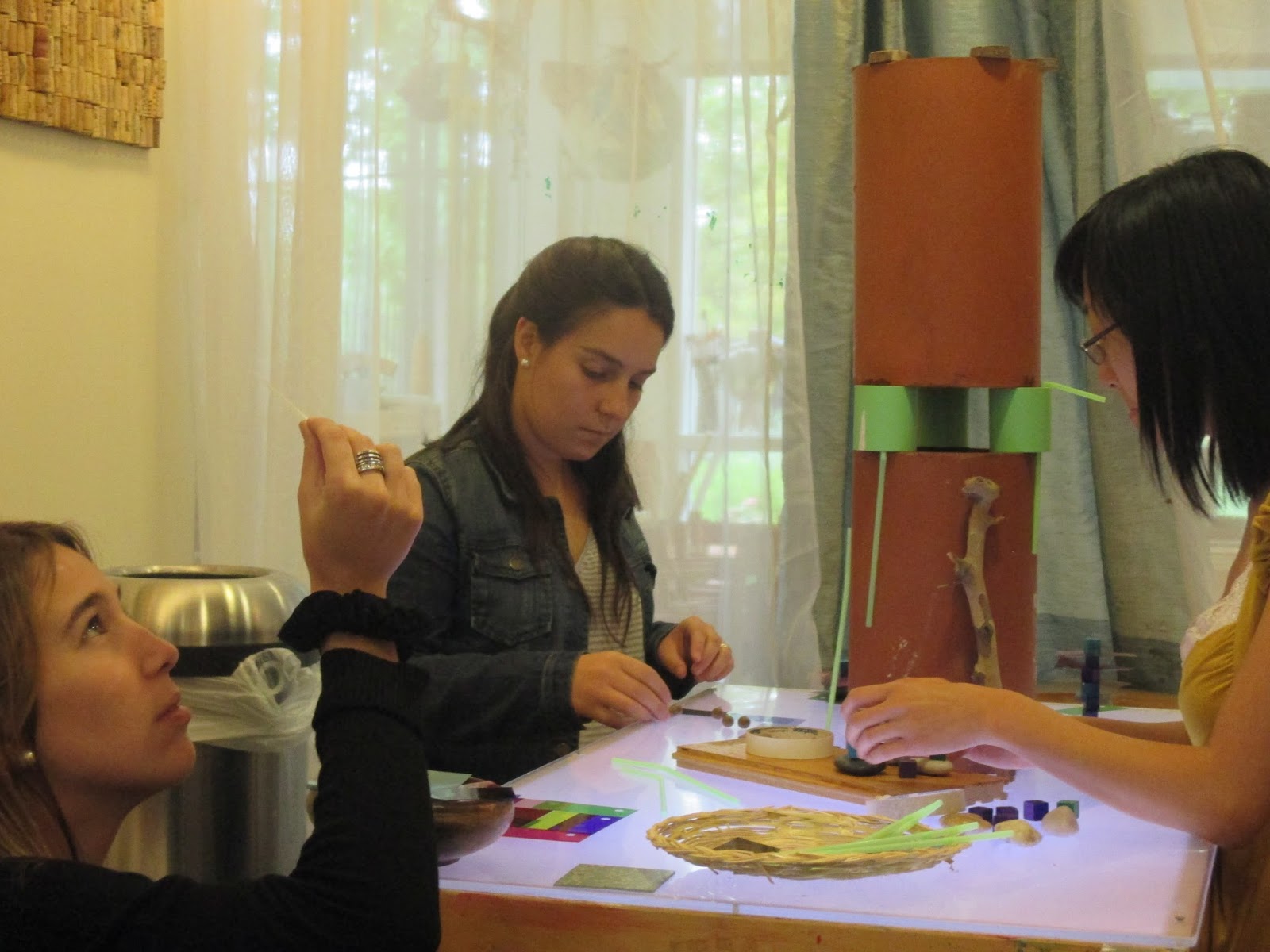
This year, our center-wide intention is to “explore our relationships with materials through research”. August’s teacher provocations provided opportunities for teachers to research through direct experience, observation and reflecting with a protocol. Our time together had four parts which relates to the cycle of inquiry that we use to drive our curriculum; provocation, play, reflection and provocation.

Provocation.


I invited the first three teachers who arrived to step behind a curtain and set up a provocation from an array of loose parts that were provided. Teachers at these provocations are from all over the center, so they had to decide what age(s) to design for, and often had multiple provocations to serve a variety of ages.

Later one of them told me; it was just like in the mornings at school: 
"I noticed my desire to quickly do it so we could get done and we could come and sit down with the rest of you."

Other teachers told us they felt inspired by setting up with one another. They improvised and then were inspired by one another. Many had to play with the materials a little bit as they set them out. "I had to construct and deconstruct a little bit before I could set things out."

While they worked, other teachers arrived and we reflected on our experiences with materials so far this year. We used “Rose, Thorn and Seed” to describe a positive observation, a challenging or painful observation and something that we’re looking forward to. These reflections are specific to the first few weeks of the year, and capture a moment of excitement and transition.

Rose:
Serena, a floater teacher "It's visible, the intention that went into choices of materials in each classroom...the simplicity in classrooms. It's refreshing and it puts the focus on relationships."


Cynthia: Our room represents everything we wanted it to, and it consistently looks cool and interesting. The materials are being used everyday.
Thorn:

Emma: We are still in the exploration phase, so there can be micromanaging to make sure things are used properly.


Kerry: Our napping schedules are making it hard to be in the classroom together and use materials on the light table for example.

Seed:
Carmel: I'm looking forward to incorporating the music and dance background these children have from [last school year] in what we're doing with materials.

When our “provocateurs” were through, they joined us. Three more teachers volunteered to...

Play!


The provocations and the play varied widely over the four weeks. Teachers explored with their senses, constructed two and three dimensional creations, created kinetic sculptures, catapults, ramps and devised collaborative and competitive games. While three teachers played, the rest of us observed and took notes.

Dolores: It was delightful to play. I should do this more.

One teacher noted that observation was easier in this setting, she had nothing else to track or do. We wondered how to make our time in classrooms feel this way. 

We also noticed that as observers in this contrived scenario we didn't interact at all. In a classroom with children we might offer materials as a way to reinforce our concept of the provocation, or pick up acorns rolling across the floor. In some ways this teacherly behavior may have helped the players, and in a lot of ways, it may have interrupted or subtly restricted the play. It was a good experiment for all.
We then sat together and used the "See, Think, Wonder" protocol to examine our observations. We this tool use often, and we considered what kind of learning and exploration was present in the play we witnessed, and planned to support it. 

We SAW 

  • blowing, dumping, crushing, throwing, building, balancing, shaking, examining, sucking an acorn through a tube
  • the irresistible draw of the light table. Even when the materials weren't specifically translucent, the table pulled players in
  • one group finishing their work before moving on to another part of the provocation, others  jumping back and forth
  • collaboration play a role in each group of players, but the amount and quality of the collaboration varied widely. (In one group, only when the action of moving something heavy REQUIRED cooperation did the group work together. In another, teachers competed with one another in a catapult game; and celebrated one another successes.)
  • teachers collect items from one table or offering and bring them to another table or part of the provocation. This is something that can sometimes frustrate preschool teachers, but they saw that even adults who create provocations were drawn to use materials in ways that appealed to them.
We THOUGHT
  • one teacher thought she recognized that the different players had play styles that related to what she knew of their personalities
  • it might be interesting to have kids play with the same materials in the same provocation that teachers did
  • one person's work influenced the next person who worked there
  • open-endedness led to creativity and collaboration
  • Katie records our thoughts.
  • teachers seemed most drawn to aesthetically pleasing materials
We WONDERED
  • how children's creativity impacts our planning; children will follow an acorn on the floor and next to the wall and start playing there; abandoning the project they were doing when the acorn dropped
  • how we can set up provocations cooperatively (teachers enjoyed doing this)
  • how the presence of authorities/observers impacts play

Finally, equipped with our observations, thoughts and questions, three more teachers stepped behind the curtain to create provocations based on our observations and intentions to extend the play we saw.

It was satisfying each week for the larger group to check out these "next step" provocations (unfortunately we didn't have time to play with them). They often solved a "problem" that came up during play, or they set up an experiment to test a theory, or answer a question. The second provocations were refined, clearly related to and inspired by the intial provocations, but with a new style and a different sense of purpose.

This time together allowed us to celebrate where we are right now, and to practice skills that support us as we help children "think what they need to think in order to learn what they want to learn" (Verbs, by Tom Hobson). Many teachers used this provocation with families at parent night in one way or another; to give them the opportunity to play, and to see first hand the cycle of inquiry we use to plan child-centered curriculum. They also helped us to get some new information about the loose parts and other open-ended materials that we've been using this year; the kind of information we can only get through direct experience, careful observation and collaborative reflection.

Where do you get direct experience that informs your work?

How often do you get to play?