Showing posts with label fairness. Show all posts

Thursday, December 11, 2014

Conversations with Nature: Preschool One Explores Natural Materials

“We often forget that WE ARE NATURE. Nature is not something separate from us. So when we say that we have lost our connection to nature, we’ve lost our connection to ourselves.”
                                                                                   ― Andy Goldsworthy

Autumn in New England is full of natural beauty – from golden leaves floating to the ground to acorns nestled in the grass to branches blown free by the winds.  These objects call out to be touched, gathered, collected, and children often do just that. Pockets that were empty before the trip to the playground return crammed full of bark and twigs and stones. Long sticks are brandished like swords and left unwillingly beside the door until they can be used again. These things entice us, draw us in, and call to our creativity. They are one of the hundred languages, and, if we make space, we can speak through them. This is Preschool One’s story.  

Rivers and Tides
We began our work with natural materials in the Studio by watching pieces of the documentary, Rivers and Tides.  This documentary features the work of artist Andy Goldsworthy, who creates beautiful installations – some in museums, but many of them outside – using entirely natural materials. I love this documentary because it not only showcases Goldsworthy’s breathtaking creations, it also shows his process. You can see his attention to detail in finding the perfect piece to add to his creation, as well as his frustration when one of his projects collapses midway.

I projected the video on the wall without sound, occasionally prompting children’s conversation with questions, such as “What does that remind you of?” or “What do you think he is using?” Here are some of their thoughts about what they witnessed*:


Alisa – It’s a snake.
Y. – Did you know there’s paths like that?
N. – Maybe it’s a drawing.
Justin – Maybe it’s lava.


E. – Hey all those are blowing away from the snake.
Justin – There’s something inside them – a sea snake.


A. – We see ice.
F. – His hands are cold.
Y. – What is he making? He’s eating it. Ew.
E. – It’s cuz all the other pieces are just like it and he can stick the pieces to the pieces.
All – BRAVO (when he finally sticks his last piece of ice).
N. – It’s a snake tree.


Justin – Maybe he’s making a nest.
Arnaud – Maybe he’s making a nest out of trees.


A. – I think he is making a house for him. He’s using stone.
Justin – Looks like a pile of rocks.
Gus – Maybe it’s melting – now.


Alisa – It’s a web.
Y. – You know why it’s not a web, because there’s a hole on a stop sign.
F. – Why is there a hole there?
Y. – Maybe so it can be a stop sign.

The Building Process
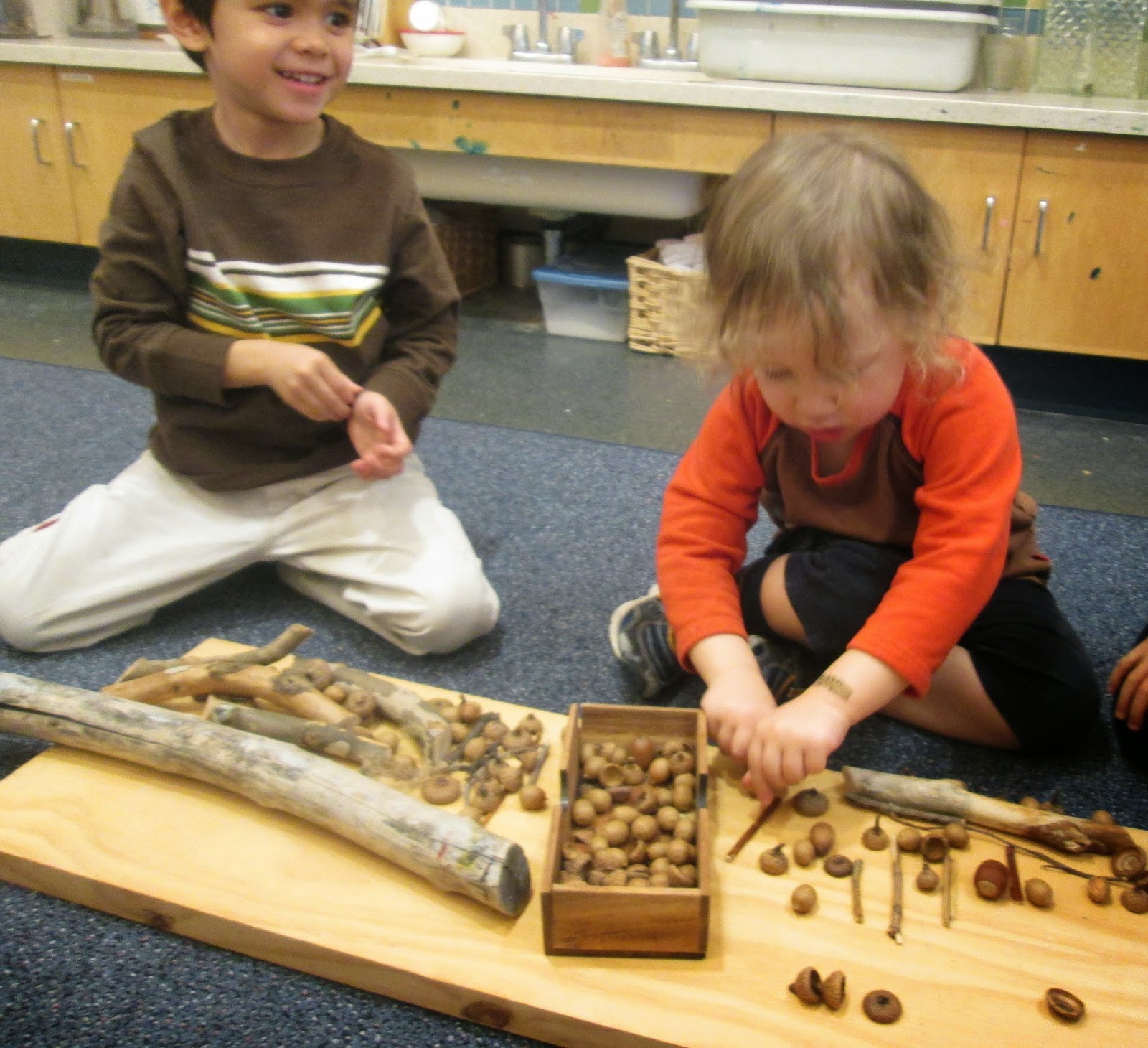
Following the video clips, I moved away the projector, spreading out several work surfaces on the floor, as well as baskets filled with many of the same materials that the artist had used. As children began building, I could see ways in which Goldsworthy’s work directly influenced their designs and their methods. Their great care in building creations using sticks, rocks, pine cones, acorns, and leaves seemed to echo the deliberation and concentration we had witnessed in the video.


As Gus surveyed the materials, he asked, “Can I make like he did?” beginning to collect sticks for a “nest.” Later, when he wanted to make one of the sticks stand up, “like a tree,” he made use of a glass jar as a stabilizing device. When A. laid out a small circle of rocks, she said, “I made what he made. I saw he made a hole with rocks, so I made a hole with rocks.” El. created a long line using all of the rough-edged rocks available. Arnaud and Justin built intricate traps, where each acorn cap or stick had a job to do.  N. enjoyed making matching stacks of things, such as a series of tree ring towers. Phineas overlapped a series of sticks, which he described as “just a design.”  E. worked to cover the entire surface of the different squares of wood set out alongside the materials. She would search for the perfect rock to fill each space, creating an orderly mosaic of materials.

Questions of Scarcity
I noticed that order and space became very important for many children over the course of the visit – lining up a series of sticks that were big enough to stretch across two other sticks like a bridge, filling a small square with only smooth stones… This meant that many conversations arose around the issues of scarcity – not having enough to finish a project you had begun – and stockpiling – holding on to many things in order to use them for future projects. Such conversations are part of the preschool milieu – how do you share space and resources with 15 (or, in this case, 4) other kids? The unique piece of this Studio experience was that this was a space dedicated to using just these particular materials, leaving more room for these discussions to happen. In many cases, the children discovered that their worries about someone else taking “all” or “too many” of something were unfounded, or that they really did not need all of the pieces they had been fighting to keep. For instance, when Gus was working to create his “tree,” the glass jar he wanted was full of sticks. He quietly sat down by the jar and began to empty it out. A. and E., who were working nearby, watched him.

A.: Oh no, he’s taking everything!
E.: Oh no, and I need sticks!
At this point, Gus left with the jar, leaving a pile of sticks on the floor.
E.: Oh, he just took that jar.
Katie: Did he take everything?
A.: No, he left those.
Katie: All he needed was the jar, so he left the sticks for you.
E.: That was nice of him. I guess I only need a few sticks.

Where the River Meets the Sea: The Big Picture
Through this experience, the children gained practice in appreciating, using, and re-using these natural materials. Treated as loose parts, the possibilities of sticks, rocks, and leaves multiplied, while children’s concerns over quantity and ownership gradually diminished. My wish is that this way of being can extend beyond the classroom into the greater natural world, where we can recognize forests, mountains, rivers, and more as treasures held in common, worth defending to be appreciated again and again by generations, rather than used up for the sake of one. We are the stewards of the earth, and we are charged with the task of passing that stewardship on. The best way I can think to do this is to help children engage with nature, cherish it, and not merely preserve, but share it in good faith. 

*The pictures featuring Goldsworthy's work are screenshots from Rivers and Tides.

Tuesday, December 11, 2012

A Conversation about a Castle, A Reflection on Fairness


A group of older preschool children have been working hard to build a castle out of clay.
During our last session in the Studio, the following conversation unfolded.

R.: Excuse me, Susan, Ian, Nina, E., can I make a bridge on that castle?
Nina and Susan say “Yes”. E. and Ian say “No”.

Katie: Why not?
Ian: It goes down.
E.: Because it might fall down.

Katie: Can you show us where you want the bridge to go?
R.: (points to a space across the top of the castle.) Can I make it go this way, E. and Ian?
Both: No!

R.: Why?
Katie: Why?
Ian: No, because that's like a sky.
E.: Because it will fall down inside.

Katie: Maybe you could show us what you want the bridge to look like?
R.: (to me) Can I use your clay?
Katie: Sure
R.: Is it okay if I do something like this? (She draws lines on the clay and holds it up for everyone to see.)
E.: Yes, that's okay.
Ian: No.
R.: Why?
Ian:  no answer
Katie: Well, now we have three votes that say yes, and one for no. If we are voting, it's okay. 

As R. began to draw the lines for her bridge, Ian seemed hesitant as to whether or not to accept them at first. However he began to nod his head and point to other places he thought the bridge could extend to.

This happened over a week ago and continues to resurface in my thoughts. Even in the interaction, I wondered about my words and my influence on the situation, about the values I was upholding in moderating the moment. Specifically, I’m thinking about fairness and all of the possible ways to present a decision or action as "fair."

Why Did I Suggest a Vote?

I suggested voting as a way to answer R.'s question as to whether or not it would be okay about making the bridge. Later, I wanted to analyze why I jumped to using this form of problem-solving rather than allowing the conversation to continue until everyone felt happy with the agreement.

Time Pressure
First, I recognized in myself a feeling of pressure about time. Studio only takes place once a week for forty-five minutes, which means that these children have a limited amount of time to work on their projects each week. Although I knew that hashing out the issue would be very valuable on multiple levels I also worried that if I didn't help to resolve things quickly, they wouldn't be able to make any progress on the castle.
This is reasonable of course, but looking back I wouldn’t prioritize time if I had it to do over again. Next time, I think I’d give the children time to resolve their issues, even if that did mean we would have to wait until the following week to enact our decision.


The Power of No
By the end of the conversation I was unsure whether Ian's continual "no" was rooted in a true aversion to the idea of the bridge or whether it was rooted in the power of saying "no" in the face of so many saying "yes." I wish I had waited to ascertain this and let R. try to work more closely with Ian to try to achieve a compromise before I offered a solution. Even if his ideas had revolved more around power than around the actual bridge question, I would have liked to hear the discussion the children's discussion about this.

The Majority Rules
Finally I knew that these children were familiar with voting and had suggested it as a problem-solving method before. But now I wonder if this was the right way of handling this particular argument.

Is Voting Fair?

Now I wonder why, in a bigger context, this idea of voting rose to my mind (and comes up elsewhere in our school) as a means of solving disputes "fairly."

On the one hand, voting is an essential part of America's political problem-solving system. It is what we hold up as being a fair way of making a single, united decision for a large group of people. Perhaps, because of this, it is ingrained in those of us who grow up here that voting is a fair and just way of making decisions and resolving disputes.

On the other hand, voting compromises the feelings of the individual for sake of the majority. Decisions are reached more quickly without having to appease every dissenting voice. When I think about it this way, voting feels less than fair to me, and it is not the ideal tool I would like to give children for solving their problems.


So, what would I prefer to advocate?
  • I think of the consensus-building exercises we have undertaken as a staff this year, where we have worked together to reach an agreement "we can live with" about issues like the possible adoption of a school-wide playground policy.
  • I think about the ways in which we constantly try to provide children with a sense of their own autonomy in as many aspects of their lives as possible, including decision-making.
  • I think about the fact that, even though there is a necessity for schedules here, there is also a lot more breathing room here than these children may encounter in other settings of their future lives.

I think that I would like to make more space for children to undertake the hard, sometimes grueling process of consensus-building, even at the expense of time and action. I would like them to feel in their hearts that fairness is important, that it can be hard, but also that it is attainable. And I would like to be a teacher who supports them in discovering this. I suppose I have found my new year's resolution!

What do you notice about the conversation I documented?
What perspectives do you have about fairness and problem-solving?

Do you ever find yourself interfering in a similar way, and how do you react in those moments?