
We just finished our first set of “teacher provocations” for the year. During these four weekly workshops, teachers
- developed their own relationships with some of the more open-ended “loose parts” we’ve made available this year
- gave and received immediate feedback on their work
- practiced thinking about provocations and materials through the lens of our “Materials Values”
- got an opportunity to play and take on different roles with one another
This year, our center-wide intention is to “explore our relationships with materials through research”. August’s teacher provocations provided opportunities for teachers to research through direct experience, observation and reflecting with a protocol. Our time together had four parts which relates to the cycle of inquiry that we use to drive our curriculum; provocation, play, reflection and provocation.
Provocation.
Provocation.


I invited the first three teachers who arrived to step behind a curtain and set up a provocation from an array of loose parts that were provided. Teachers at these provocations are from all over the center, so they had to decide what age(s) to design for, and often had multiple provocations to serve a variety of ages.
Later one of them told me; it was just like in the mornings at school:
"I noticed my desire to quickly do it so we could get done and we could come and sit down with the rest of you."
Other teachers told us they felt inspired by setting up with one another. They improvised and then were inspired by one another. Many had to play with the materials a little bit as they set them out. "I had to construct and deconstruct a little bit before I could set things out."
While they worked, other teachers arrived and we reflected on our experiences with materials so far this year. We used “Rose, Thorn and Seed” to describe a positive observation, a challenging or painful observation and something that we’re looking forward to. These reflections are specific to the first few weeks of the year, and capture a moment of excitement and transition.
Rose:
Serena, a floater teacher "It's visible, the intention that went into choices of materials in each classroom...the simplicity in classrooms. It's refreshing and it puts the focus on relationships."
Cynthia: Our room represents everything we wanted it to, and it consistently looks cool and interesting. The materials are being used everyday.
Thorn:
Emma: We are still in the exploration phase, so there can be micromanaging to make sure things are used properly.
Kerry: Our napping schedules are making it hard to be in the classroom together and use materials on the light table for example.
Seed:
Carmel: I'm looking forward to incorporating the music and dance background these children have from [last school year] in what we're doing with materials.
When our “provocateurs” were through, they joined us. Three more teachers volunteered to...
Play!
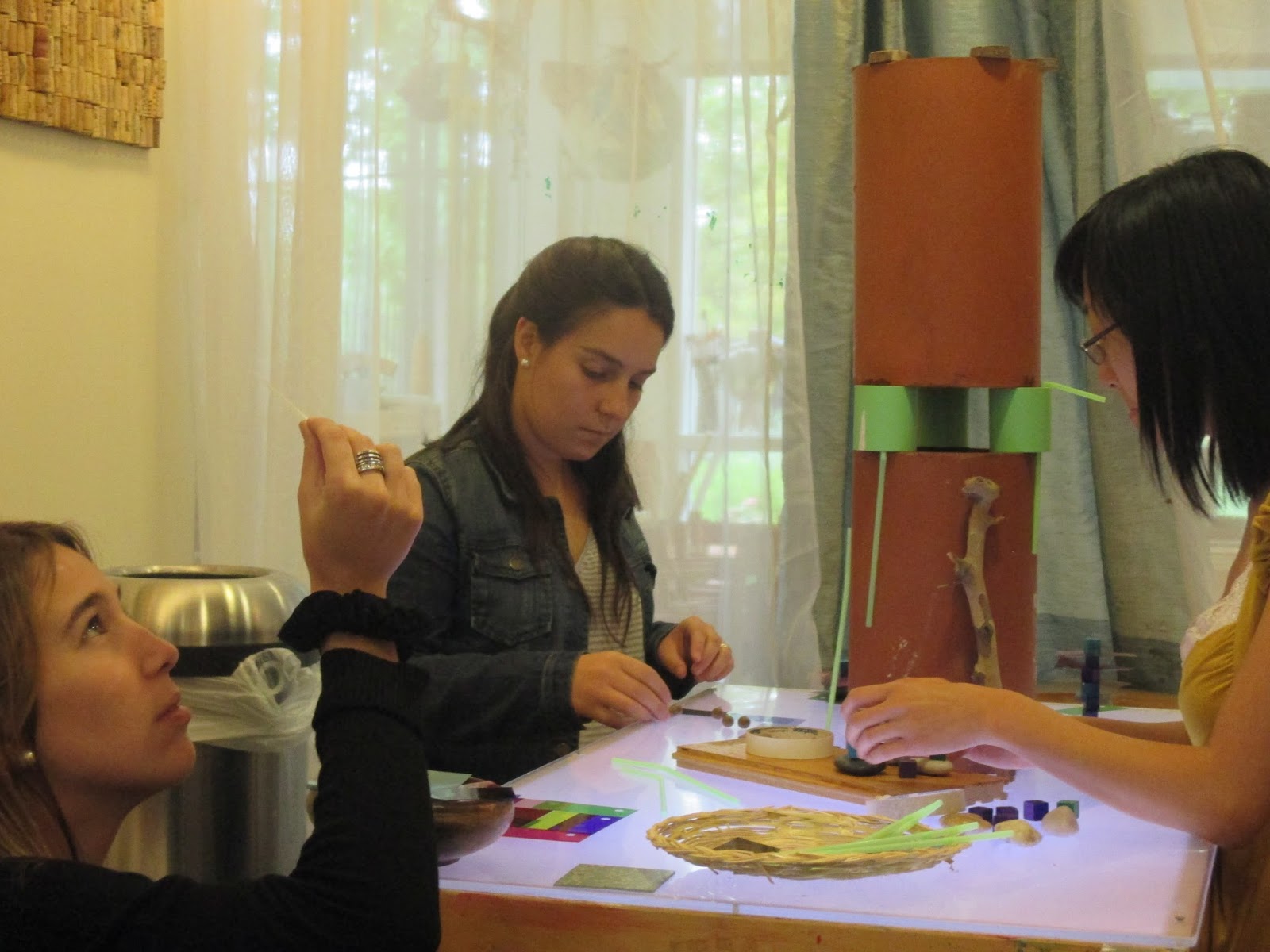
The provocations and the play varied widely over the four weeks. Teachers explored with their senses, constructed two and three dimensional creations, created kinetic sculptures, catapults, ramps and devised collaborative and competitive games. While three teachers played, the rest of us observed and took notes.

Dolores: It was delightful to play. I should do this more.
One teacher noted that observation was easier in this setting, she had nothing else to track or do. We wondered how to make our time in classrooms feel this way.
We also noticed that as observers in this contrived scenario we didn't interact at all. In a classroom with children we might offer materials as a way to reinforce our concept of the provocation, or pick up acorns rolling across the floor. In some ways this teacherly behavior may have helped the players, and in a lot of ways, it may have interrupted or subtly restricted the play. It was a good experiment for all.

We then sat together and used the "See, Think, Wonder" protocol to examine our observations. We this tool use often, and we considered what kind of learning and exploration was present in the play we witnessed, and planned to support it.
We SAW
- blowing, dumping, crushing, throwing, building, balancing, shaking, examining, sucking an acorn through a tube
- the irresistible draw of the light table. Even when the materials weren't specifically translucent, the table pulled players in
- one group finishing their work before moving on to another part of the provocation, others jumping back and forth
- collaboration play a role in each group of players, but the amount and quality of the collaboration varied widely. (In one group, only when the action of moving something heavy REQUIRED cooperation did the group work together. In another, teachers competed with one another in a catapult game; and celebrated one another successes.)
- teachers collect items from one table or offering and bring them to another table or part of the provocation. This is something that can sometimes frustrate preschool teachers, but they saw that even adults who create provocations were drawn to use materials in ways that appealed to them.
We THOUGHT
- one teacher thought she recognized that the different players had play styles that related to what she knew of their personalities
- it might be interesting to have kids play with the same materials in the same provocation that teachers did
- one person's work influenced the next person who worked there
- open-endedness led to creativity and collaboration
- teachers seemed most drawn to aesthetically pleasing materials
 |
| Katie records our thoughts. |
We WONDERED
- how children's creativity impacts our planning; children will follow an acorn on the floor and next to the wall and start playing there; abandoning the project they were doing when the acorn dropped
- how we can set up provocations cooperatively (teachers enjoyed doing this)
- how the presence of authorities/observers impacts play
Finally, equipped with our observations, thoughts and questions, three more teachers stepped behind the curtain to create provocations based on our observations and intentions to extend the play we saw.
It was satisfying each week for the larger group to check out these "next step" provocations (unfortunately we didn't have time to play with them). They often solved a "problem" that came up during play, or they set up an experiment to test a theory, or answer a question. The second provocations were refined, clearly related to and inspired by the intial provocations, but with a new style and a different sense of purpose.
This time together allowed us to celebrate where we are right now, and to practice skills that support us as we help children "think what they need to think in order to learn what they want to learn" (Verbs, by Tom Hobson). Many teachers used this provocation with families at parent night in one way or another; to give them the opportunity to play, and to see first hand the cycle of inquiry we use to plan child-centered curriculum. They also helped us to get some new information about the loose parts and other open-ended materials that we've been using this year; the kind of information we can only get through direct experience, careful observation and collaborative reflection.
How often do you get to play?


