Showing posts with label weekly provocations. Show all posts

Tuesday, February 16, 2016

Schema Theory; Following The Threads of Children and Teachers

“There’s a thread you follow.
It goes among things that change.  
But it doesn’t change.
People wonder about what you
are pursuing.


You have to explain about the thread.
But it is hard for others to see.
While you hold it you can’t get lost.”


From The Way It Is by William Stafford


January’s teacher provocations unpacked Schema theory. This theory recognizes repeated patterns in children’s play as threads that connect children’s learning over time. Most of us have encountered a child who throws everything they can, who spends lots of time on the swings learning how to jump off, and who watches an airplane move across the sky. This child might have a “ trajectory” schema. Children who fill buckets or bags and make deliveries may have a “transporting” schema. These two examples are physical presentations of schemas, but someone with a circular or rotational schema may enjoy spinning things (and themselves) and enjoy drawing circles and thinking about how a jet engine, a bicycle pedal or a Ferris wheel works. For some depth on schema theory, look here. For a practical chart to help you start identifying and planning for schemas, check out this chart and remember this is NOT a comprehensive list. There are as many schemas as there are children.

Thinking about children’s play and work this way helps teachers and parents take a new look at repeated play behaviors and see them as constructive, engaged learning actions. (Sometimes adults find themselves stumped or irritated by repeated behaviors and this perspective can help us identify the learning taking place even as the child is pulling all the toilet paper off the roll, or covering their arms and hands with paint.) Teachers can use our knowledge of individual children’s schemas to carefully prepare our provocations to support the ways our children are learning. Story cubes can help a child with a trajectory schema in co-creating a narrative, adding pieces of fabric to the block area might intrigue a child who has an enveloping schema.


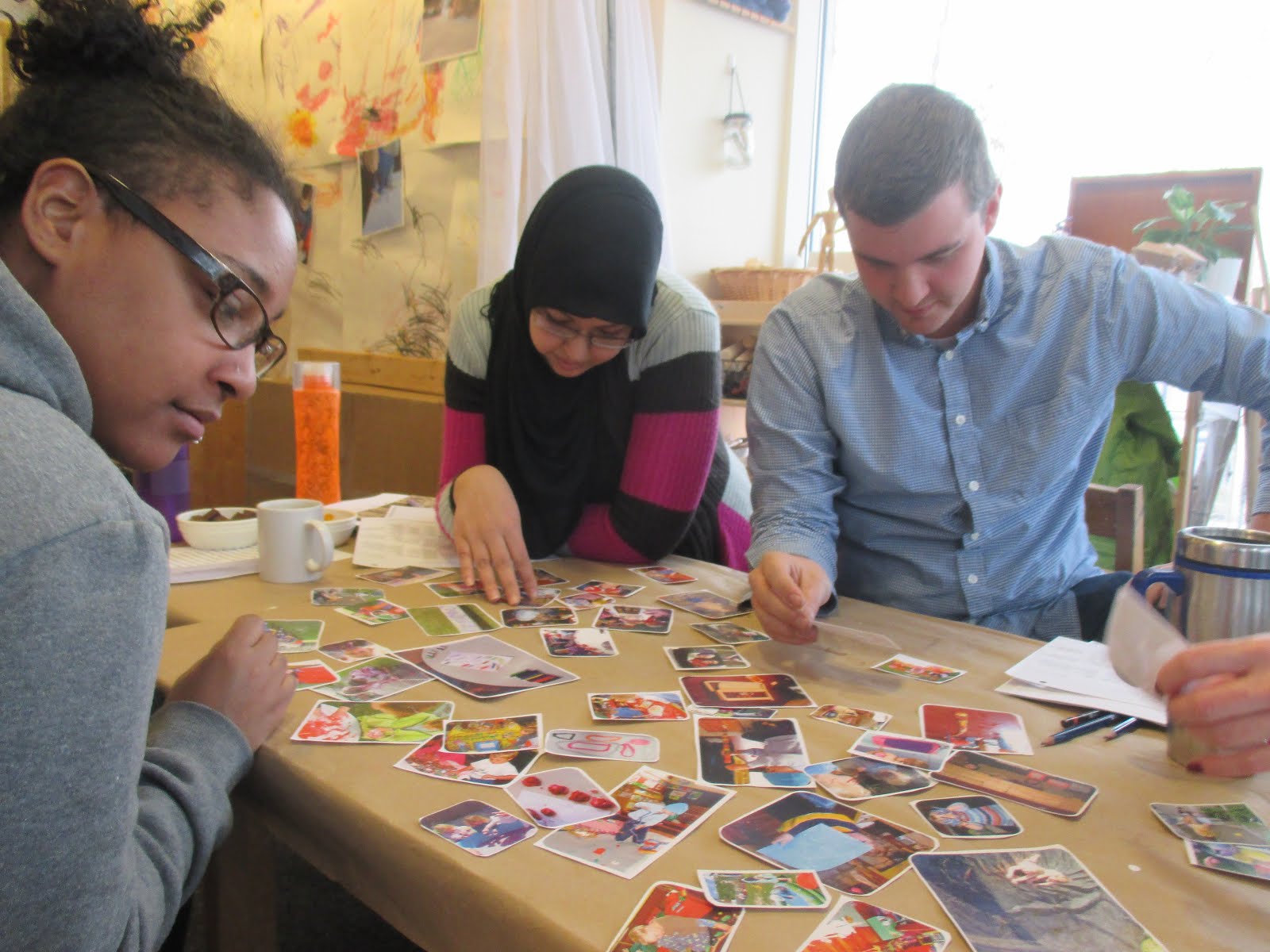
Unlike many topics we explore together, this one was, for the most part, an unfamiliar concept. We did some reading from Getting Started With Schemas by Nikolien van Wijk (a book I bought in New Zealand where schemas are more commonly used to understand children’s play and work), and from other sources. We sorted photographs of children’s play by schema, drew stories of schemas we see every day and as we worked, we talked.

Over four meetings, I began to see threads of common understanding in how teachers constructed this idea of schemas and how they fit into our work. I think that some of these threads may be abstract schemas, habitual ways of considering new ideas. I don’t have enough evidence from these meetings to identify the repeated patterns for individuals but overall I heard teachers folding this new information into their existing expertise in a variety of ways. I’ve grouped them here to demonstrate the many different ways to consider new ideas about our work, and to demonstrate the parallel tracks our professional development and our teaching of young children can take.


Analyzing: Some teachers took apart the theory of schemas, looking at it from different angles.


“How does adult... interest or [action] impact a child’s schema? How does the child react to being seen this way?”


“I sometimes wonder, is that [repeated behavior] keeping them from doing other things? But I guess that is the thing, actually.”


“I’m becoming very aware of children’s and adult’s agendas.... I’m not attuned enough yet to see a pattern, but I see how schemas could help me see children’s agendas more clearly.”


Considering development: Some teachers fit the concept of schemas onto their preexisting knowledge of how children change and grow.


“It’s hard for me to see a schema NOT as something that naturally comes after one stage and before the next.”


“As kids get older it’s easier for me to see how much attention they can give to one thing.”


“How do I learn a child’s schema without being influenced by stages of learning?”


Self-reflecting: These teachers thought a lot about how their emotions connect with what they learned about schemas.


“Why does this behavior bother me? Why does it matter if he fills a bucket every day?”

“This helps me to reframe what I take for granted in children’s play.”

“Developing curriculum in this way challenges me to think about why I say no, make rules.”

“When I can put myself in a child’s shoes, I’m better able to teach. This is another way to do that.”


Questioning: These teachers tend toward big questions, and their learning about schemas catapulted their thinking into philosophical directions.

“What makes different kids develop different schemas?”

“What is the nature of learning?”

“So... schemas are always patterns but patterns are not always schemas, right?”


Strategizing: Some teachers rolled up their sleeves and immediately considered how this theory would function.
“This is a way of watching a child’s focus; not on one idea or activity but across themes, across materials and activities.”

“What a wonderful way to think about redirection... and about continuing in a direction!”

“Kids in my class are fighting, are being powerful and dominating one another. I’m not sure what schemas they’re exploring but I’ll take notes.”

“It’s a way of saying yes, which my team is trying to do right now. We notice and then say "Let’s find a way to make these things happen”.

“It’s a helpful way of getting to know new children.”


It’s important for me to note that these are not transcriptions of conversations. I sifted four different 90 minute conversations into these categories. I looked for patterns in the same way that a teacher looking for schemas will. Sometimes two people with different threads spoke to one another. It was challenging, but teachers here are used to communicating despite differences. Just as children with different schemas can be invited to play together by carefully designing provocations, adults with different approaches to new ideas can be invited to talk about them through careful provocation. The variety of activities (group text study, conversation prompted by quotations, illustrating a narrative, collaboratively sorting photos by schema) provided allowed folks with different preferred threads of investigation to connect.

Self-reflection is a teaching skill. The more we can see our own thread, the better we can find them in the work and play of others. Which of the above resonates with your way of wondering?

How do you see this kind of work happening with the third protagonists, families? What threads of habitual thinking do they hold through a variety of different experiences?

Tuesday, September 29, 2015

"It was delightful to play. I should do this more."

We just finished our first set of “teacher provocations” for the year. During these four weekly workshops, teachers
  • developed their own relationships with some of the more open-ended “loose parts” we’ve made available this year
  • gave and received immediate feedback on their work
  • practiced thinking about provocations and materials through the lens of our “Materials Values”
  • got an opportunity to play and take on different roles with one another

This year, our center-wide intention is to “explore our relationships with materials through research”. August’s teacher provocations provided opportunities for teachers to research through direct experience, observation and reflecting with a protocol. Our time together had four parts which relates to the cycle of inquiry that we use to drive our curriculum; provocation, play, reflection and provocation.

Provocation.


I invited the first three teachers who arrived to step behind a curtain and set up a provocation from an array of loose parts that were provided. Teachers at these provocations are from all over the center, so they had to decide what age(s) to design for, and often had multiple provocations to serve a variety of ages.

Later one of them told me; it was just like in the mornings at school: 
"I noticed my desire to quickly do it so we could get done and we could come and sit down with the rest of you."

Other teachers told us they felt inspired by setting up with one another. They improvised and then were inspired by one another. Many had to play with the materials a little bit as they set them out. "I had to construct and deconstruct a little bit before I could set things out."

While they worked, other teachers arrived and we reflected on our experiences with materials so far this year. We used “Rose, Thorn and Seed” to describe a positive observation, a challenging or painful observation and something that we’re looking forward to. These reflections are specific to the first few weeks of the year, and capture a moment of excitement and transition.

Rose:
Serena, a floater teacher "It's visible, the intention that went into choices of materials in each classroom...the simplicity in classrooms. It's refreshing and it puts the focus on relationships."


Cynthia: Our room represents everything we wanted it to, and it consistently looks cool and interesting. The materials are being used everyday.
Thorn:

Emma: We are still in the exploration phase, so there can be micromanaging to make sure things are used properly.


Kerry: Our napping schedules are making it hard to be in the classroom together and use materials on the light table for example.

Seed:
Carmel: I'm looking forward to incorporating the music and dance background these children have from [last school year] in what we're doing with materials.

When our “provocateurs” were through, they joined us. Three more teachers volunteered to...

Play!


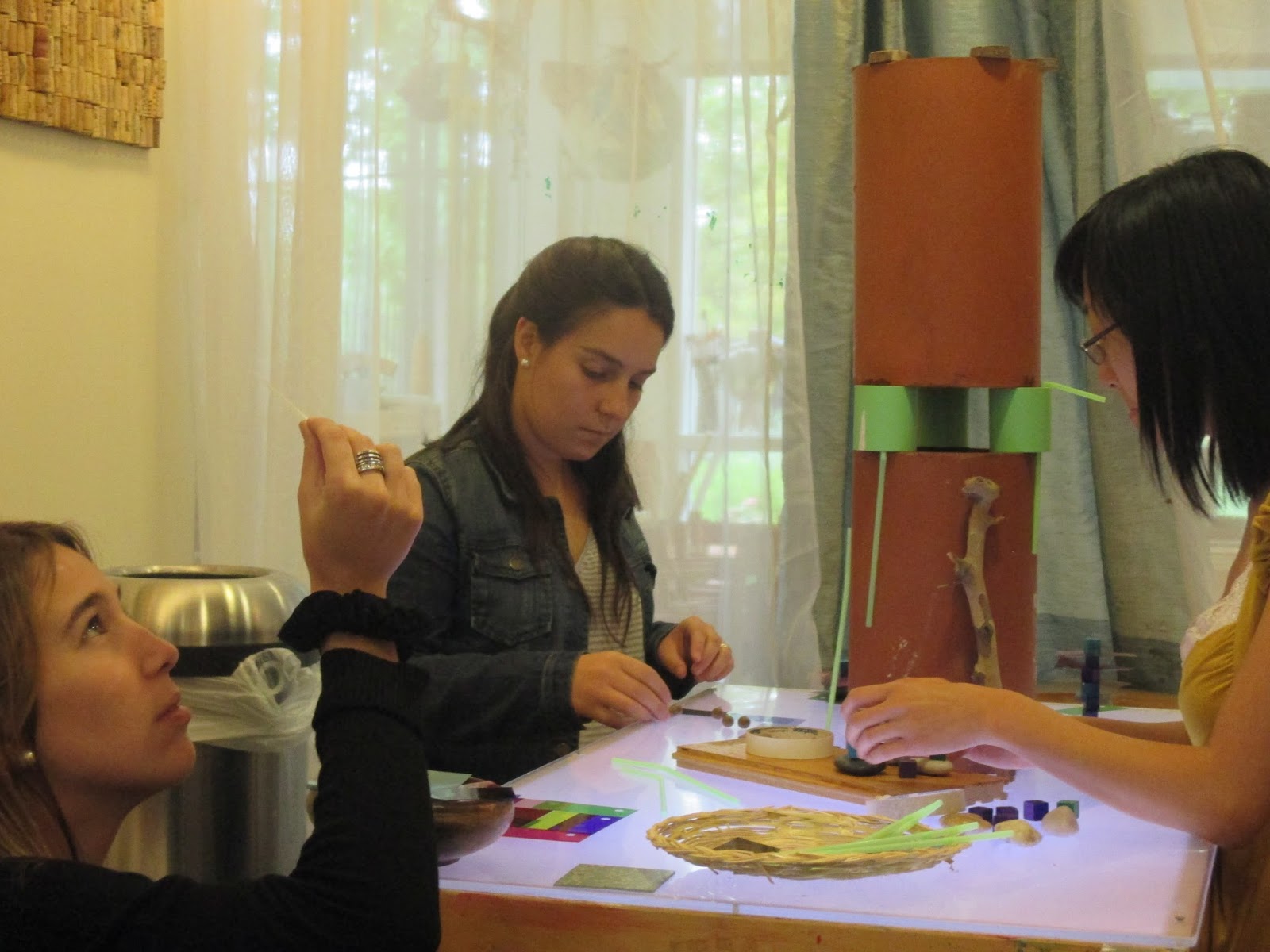
The provocations and the play varied widely over the four weeks. Teachers explored with their senses, constructed two and three dimensional creations, created kinetic sculptures, catapults, ramps and devised collaborative and competitive games. While three teachers played, the rest of us observed and took notes.

Dolores: It was delightful to play. I should do this more.

One teacher noted that observation was easier in this setting, she had nothing else to track or do. We wondered how to make our time in classrooms feel this way. 

We also noticed that as observers in this contrived scenario we didn't interact at all. In a classroom with children we might offer materials as a way to reinforce our concept of the provocation, or pick up acorns rolling across the floor. In some ways this teacherly behavior may have helped the players, and in a lot of ways, it may have interrupted or subtly restricted the play. It was a good experiment for all.
We then sat together and used the "See, Think, Wonder" protocol to examine our observations. We this tool use often, and we considered what kind of learning and exploration was present in the play we witnessed, and planned to support it. 

We SAW 

  • blowing, dumping, crushing, throwing, building, balancing, shaking, examining, sucking an acorn through a tube
  • the irresistible draw of the light table. Even when the materials weren't specifically translucent, the table pulled players in
  • one group finishing their work before moving on to another part of the provocation, others  jumping back and forth
  • collaboration play a role in each group of players, but the amount and quality of the collaboration varied widely. (In one group, only when the action of moving something heavy REQUIRED cooperation did the group work together. In another, teachers competed with one another in a catapult game; and celebrated one another successes.)
  • teachers collect items from one table or offering and bring them to another table or part of the provocation. This is something that can sometimes frustrate preschool teachers, but they saw that even adults who create provocations were drawn to use materials in ways that appealed to them.
We THOUGHT
  • one teacher thought she recognized that the different players had play styles that related to what she knew of their personalities
  • it might be interesting to have kids play with the same materials in the same provocation that teachers did
  • one person's work influenced the next person who worked there
  • open-endedness led to creativity and collaboration
  • Katie records our thoughts.
  • teachers seemed most drawn to aesthetically pleasing materials
We WONDERED
  • how children's creativity impacts our planning; children will follow an acorn on the floor and next to the wall and start playing there; abandoning the project they were doing when the acorn dropped
  • how we can set up provocations cooperatively (teachers enjoyed doing this)
  • how the presence of authorities/observers impacts play

Finally, equipped with our observations, thoughts and questions, three more teachers stepped behind the curtain to create provocations based on our observations and intentions to extend the play we saw.

It was satisfying each week for the larger group to check out these "next step" provocations (unfortunately we didn't have time to play with them). They often solved a "problem" that came up during play, or they set up an experiment to test a theory, or answer a question. The second provocations were refined, clearly related to and inspired by the intial provocations, but with a new style and a different sense of purpose.

This time together allowed us to celebrate where we are right now, and to practice skills that support us as we help children "think what they need to think in order to learn what they want to learn" (Verbs, by Tom Hobson). Many teachers used this provocation with families at parent night in one way or another; to give them the opportunity to play, and to see first hand the cycle of inquiry we use to plan child-centered curriculum. They also helped us to get some new information about the loose parts and other open-ended materials that we've been using this year; the kind of information we can only get through direct experience, careful observation and collaborative reflection.

Where do you get direct experience that informs your work?

How often do you get to play?


Tuesday, January 6, 2015

Everybody Knows; Working with Our Commitment to Anti-Bias Curriculum


In the month of November, we recommitted ourselves to our anti-bias curriculum and teaching for liberation. Four years ago, our staff started a two year exploration into what it meant to create anti-bias curriculum in our classrooms. Teachers examined our biases and our privilege. We looked closely at systems and materials in our center and how they worked to support or counter the biases of our dominant culture. It was a deep, emotional collaboration and those of us here at that time will not soon forget what we learned. There are certain practices, norms and materials at our center that support this kind of teaching, but more important are teacher attitudes, habits and knowledge, so we worked on those in teacher provocations.

We have had some staff turnover since our first investigation of anti-bias curriculum. Many of our newer staff see the word “anti-bias” on our
website, see the poster of Louise Derman-Sparks’ Four Anti-Bias goals (letterpress printed by our atelierista, Katie Higgins-White!) that hangs in every room of our center, and they like the idea of teaching for justice.  None of this helps  these teachers know what to DO. This month we worked to see our work in the context of oppression so that we can make choices that lead to liberation. 

In many ways, teaching for liberation means questioning the things that we “know”.

An example; everybody “knows” it feels good to receive a complement. Complements are a way that many adults greet young children and build a relationship. When we begin to see how we broadcast our own biases, and learn how they affect the identities of children in our care, we want to counter some messages in our work with children. After we learn more we see how we are reinforcing stereotyped messages about gender. 

Suddenly, if we pay attention, we hear our complements differently.  We notice that we may respond to even the smallest babies with complements about their appearance when they think they are female babies and about their actions if we think they are male babies. (A most telling example of this occurs when an adult accidentally misunderstands a child's gender, and makes the "wrong" kind of complement.) We see that we are telling a story to a child about who they are when we complement them for being pretty, having a “cool dress” or being strong or funny. In fact, we’re colluding with most of the media that they’ll consume in telling them this story.

Our anti-bias practice requires teachers to notice these kinds of actions, to think about them, talk about them and try to build a new habit. Now we know that we can greet a child without a complement at all and wait to see what we’d like to say. We know that we are co-constructing children’s world with them, that we have tremendous power and that we can counter the dominant “story” in our culture that girls’ and women’s worth depends on our aesthetic value and that boys’ and men’s worth depends on what they do. We know that we must work to counter this stereotype and that it’s worth doing because it helps children grow up with a sense of worthiness connected to how they are in the world, what they think and what they do rather than how they look or behave.

At the end of the week, I’ll post about our provocations and describe how teachers defined anti-bias curriculum, we practice it at our center, and how we reacted to some stories of teachers and parents dealing with issues of difference and bias.

If you want to follow along, we listened to the firstchapter of an episode of This American Life about classroom discipline entitled "Is This Working?" And read “Holding Nyla” from the endlessly helpful text about doing education for liberation with young children, Rethinking Early Childhood Education, edited by Ann Pelo.

Where is your center on your anti-bias journey? What are you still working on?

Thursday, May 1, 2014

Thinking About Our Year-end Showcase Together

For the last few years, our center has hosted Showcase, an evening when teachers create special displays or panels to highlight moments from the year we are ending together. In a center full of great teachers, we can feel stressed to perform, overwhelmed by all the possibilities or pressured to compete with all the incredible work happening.

I met with the administrative team and we agreed that in the three years that we've had showcase, not once has anyone "not done enough" or disappointed anyone. In fact, when we reflected on these past events, we felt like many people could have done less and still be very happy with their result. In order to head off some of the pressures felt by teachers, and to help us to create the kinds of displays we can be proud of with less effort, we had provocations this month all about Showcase. 

Part of my design of teacher provocation is considering who will attend. Sometimes it's random, and teachers appreciate working with people from around the school. Other times, I'll pick different aspects of the topic, so that teachers can choose which to attend based on their interests. Still other times, we ask people to attend based upon whether they are a new or veterarn staff because those groups have different needs or points of view. This month, I invited Team Coordinators to come first. These veteran teachers with added responsibilities on their team are often the ones cursing at the copier, or having Showcase nightmares in the weeks leading up to the event. I specifically invited this group to name the stressors, the expectations of different protagonists, and our values for Showcase.
Serena and Tracy list the stressors that coincide with planning Showcase.
Sammie, Sarah and Erin consider what families expect from Showcase.


Next, our newest teachers attended, most of them with only a vague idea of what Showcase would be, or with a huge impression from having attended early on in their time with us without having to contribute. We spent a lot of time looking at images of past Showcase displays and discussing what worked for us and what didn't. Finally other teachers, all of whom had been a part of showcase, but who didn't have the same weight on their shoulders as the TC's.

Amy and Sara discuss documentation of Showcases from before they joined our community.


Amy, Sara, Monica and intern Madhumita use Deiter Ram's 10 Principles of Design to analyze past Showcases.
All three groups spent some time reflecting individually in writing, and then sharing their impressions of Showcase. We thought about other events that we've been a part of like this one;

  • teaching a culminating yoga class during teacher training
  • a final gallery show in art school 
  • collaborating on a piece of published writing
  • a wedding 
  • numerous plays 
  • political events and how these shaped our assumptions and our thoughts about Showcase. 

Then we examined Deiter Rams’ “10 Principles of Good Design”. Most teachers have no training in design, and yet we design provocations, documentation and displays like these. We used these principles to guide our thinking about past Showcases as we examined books of documentation. We identified which principles we embraced already as a community (1,3, and 6) and which we could try to fold into our work this year  (2,4 and 10) . From these meetings, I created this summary of our collective wisdom. I wonder what will feel different about our Showcase this year.

What’s Your Metaphor? How do you view Showcase? Is it a marathon? An essay? A play? An art show? A final for a really hard class? A reunion or a wedding celebration? Sara shared how her history as a story-telling performer affected the improvisation and depth that she brings to designing documentation, while another teacher’s experience working in a gallery taught her to handle the stress of last minute design changes. We've all planned an event, or final draft. Those experiences taught us something and affect what we assume about showcase and how we prepare. Talk with your team about your history, and how you see Showcase now. One teacher told us that Showcase was a stressful event like having a tooth pulled. If she changed the way that she sees the event, would that change the way she feels about it?

How Much is Just Enough? Different teachers talked about how much text is the right amount to display. One teacher looked back at her brief interpretive paragraphs from last year’s Showcase and said that it looked a little too long to her now. Think about how long it takes you to read text, and how much time you can expect a viewer to spend in your room. Use this information to make decisions about how much writing to include on the walls. Teachers pointed out that it’s nice to have your collection of documentation in a binder nearby for anyone who would like to look for more depth. (Note, this document is 933 words. See how long it takes you to read.)

An excess of images can also lead to a sense of “overstimulation” that several teachers mentioned when describing their past encounters with showcase. Eileen brought up her own experience of choosing “the best of the best” for photography exhibits, a good tactic to keep in mind when selecting pictures for display. This also plays into honoring one of the principles of design - to be environmentally friendly. Consider what will happen to these images after Showcase ends: how many prints can you easily save for future use or give away to families to take home? Make your pictures count!  

What Have You Already Done? Many of our teachers have had the experience of displaying their past work in a gallery. Think about what you’ve already done this year and how you can prune it a little bit, change the look but avoid writing more than a small summary or interpretive piece. Since the second week of school, Toddler 2 North has been collecting documentation in a basket for possible inclusion in Showcase. You can also do this digitally on your computer by copying documentation into a Showcase folder if you like.

What is Too Big or Too Small? We heard that some people can’t read small print without their glasses, or that some people think that larger is more aesthetically pleasing. Eileen brought up her experience in a gallery “when I'm looking at a big piece with someone else, we might say something about what we see because we're seeing the same things at the same time. When it's smaller, I’m reading the whole thing on my own and having a private experience.” Consider what sort of experience you are trying to provide as you choose the size of your images and text - do you want to open up conversations between viewers or offer a moment for quiet, individual reflection?

What Does It Mean to Be a Team? I brought up that if a team can come together behind a shared vision, the display is often much more legible as a whole, and it can be more succinct and focused than the more common approach of three individuals telling their own stories. Katie realized that part of the panic in the last days and hours before provocation are largely due to an “every person for herself” mindset that occurs when each teacher is designing their own display. If the three people are working together, they’ll have communicated about what’s happening weeks before, and they’ll be working toward shared goals, finishing earlier and enjoying their pizza (Center-wide take out is our pre-Showcase tradition). How can your team decide together what to display from your shared work this year?

Is Showcase Just About What's on The Wall? Sara reminded us that Showcase is not the displays that we hang, it’s the interaction among community members and with the displays. We are creating a structure where Showcase can take place, one that invites people to consider big ideas, whole stories, or fundamental questions. The Showcase is found as much in the conversations as it is in the printed word or pictures. Consider the ways in which you can make space for them in the design of your presentation.

How Is Our Work Part of Something Larger? Showcase is intended as an opportunity for teachers, children and families to view the work happening all over the center. It also offers our own families and friends a window into what we do. Erin pointed out that our design can facilitate this kind of movement.

How can our design encourage readers to take in the work of the whole community, and make connections among all that they see? How can the stories we present work together to illustrate our identity as a center as well as individual classrooms?

Have you been a part of our Showcase in the past? What were your impressions? Has your center hosted a tour, or a culminating event like this one? What wisdom can you offer us?

Thursday, January 30, 2014

How Do You Try New Things?

Those of us who live in the land of child care and education get TWO “new” years, two fresh starts. For most of us there is a fresh start in the fall and then another that we share with the rest of the world in January.

Last August, our staff decided that we were ready to integrate in-depth project work into our curriculum and started preparing during our work days. We invited Sandra Floyd, mentor teacher at Epiphany Early Learning Preschool (and friend of mine!) to visit us and share her stories and perspectives on in-depth projects with young children. Together, we made a plan for a relative timeline for beginning our own project work. Like most centers, our curriculum really deepens by the winter time. Groups have gelled and interests have ripened. In addition, since this will be a departure for our teachers, we wanted to take all the time we needed to change our systems and learn about negotiated curriculum before we jumped in. As a result, we chose January to be our turning point when we expected that teachers would invite children into our first small group projects.

There is a book by Cher Huber, called "How You Do Anything is How You Do Everything", and I bring this idea up often with teachers. If I look at how I left the house this morning (woke up late but cheerfully with my son, no real routine, enjoyed pancakes with my toddler, left the dishes in the sink, had to run back for raincoat and boots once I got outside and realized that it was raining, sang songs together and talked about big ideas with my partner in the car on our way to work) it tells me a lot about how I do a lot of things; not terribly organized or neat,very focused on some things to the exclusion of some others, involving love and fun, thinking about things and my favorite people. In this spirit, I invited our staff to think about how we started new things in the past to learn how we might start our project teams this year. 


We talked about leaving the country for the city, installing a toilet, quitting soda, presenting at a conference, bike commuting, learning to knit, practicing yoga and dozens of other new things we tried. Just listing all the new things had an effect on people; some seemed surprised at how many new things they'd attempted lately, and others had a hard time creating a list at all.


If you'd like to try this yourself, think about some new things you tried in the last few years (marriage, sushi, rock climbing, Spanish lessons) and narrow it down to one successful thing and one unsuccessful thing. Answer these questions:


Successful thing:
Not so successful thing:

Why did you try it?

Why did you try it?
What words come to mind when you think about doing this thing? 

What words come to mind when you think about doing this thing?
What were your positive thoughts before you tried it?

What were your negative thoughts before you tried it?
  
What were your negative thoughts before you tried it?

Did you try it alone or with a friend?

Did you try it alone or with a friend?

What helped you succeed?
Why didn't you succeed?


Together we discovered that different motivations, self-talk, and strategies worked for different people. Despite this, everyone felt that they learned something about themselves that would help them on their next new endeavor. 

Whatever new things you may be trying out in 2014, this collective wisdom may help you accomplish them!


What motivated successful tries? 
Because it's: healthy, necessary, expresses who I am.
I knew I could do it.
For the challenge
I like big changes.
To prove something to myself or someone else.
Cool people I wanted to be closer to
Doing something for myself
Looking for a new hobby
I was not successful at the opposite.
Why not?
I didn't have to if I didn't want to.
It would be calming for me.
Change can be fun.

What motivated unsuccessful tries?
I felt like I was ready mentally to do it.
I thought it would be healthy.
I thought it would help me find something to do with my hands.
I was interested in it.
People around me were doing it.
I think I should/someone told me I had to do it.

I wanted to prove something to others.

Words that come to mind when we think of the successful thing:
Successful, arduous, challenging, exciting, whole body, complicated, calming, fun, intimidating, accomplished, feel good, gutsy, new, beautiful, flexibility, practice, interesting, refreshing, success! fun, relief, proud, excitement, joy, effortlessness, sharing.

Words that come to mind when we think of the unsuccessful thing:
frustrating, boring, utter failure, procrastination, self doubt, shame, anxiety, new, finances, impatient, comfort, wanting to feel a different way than I do, conflicted, cognitive dissonance, she can do it so I can do it (Comparison) competition, tired, frustrated, bored, nope, defensive, Oh my god! Wanting to turn in on myself, embarrassment, pissed off, blaming ("It would have worked if only...") 

Thoughts we had before our successes
I can do this.
I love this.
This is going to be great.
I love change.
I'm going to be so ________ (Identity)
I don't have enough resources to pull it off.
Maybe I'm underestimating myself.
Who might this affect?
Will I have the follow-through?
I'm a fraud. I'm waiting for the other shoe is going to drop
How can I do it? (Making a plan.)
I can't do it. (Self doubt)
I've failed before.

Thoughts before an unsuccessful try:
people will love it!
salary or other extrinsic rewards
maybe I'll meet some interesting people (bribing yourself)
What if it's just like the last time? What if it takes for ever?
How could I ever do this?
What if it doesn't look/turn out the way I want it to?
I'm not... (Identity)
I don't think I can afford this.
Will I embarrass myself.
It's going to take a long time and involve a lot of details.
I think I'm going to succeed
I don't like what I am going to do.
This will be easy.
I'm afraid I might be scrutinized.
I'm afraid.
This will be a neat thing to try. 
It'll be great this time I just have to stick with it. 
It'll be so nice when this is all over. 
Wouldn't it be awesome to create?! 
No big deal, I'm ready. 
I can totally do this.


What helped you succeed?
I felt good doing it
I felt healthy and got out of my head.
I knew I could.
I had to do it.
I made an investment.
My passion for it.
I had support from a team.
Listening to others telling me I was succeeding in spite of my own judgments of myself.
I played to my strengths
Repetition
I avoided comparing myself to others.
I trusted myself and others, let go of control. (For example, trusting my sister to make the onions at Thanksgiving!)
External accountability/peer support
A more flexible attitude, willingness to learn something
I brought someone else into the process.
competition
I learned from my mistakes in the past.

Why Didn't You Succeed?
It takes so long, and it's SO boring... not fun. (It was a bad match.)
fear
social opportunities
I didn't have natural ability 
I was working alone.
no support/guidance/resources 
competition

This exercise and collected insight gives us a great opportunity to learn from the past in order to succeed in the present. How could you use this information to support a new endeavor? PTCC Teachers, has this collective wisdom informed you as you get started with project work?