Showing posts with label center-wide. Show all posts

Friday, May 8, 2020

Extended Encounters: Part III

**This post is the third in a series about our three-month material investigation. To read more, go to the first post here.**

Going Deeper
Spending an extended period of time with the same material led many classrooms to really delve into the possibilities and potentials of their chosen area of exploration. Teachers and children alike developed new understandings and expanded their vocabularies as a result. 


“I never had the depth of knowledge [about natural materials] before… I was learning what items are called what names. I went from an admirer of nature to understanding a little bit more about it. They were playing around with it all the time… but some of their questions were fascinating and led to introducing new vocabulary like density. … and exploring along with kids perhaps at the same level at times brought me joy…. I don’t know why, but the whole time, a piece of poetry kept coming to my mind:


“To see a World in a Grain of Sand
And a Heaven in a Wild Flower 
Hold Infinity in the palm of your hand 
And Eternity in an hour…”
 From Auguries of Innocence by William Blake
Akbar, Toddler 2 North


“I think that the requirement of using the material in your curriculum everyday really forced our team to push past what the surface level uses of paper were. We spent the first weeks having paper in our room and building up our children's vocabularies about the material. But once we had spent a few weeks on that we were forced to dig deep into how paper can be used in the classroom. We found ourselves asking questions like  "what does paper sound like" or "what happens to paper when it gets wet." And as we expanded our idea of how "paper" could be in the classroom so too did our children. Today if you took all the paper out of our classroom, it would be mostly empty.”
- Wheeler, Toddler 1 South


“... because the kids are so much shorter, they would notice things on the ground, and it reminded me to look down not just up… and the question “what’s inside” sparked a lot of interest… it was amazing how happy or angry they got depending on what was inside the acorn.”
- Elayne, Toddler 2 North


“When we decided to explore natural materials for the first three months of the year, I had no idea how far we could go with offering authentic, raw materials from the outdoors. In the past, we had laminated leaves to offer our babies a close-up, yet indestructible way to access the leaves that fall to the ground. This year, we have offered fresh leaves, branches, pine cones, and even produce from our garden! … It’s been thrilling to see our babies, as young as three months, reach for and grasp leaves and pine cones. As they’ve grown, we’ve expanded our exploration by offering giant leaves from collard green plants, for example. How exciting it is to see how babies can make their mark, and thus, learn about natural materials, when they wouldn’t usually have access to them!”
- Christina, Infant South


“It all started with a lid. We brought lids into the classroom in August because it was a loose part that we had available to us. I had the expectation that children would use metal lids to explore sound. Although the infants did explore sound, I was amazed by the variety of ways children interacted with lids, and how their actions led us teachers in the development of our loose parts exploration over the past few months. After the children explored the sounds of the lids, they began experimenting with how the lids fit into different objects. This helped expand our loose parts curriculum into containers of different sizes. Next, the kids seemed interested in how the lids stick to other objects, and this informed our investigation of magnetic properties. The children currently seem interested in the shape of the lids, and we plan to investigate wheels and things that spin. I am amazed that the infants have shown interest in lids constantly for three months! I am fascinated by the new properties of this material that the kids continue to discover, and how their interactions with one material have been a driving force for our curriculum throughout the year. I am eager to see what the children discover next, both with lids and with other loose parts!”
- Hannah, Infant North

Monday, May 4, 2020

Extended Encounters: Part II

**This post is the second in a series about our three-month material investigation. To read more, go to the first post here.**

A Portal to Possibilities
In almost every classroom, the longevity of our exploration allowed the materials to not be simply a focus in the room, but a catalyst for other important work by children and teachers. It often served to highlight, support, and sustain larger questions, which might not have been visible without our intense observation and thinking about the original material in question. 


“Wood was present in our classroom in many forms and discussed in team meetings. I am less sure if it provided a lens for getting to know each other or a rich focus for the class. We definitely had fun. 
Early on we had a few conversations about the sensory experience of wood - what it looks like, feels like, smells like. However the children in P1 seemed more interested in what you could do WITH wood, and TO wood, than in the intrinsic qualities of wood itself. Children often used sticks in dramatic play indoors and outdoors… They used wood as a background for activities such as building, sorting, and counting… Combining wood with other materials such as string and wire and tape offered opportunities for children to create new things... They were excited to collect sticks on the river walks and on the playground, and to use tools such as drills and saws with wood... It seemed to me that their interest was in the experience of using the tools themselves, and less about how they could use tools to discover more about wood."
- Loren, Preschool 1


“The Natural Materials area in our classroom seemed like the place where the children came together and did a lot of coordinated play as well as side by side play…. These open-ended materials showed me about each child and how they thought, what their interests are and what excites them. C was all about cooking and using her imagination, M loved to sort, and R liked to bring other materials such as trucks or blocks to the Natural Material area to create something different. For me having the Natural Materials in the classroom brought this classroom together, from the children that moved up from Infant North to new children that started this year, to all the teachers.”
- Caroline, Toddler 1 North


“... I never would have guessed [the natural materials] could be used so many ways… seeing [them] used as placeholders for food, being carried around the room… and the joy of using the things they had grown in the garden…"
- AJ, Toddler 2 North


“Our investigation of loose parts has been so transformative in my thinking and even in my everyday life. I love the planet and feel that we should find value in our environment. I was not expecting this investigation to bring me more insight in my everyday thinking when we started, but surprisingly it has extended out in what I have been observing in the community I live and participate in… Loose parts are an intricate part of our classroom identity and opened a bigger question for me and my team about "how do things/people/community fit together?" I believe that this is a concept that is at the core of humans, our identity, and the need to connect. I am surprised that that is what I found from the experience, and I love that it has bent my thinking. This world is made of loose parts and we can get philosophical and say so are all individual people, we are searching for a sense of belonging and acceptance, not in spite of but because of our miss matched attributes.”
- Aleksandra, Infant North

“As we started to amass natural materials the children began to think about categorization and where and who the objects "belonged" to.  We created a natural materials shelf for our classroom and the children sorted the objects to place on the shelf.  During their play they would often return to the shelf to gather materials they needed.  The theme of belonging has since been an ongoing thread in our classroom that children, teachers, and families are exploring through multiple facets of our curriculum.  Our natural materials investigation was therefore a catalyst for a much deeper dive into questions such as:
"Does it belong?"
"How does it belong?"
"How do you come to belong? (to a group, game, place, community)"
- Amanda, Preschool 2

“We started off with a very large, nondescript clay block and a few hand tools. As weeks passed children’s interactions with the clay changed. I was intrigued, observing the changing relationship of each child with the clay as well as how their relationships with each other evolved when working with the clay together.... In their early introduction to clay the physical act of working at changing the block of clay seemed to be their main goal… As the clay chunks became smaller and more easily moved by the children we started to observe more individualized clay exploration. It became apparent when each child claimed chunks or slabs on their own they named, with pride, a specific creation such as “pizza”, “tree” “pasta”. As a group, they influenced each other more and began to migrate to the same play concepts and ideas while the individuality of their clay objects became an extended social experience… Eventually the small parts and tools used to alter the clay started to become something more... Patterns created from using materials emerged and took on their own meaning. The clay investigation came full circle. In the Studio small parts were hidden deep in a clay block by half of the class. The other half went to the Studio on another day and worked at extracting the pieces their friends had hidden, using tools, both side by side and together, for a common goal.”
- Janet, Toddler 2 North

“In the beginning of the year, [we] introduced a few of the natural materials by creating still lifes... As the year progressed we decided to challenge the children by having them create their own still life and draw it. One thing that surprised me about this investigation was how focused the children became and the pride that [this experience] instilled in their work. What brought me joy during this investigation was how the children then started taking pictures of their own work - I believe this investigation of the material helped them to gain confidence in themselves.”
- Ally, Preschool 2

Wednesday, April 29, 2020

Extended Encounters: Reflecting on our long-term material investigations

“A first encounter for children with materials… is a necessary step in children’s process of knowing. Through such encounters and explorations, children build an awareness of what can happen with materials, and adults build the ability to observe and support the significance of each particular experience.”
-        Giovanni Piazza, “Materials, Relationships, and Languages,” in ed. Gandini, Hill, Cadwell, and Schwall, In the Spirit of the Studio, p. 13.
-----------------------

How do we build a relationship with a material? What can we gain by continuing to engage and re-engage with a material over an extended period of time? These were some of the questions at work for both teachers and children this year as each classroom embarked on a three-month-long material investigation together.
At the start of the year, each classroom chose a specific type of material (light, paper, loose parts, clay, natural materials, paint, or fabric) to explore, signing on to have that material present in their classroom every day and be part of their documentation, reflection, and curriculum planning for the next three months. Five classrooms chose natural materials, one chose paper, one chose clay, and one chose loose parts, and away we went!
Our material investigation was by no means an easy undertaking. It required stretching, growing, learning, and disequilibrium on the part of teachers and children. The same way that children often express frustration as they learn a new skill or grapple with a new concept, many teachers found themselves challenged to think differently about their material and its possibilities. 
Different classrooms took different approaches to this project – some classrooms set themselves a focus from the start, while others explored more openly, waiting for an interesting question or idea to arise. Some materials came with particular challenges that necessitated flexible thinking and collaboration on the part of teams. For many classrooms, the material itself provided a lens or portal through which other threads could be explored. In a few cases, however, the natural material itself proved the catalyst for going deeper, encouraging the children and teachers to learn more about that material’s unique possibilities. 
Many of our teachers took time to reflect on their experience with this long-term investigation, using the following prompts as a starting point:
  • How did your understanding of the material and its possibilities change over time?
  • How did children's interactions with the material change over time?
  • What was surprising or challenging to you during the investigation?
  • What brought you joy during the investigation? 
Excerpts from their reflections are collected here under the groupings of “overcoming challenges,” “a portal to possibilities,” and “going deeper” in order to share one facet of our work with you. Of course, there is always overlap, and there are cases where teachers’ words could fit into any of these categories. In each case, I used my best judgement to put them under the heading that seemed the best fit. Thank you for reading and please share any of your own thoughts and experiences from this investigation!
- Katie
----------------------------------------------------------------------------
Overcoming Challenges
Many challenges arose for different teachers over the course of this work - some expected and some not. Sometimes it was a challenge to find the right approach to the material in order to engage both the children and teachers in the exploration. In other cases, the material itself necessitated flexible thinking around issues, such as how to use it safely with young children. 


“It was hard at the beginning to include a material that none of us were quite interested in. Over time, though, the children's interest in this material evolved to another unexpected way of usage: Space. Children demonstrated awareness of the material as a tool to create a physical space and define it, moving the paper as a "stage" to sit, jump or play on it, or using it to hide. This was amazing to see. It brought me joy to realize the many ways and uses the children gave to sheets of paper.”
Connie, Toddler 1 South


“At first, I thought that the children would show interest in the properties of paper by exploring it in ways that included trying to rip it, crinkle it and scrunching it up into a ball. I was surprised to see that the children rarely did any of those things and would only engage with the paper when teachers initiated the paper play… The challenge for me was that I didn't know what the next steps would be after making paper. It was challenging to continue to have to think about this material that the children seemingly weren’t interested in - and I think that the teacher's lack of consistent of enjoyment with the material also played a huge part in it as well….I think that the dynamic between the children and paper, and each teacher's investment in this material investigation shifted when I hung the Tyvek paper up in the corner. It led to thoughts about space and prosocial behaviors amongst the children. This was exciting! It felt harmonious to be able to combine the paper investigation with a thread that was so prevalent in our room.”
Myra, Toddler 1 South


“Exploring natural materials in Infant South has been both invigorating and just a bit worrisome. It has been a learning experience when it comes to offering babies materials that are safe. But mostly it’s been fun to watch what they do with leaves, how we offer leaves and how they have been studying the myriad of leaves. It's been such a joy to watch how our babies have shown how long the process of exploring one material can go on for.” 
Dilcia, Infant South


“Something I found challenging was... diving deeper into our seed pod focus of our natural materials. We had some photos of seed pods but we never got around to doing anything else with the thought. Another challenging thing... We had a plan to crack open some acorns a few more times with T2 but because it’s considered a choking hazard, we had to stop. Unfortunately, something out of our control...However, at my old center, bringing any materials from outside or from home was never even heard of and I was told we weren't allowed to (along with many other things we weren't allowed to do).” 
Kelsey, Toddler 1 North 


“Throughout this emotional time [the start of the year], clay was offered during each morning and afternoon provocation….Almost immediately, the clay became food… Each child seemed to find comfort and safety with this thread…. [However} after a few months of their exploration of cooking and clay, the idea seemed to fizzle. I was frustrated because it felt like we hadn’t done enough. It seemed like other rooms had found their “thing” and were taking their material investigation further and further each day. It wasn’t until Ivonne brought up the idea that, “children will explore something until they find an answer, or will give up because they have lost interest” that I was really able to reflect on our use of clay. Did the children let go of the cooking idea because they finally felt safe and secure in the classroom? Were they able to accept the idea that their parents would come back at the end of the day? Was cooking a way for them to connect, share and learn alongside their peers, despite their big emotions? 

These were questions I wanted to find answers for. So, I observed. I watched the children come into the classroom each morning, happier and happier as each day passed. I listened as parents told us “She spent the entire weekend missing school and wanting it to be Monday!” I learned from the children that not all questions have clear answers - sometimes you have to stop looking to find it.” 
- Imy, Toddler 2 South 


“At the beginning the kids didn’t really know what to do [with the natural materials]… they mostly didn’t really use them. What brought me joy was, as we left them out, they used them more and more, and they used them lots of different ways.” 
- Kerri, Toddler 2 North 


“Our interactions with the material first started off very simple with a slab of clay on the floor. Children would break off pieces of the clay and call it pasta, pancakes, or waffles, perhaps mimicking what they had eaten for breakfast before coming to school… After some time exploring the idea of cooking, and adding natural materials, interest started to fade away from the clay, so we decided to change how it was presented… to help them re-engage with the clay… but we had no such luck. At this point, we were feeling a bit stuck, but we then started to think about the element of surprise, and hiding/finding objects [in the clay]. We first started to do this just in the studio, bringing one group to the studio to hide objects and one group to find objects. Through this we noticed that children started to become curious about loose parts, so in our team meeting we talked about bringing loose parts to the classroom. Once this was done, children started to re-engage with the clay, and we observed children build (vertically and horizontally), hide, make marks, and so much more.”
Kate, Toddler 2 South


“Not that it was a competition, but I'm not sure who has enjoyed our material investigation more; the babies or me. I obviously love natural materials, and I was excited to share my enthusiasm with our babies, families, and teammates. I was a bit intimidated at first, however, because I am not used to delving into an investigation right away, especially when we are so focused on just getting to know our babies and help them eat and sleep. But having a focus on a type of material, even if I didn't really get to observe it in action every day, still helped me get to know our babies through their individual styles of exploration….[sometimes the material itself] was ancillary to the relationship building that was happening at the forefront of their exploration. I learned about how an ongoing material investigation like this is not just about them learning about the material; everything that comes out of it is valuable.”
Amara, Infant South


“In the beginning of our investigation, hearing the term ‘loose parts’ made me wonder what that really means. I have been taking out some loose part materials to investigate over the past years, but I had not really intentionally thought about how much a loose part can be used in different ways and how children would investigate this specific material differently than others...I also struggled to set up the classroom with only loose parts - I still find myself taking out blocks and other materials that I never thought would be considered loose parts. But I learned that anything you find is considered to be a loose part.”
Gladys, Infant North 

Thursday, February 15, 2018

Sight & Sound


Surrounded by mylar and paper, every movement makes a sound.

This year, we are exploring SOUND throughout our center as our umbrella project. This has, of course, taken different forms in different classrooms. In the infant rooms, the emphasis has been on offering materials that make sounds when manipulated – crinkly mylar and paper, drums, shakers, etc. The teachers have also been paying attention to the sounds that the babies make, as well as the specific sounds (both in the classroom environment and elsewhere) that the babies seem to notice and investigate. Many of the toddler rooms have been thinking about sound in relation to instruments, singing, and performing in one way or another – from an interest in the Beatles that developed from a love of “Yellow Submarine,” to trying to identify musical instruments and artists from sound alone, to being in a band themselves, to creating their own instruments. One group of toddler teachers, noticing the ways in which the sounds animals make were an important signifier for their children (who love animals), have begun to listen to animal sounds with the children as a way of continuing this thread.  Another group has been thinking about the way sound relates to cause and effect – when something happens (a ball rolling through a tube, a toy dropped on the ground, a shovel of sand dumped into a bowl), there is often a sound that accompanies it. The preschoolers’ investigations included exploring the different sounds that paper can make when it is manipulated in different ways during some visits to the Studio, as well as games with trying to match different sounds and experiments with how sound travels and changes through different materials.
Paper becomes an instrument.

Recently, I have been thinking about the way that sight and sound are linked. This first popped into my head back in December when I went on a nighttime river walk with a group of children and their teacher. It was dark (daylight savings style), and we brought flashlights with us to light our way. Part of our discussion as we walked along was about looking for animals who might be hiding or nesting nearby. As we made our way down to the riverbank, we shined our flashlights back and forth into the trees and grasses, looking for creatures. Did we see any? No. But something else happened – the children began to hear things. Rather than the usual process of pointing at things to ask “What is that?,” the children were cocking their heads and asking, “What is that sound?” They were noticing noises that weren’t necessarily new (cars rushing by on the road, branches knocking together in the wind, water lapping at the shore, geese honking in the distance), but that had gone unremarked in the light of day. This brought to mind that idea that “losing” or dampening one sense causes the others to be sharpened. With less visibility, the children were relying more on their hearing to explore and “see” the world around them.

Shining a light to try to identify a sound in the bushes.
This idea of “seeing” with your ears rather than your eyes actually goes much deeper than this. The research of Lore Thaler, Stephen Arnott, and Melvyn Goodale has found that the use of echolocation by some blind people actually activates their visual cortex, essentially helping them to create a sort of image in their brain through the use of sound. The artist Neil Harbisson, transformed the different colors of the spectrum (and some that are even beyond human vision) into audible frequencies, allowing him to effectively “listen” to them. There have actually been studies that show a consistent correlation between music, emotion, and color for listeners, suggesting that these associations are culturally significant in the US and Mexico, and, perhaps, with time may be found to be universal.  This, for me, connects to a provocation that I have often offered to children over the years: listening to music and thinking about it visually. What sorts of lines or movements would you make with a paintbrush on paper to capture this song? What colors would you choose for this music?

One of the things that I value about an umbrella project is that it offers us a unique lens through which to look at (and listen to!) children's play. Because of our emphasis on sound this year, I have found myself picking up on the ways in which this topic has surfaced in children's play and conversations, and I know many other teachers have as well. It also has led me to make connections between the things that happen day to day at school and my understanding of sound in the broader world, much in the same way that our curriculum for children strives to relate to their lives beyond our walls. I think the next step for many of us this year and in years to come is to take these individual moments and conversations and build upon them, deepening our exploration of sound into something beyond noticing and questioning and into hypothesizing, experimenting, and theorizing.

What possible "next steps" could you imagine for the children who went on the night walk? For children who are interested in different instruments and performance? For infants who are encountering many materials for the first time? 

Thursday, October 12, 2017

Our first Umbrella Project!


Investigating Together:

Exploring the Charles River as a Center

“Learning and teaching should not stand on opposite banks and just watch the river flow by; instead, they should embark together on a journey down the water. Through an active, reciprocal exchange, teaching can strengthen learning how to learn.”
-       Loris Malaguzzi


The idea of embarking on an umbrella project came from work that is done in both Reggio Emilia, Italy and in the Sabot School at Stony Point in Richmond, Virginia. It is a center-wide investigation undertaken by children & teachers that continues throughout the year, in various forms both big and small. Together as a center, we defined what the topic of an umbrella project might be:

“A compelling, enticing, accessible, physical thing, event, place or idea (a noun) that elicits a emotional and metaphysical response between people. A catalyst with opportunities for investment in deep, dynamic connections, new ideas (growth).”

 For our first umbrella project (which we investigated during our 2016-2017 school year), we chose the subject of the Charles River – a unique and beautiful piece of nature in the midst of our urban surroundings. The river has always been a part of our school’s landscape – it can be seen through the Studio and T2North windows, and it is a location for occasional walks – and this year we sought to strengthen our relationship with and understanding of it through this investigation. For many classrooms, even the act of allowing children to get out of the buggy by the river was a revelation in itself. For others, the process of returning again and again led children to ask for and recognize just what a “river walk” meant. In addition, our attention and consciousness of the river opened our eyes to the way in which it changed over the course of the year – from the blooming flowers in summer, to the falling of the leaves in autumn, to the freezing of the water in winter, to the appearance of goslings in the spring. 


In order to share just a fragment about what I found to be a powerful center-wide experience, I used some of the headings from Ann Pelo’s book, TheGoodness of Rain: Developing an Ecological Identity in Young Children : walk the land, learn the names, embrace sensuality, explore new perspectives, create stories, and create rituals. Pelo describes these as ways in which we can foster children’s relationship with and stewardship of the natural world, and I believe they were all present in our investigation this past year. 

Walk the Land ------------------
Returning again and again to the river throughout the year allowed us to broaden our knowledge of its terrain. We learned the best places for children to throw rocks and sticks, or to look out over the river, to collect, to watch boats, or to gather flowers. Children grew familiar with the landmarks they would pass on the walk to and from the Charles. Teachers marked the evolution of children’s ability to traverse the challenges of uneven ground, long grass, mud, and tree roots.

At the beginning of the year, the prospect of walking along the river was a bit daunting for some. Many classrooms began with buggy and stroller rides, not yet venturing to let the children down to explore. However, over time, both teachers and children became more comfortable with the river and its banks, finding places where they felt safe to investigate beyond the buggy. Even our youngest infants spent time sitting, laying down, or crawling near the river. Building a relationship with this place allowed us to broaden our comfort zones  and place more trust and autonomy in children.

Create Rituals --------------------

Over our year of visiting and revisiting the river, many classrooms developed rituals to help build community and to strengthen children’s connections with place. In some cases, this took the form of finding a “spot” that a group would visit during each trip to the river. A gated ledge that allowed children to view the river up close without fear of actually entering the water became a favorite place for many to search for sticks to throw in on each walk. One classroom always stopped to look at the “turtle stone” that they passed on the walk to and from the river. For some children, it was important that everyone have a turn to push the crosswalk button as we waited a the juncture of memorial drive and DeWolfe street.

Embrace Sensuality --------------------
The sound of waves lapping after a boat has passed… the honking of geese… the feel of wind against your face or the sun on your back… the smell of autumn leaves, of chamomile buds, of daffodils… the softness of milkweed seeds… the prickle of burdock and sweet gum pods....  the sour taste of sorrel … the spicy taste of wild chives…

The river invited us to explore with all of our senses. We opened our ears to the sounds(after hearing a jet ski zoom back and forth, one child remarked, “It’s like a motorcycle!), and our skin to the feel of the  river’s offerings. Our eyes took in the many delights on display – the colors of autumn and spring, the ice and snow of the winter. We searched out opportunities to smell and taste where we could. Each visit became so much more than a walk – it was a full-body experience.

Explore new Perspectives ---------------
Our commitment to the Charles River led us to witness its beauty through a variety of lenses and from a variety of places. We watched it through windows, through the pillars of the John Weeks footbridge, and up close on its banks. We represented it in multiple media, and we took note of the ways the river itself changed through the seasons.

Visiting the river also offered teachers an opportunity to take on a child’s point of view. Infant teachers wondered at the view of the trees a baby might see lying on their back. Toddler teachers noticed how a seemingly small hill provided a real challenge to children still learning to walk. Preschool teachers shared the joy of being able to gather flowers without the restrictions of more manicured environments. The sight of a goose on its nest or a snail on the path brought as much excitement and interest to the adults as to the children.

Learn the Names ---------------------
As we move beyond the generic names of nature – bird, flower, leaf – into the specific, we are building our relationship with the natural word, just as we would a person. Over the course of the year, children and teachers across our center developed a greater intimacy with many of the things we encountered near the river.

Young toddlers came to know the difference between a goose and a swan, while older children (and teachers!) grew knowledgeable about some of the plants that grow on the riverbanks (“Watch out for burdock – it’s so sticky!”). We revisited these things in a variety of ways – not only on the walks themselves, but by bringing remnants into our rooms through photographs, collections, drawings, and field guides.

Create Stories ----------------------------
As we build relationships with a place, we begin to collect stories about it. We remember the things that we have seen, the special encounters we have had, and the changes we have noticed as a result of our kinship with this landscape. Through our documentation, teachers remind children of these stories and share them with those who were not present.

One example of the development of a story came early on in the year. Many children spent time painting under a large oak tree near the footbridge. Then, one day, some other children discovered that part of the tree had cracked and fallen. Over the next few days, children from many different classrooms encountered the tree in various stages of removal –from branches being cut to a stump in the ground, to an empty patch of dirt. This is a story that many preschoolers still remember and will reminisce about as we cross Memorial Drive.

----------------------------------------
This year, we are exploring sound as a center. Stay tuned - I'm sure there will be posts about it as the year progresses!

- Katie 

Wednesday, May 3, 2017

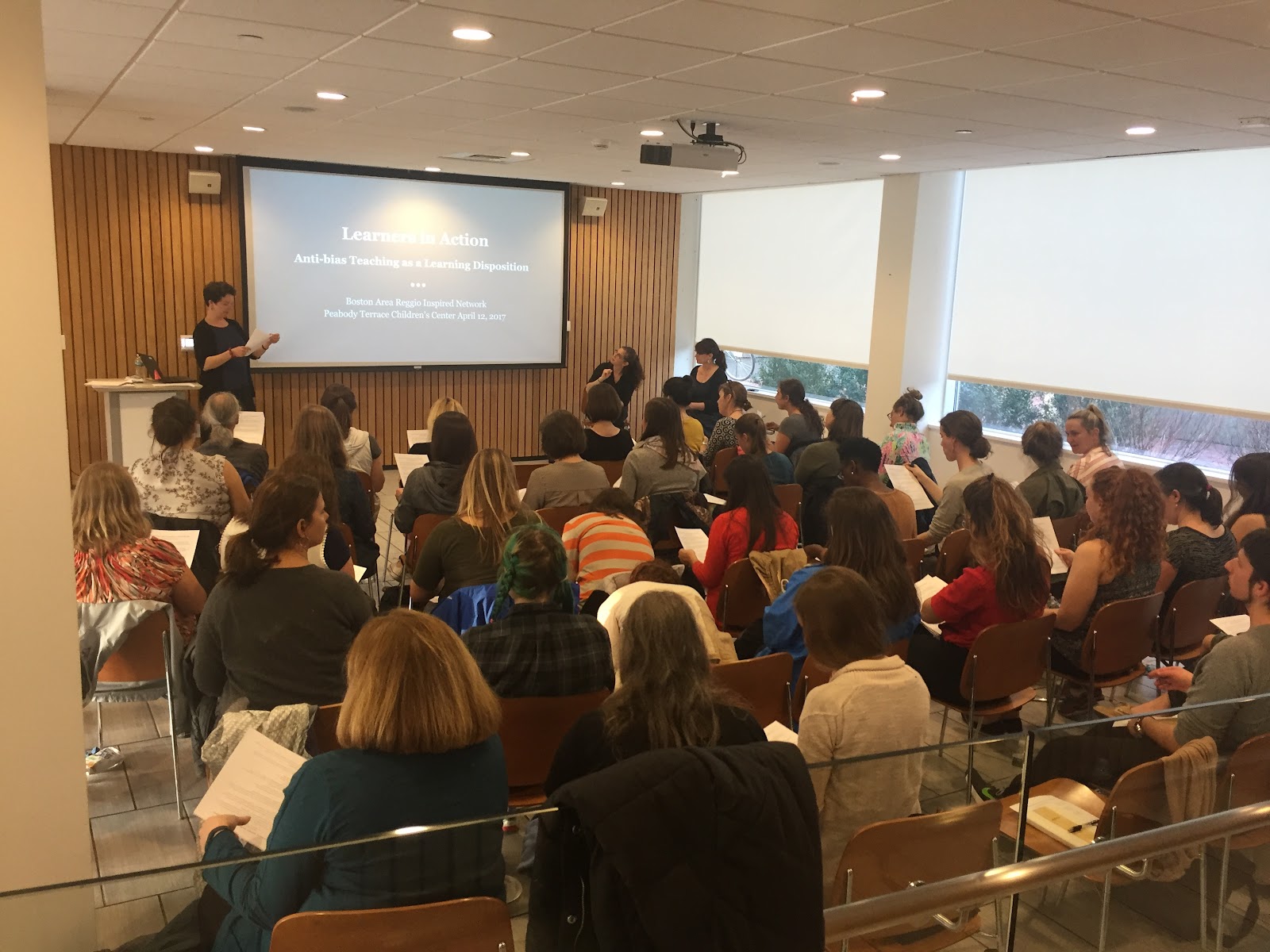
Anti-Bias Education is Not a Concept or a Skill, it's a Learning Disposition

Last Wednesday, we welcomed fifty educators as part of Boston Area Reggio Inspired Network’s 2017 series. We reflected upon how we’ve brought liberatory teaching into our own practice, and planned strategic next steps using Margaret Carr’s structured view of learning dispositions.


Learning Dispositions are “situated learning strategies plus motivation”.
-Margaret Carr, Learning Stories; Assessments in Early Childhood


Teaching and learning are situated within a specific group of people with a variety of identities and within our larger contexts; our classrooms, communities, nation and world. Anti-bias teaching starts out haphazard and ad hoc sometimes but before long we realize our work must be strategic to stay accountable to our goals. We are motivated to do this learning and teaching by its obvious urgency; children’s worldview, culture and safety can be at stake.


“Becoming is better than being”


Carol Dweck’s “process goals” and “performance goals” describe two different approaches to learning, and it is crucial that we are not perfectionists in the work of education for freedom. Dweck researches learners’ orientations to errors and other challenges. Learners with “performance goals” and a fixed mindset want to get it just right without effort. They want to “be” smart or strong, but dislike making mistakes, and feel uncomfortable with the struggle it takes to “become” smart or strong. “Process goal” learners have a growth mindset and seem to enjoy struggle, and recognize that good outcomes; the right answer, for example, or a new skill, come out of hard work and mistakes. They are willing to do what is needed to “become” better.


We can’t wait for anti-bias education until we are ready, worry about achievement or get it right the first time. We can only counter bias through the invaluable process of becoming more knowledgeable, more open, more awake, more willing to act and move through our errors with humility.  Because biases and unfairness are in the world, they are in our classroom and in us.  We will struggle and we must be ready to listen when folks tell us that we’ve made mistakes.


We need a view of learning that sees “development as the transformation of participation” (Carr, again, naturally). These domains take a process orientation for granted and measure that process through a narrative built of observations.


She identifies five domains of a learning disposition:
Taking an Interest,
Getting Involved,
Persisting with Challenge or Uncertainty,
Expressing thoughts and feelings and
Taking Responsibility.
These domains are a perfect way for us to understand our own growth as teachers for liberation.

Learning from History
Many years ago, I asked our mostly white staff to self-identify; whether they knew nothing, something or were experts about anti-bias curriculum. Everyone RAN over to the “experts” part of the spectrum. (I didn’t know what I didn’t know about people’s poor ability to accurately appraise themselves about things they don’t know much about, and I underestimated the personal drama of being asked to do it publicly.) People in the “expert” area explained themselves;  “I have an Asian neighbor.” or “I don’t see color.”

These folks were beginners, but they thought they were experts. I learned from my mistake; this time, we used Carr's domains as an objective yardstick to help us figure out what kind of learning we’ve done and what kind we are headed into.


After a short presentation about our collective journey with anti-bias education at Peabody Terrace Children’s Center, we used a protocol to create our individual narratives of engagement with anti bias education and reflect.


Then, we brought in the key element of feedback. We shared our stories with others and they helped us determine which of the learning domains we were working within. Finally, well-informed, we identified for ourselves what kinds of actions might help us move forward from where we are.


Domains of Learning Dispositions:
Learners taking an interest are developing:
  • A view of self as interested and interesting,
  • Interests,
  • Expectations that people, places and things can be interesting,
  • Abilities and funds of relevant knowledge that support their interests.
Learners getting involved are developing:
  • A view of self as someone who gets involved.
  • Readiness to be involved, pay attention for a sustained length of time
  • Informed judgments about the safety and trustworthiness of the local environment, Strategies for getting involved and remaining focused.
Learners persisting with difficulty or uncertainty are developing:
  • A view of self as someone who persists with difficulty and uncertainty
  • Enthusiasm for persisting with difficulty or uncertainty,
  • Assumptions about risk and the role of making a mistake in learning
  • Sensitivity to places and occasions in which it is worthwhile to tackle difficulty or uncertainty and to resist the routine.
  • Problem-solving and problem-finding knowledge and skills,
  • Experience of making mistakes as part of solving a problem
Learners communicating with others are developing:
  • A view of self as a communicator.
  • The inclination to communicate with other in one or more of the 100 Languages, to express ideas and feelings,
  • Responses to a climate in which learners have their say and are listened to,
  • Facility with one or more languages, familiarity with a range of context specific ‘genres,’ script knowledge for familiar events.
Learners taking responsibility are developing:
  • A habit of taking responsibility in a range of ways, to take another point of view, to recognize justice and injustice, a view of self and others as citizens with rights and responsibilities,
  • Recognition or construction of opportunities to take responsibility
  • Experience of responsibility, making decisions, being consulted, an understanding of fairness, strategies for taking responsibility
(Adapted from table 2.1, in Margaret Carr’s Assessment in Early Childhood Settings: Learning Stories)


As someone who thinks not only about individual development, but also about how our organization grows and changes, these domains also helped me to see which domain our center is exploring. We have firmly established interest, involvement, persistence and communication about anti-bias teaching. We are on the edge of taking responsibility; this is our next frontier. This framework takes for granted a "growth mindset" and in situating teachers' development within the realm of learning dispositions, it is my hope that teachers work to let go of their hangups that come with performance goals.
Does this structure help with some of the feelings of unsettledness, inertia, or hopelessness that sometimes accompany this work?

How could we use this way of understanding with families?