Showing posts with label welcome. Show all posts

Wednesday, July 3, 2013

"There are always things we learn when they ask questions of us"

Throughout the year students and teachers from around the world visit our center. Each year we host a group from Iceland, one from Japan and one from Singapore. We discussed this with Lella Gandini when she visited a few months ago and she asked 
"And why do they come?"
"Because we say 'Yes'?" said my director, Katy with a smile.
"and you say yes because there are always things we learn when they ask questions of us."

Of course, Lella is exactly right. We learn from their questions and from seeing our center through their eyes. Today I visited with some students of early childhood education from Singapore. They work at centers with the same age range that we do. It was a joy walking around with twelve young women as they peeked into classrooms, sat down to play with children, pored over our documentation, and pointed out details of our environment to one another.

Here are some highlights of our conversations together today:
  • I learned that it is very common for centers to be open there between 7 am and 7 pm daily "or longer, if they have parents who work late" said one of the students.
  • They were struck by the fact that we had male teachers. After some conversation about this someone asked if male teachers were allowed to change diapers, and told me that this was not allowed in their centers even in the rare cases that they have a man working there. "They can only teach a class, like maths." This is interesting, because of course, although male teachers are "allowed" here in the US, they are not the norm, and we have to work hard to recruit male teachers because we believe that children benefit from having men and women in nurturing roles in their lives. The students were all excited because they believe that child care teachers should be men and women, they'd just never seen a male teacher before.
  • After watching a dad spend snack time with his child's class during an extended drop off time, students asked questions like: "How long are parents allowed to stay in the morning?" and "How many days during the year are parents invited to visit the classroom?" It was clear to these students that we welcomed families, and it felt a little unfamiliar to them, but they were excited about it, too.
  • The students were lucky to come just days after our annual Showcase, so we had extra special and extra large pieces of documentation all over the center. They compared what they saw to the report cards that they issued to families at this time of year, and said that they saw "the whole story of each child" when they looked around our center. They marveled at pieces of documentation that welcomed families' collaboration. A couple who were familiar with Learning Stories were happy to see something familiar.
  • They were surprised that we don't take showers each day. Singapore, they told me, is so hot that children take a shower between lunchtime and naptime to cool off before they rest. The recent weeks have been so muggy, I felt envious when I heard this.
  • They were touched by how children talked together. "The children are so encouraging with one another!" they said.
  • They asked about our dress code, and were surprised that we are allowed to wear shorts to work.
  • "It is obvious how children's work is valued here." one said, reading the stories of the children of Toddler 1 North.
  • "Children must walk in and think 'This is the place where I belong!' every day." said one student.
Teachers also learn just from having visitors in their classrooms, not from what they say, but from their very presence. The observer effect in a classroom is one that usually results in straightening our backs, looking around at our classroom and imaging what another sees. I'm happy that in our center, this usually results in a sense of satisfaction for teachers, and an opening of blindspots.

How does it feel when people visit your classroom or workplace? Have you visited our center? What was your experience?

Wednesday, October 3, 2012

Why a blog?


Blogs are an interesting part of the internet. There are people who read blogs (me) and there are people who don't. Here are some questions people who don't read blogs sometimes ask me:
  • "What's the difference between a blog and a webpage? Or a tumblr?" 
    • Well, a blog is a kind of webpage that gets updated with words and pictures on a regular basis. Tumblr is a webpage where you can have a little blog that's not very long.
  • "Who reads this stuff?" 
    • That really depends on the blogger. Some people share their work with friends and family and others broadcast it to the whole internet.
  • "Why would you want a blog? Why not just send it in an email to the people you know? Or put it up on Facebook?"
    • Some people have a blog about a special topic, bikes for example, or yoga, or cooking. Or their vacation, or their baby, or the costumes they knit for their cats. A blog is a way for them to reach out to other people who share their interest. (Take a look on the right, under "Beautiful Blogs" for links to some of the blogs that Katie and I follow.)
    • Other people have a blog as a storage location; a place to keep their writing or photographs or big ideas.
    • Blogs can be community sites too. A blog with an active readership is like a cafe bustling with people who are interested in the same things. "Love Isn't Enough" is a blog I follow that is concerned with "raising a family in a color struck world". Readers there engage in real conversations about difficult topics. 
We've been thinking over the past few years about starting a blog, but we've also thought about not doing it; it's some extra work, it may go unread, like any regular practice, there's the possibility of failing to keep up. This year Katie and I decided that we are ready.

There are two parts of my work this year that will be served by a blog; making teachers' work visible, and partnering with families. I'll use this blog to document the documenters. Your teachers have spent years painstakingly putting together storybooks, powerpoints and beautiful slideshows about the work your children are doing; I'd like to use this blog to highlight teachers, their learning and their work. I'd also like to help families to learn more about what we mean when we say that we are inspired by the teachers and families of Reggio Emilia, that our curriculum is anti-biased, play-based and child-centered. I'll demystify some of our jargon and hopefully, I'll invite you into conversations in the comments about things that are important to all of you.

We can also use this blog as an archive. If we post regularly, then it will hold our ideas and our history for us to pass them on to later staff and families. If people wonder what the center used to be like, if we want to see how much we change every year (and we change so much!) we can look back at the blog. It can also help staff with our professional development. Currently, if we want to remember what article we read at the "Reggio Roundtable" we held about outdoor play and learning, or remember how that other preschool classroom dealt with a fascination with Pokemon, we have to ask each other, look back in old notebooks and try to remember. However, if we keep this sort of information on our blog, teachers can easily search and use our blog as a resource.

We hope that you enjoy reading this blog and that it can be helpful to our community. Please read it often and comment when you read so that we hear as many voices as possible.

-Kendra

Wednesday, September 19, 2012

Inserimento


"Inserimento"


I worked and studied in a center inspired by the teachers and families in Reggio Emilia for years before I ever heard the Italian word "Inserimento". I'd like to share it with you because I think it honors our mentors and heroes when we use their words. For instance, I'm the "pedagogista" (instead of the coach or coordinator) at Peabody Terrace Children's Center because I want to remind myself and our community that I am the intellectual descendant of generations of pedagogisti who have supported reflective teachers all over the world. And yet, I had never heard "inserimento" because it is associated with infant and toddler centers and I worked at a preschool with an after-school care for older children. In Italy, infants and toddlers go to one center and preschoolers go to another, and when a family first comes to childcare, they are embraced by the community; this is the process of inserimento.

Since families first started paying someone to watch children so that mothers could work childcare was viewed as a separation of mother and child. If this is the model, then child care workers have to try to lessen the pain of this separation, and help the child spend her time until her mother returns. Inserimento is another way of viewing this same situation. Literally, I'm told, it means "insertion"... We ask "How is this family added to the community?" rather than "How will these teachers substitute for mother?" For us, the process of bringing a child to the infant room is broadening her community, building new relationships upon the attachment that she already feels with her family. Our situation is one of addition instead of subtraction. In fact, inserimento is a process of teachers and families "opening oneself to others" (Bambini,114) not just teachers and children. The incremental way that we welcome families into our infant rooms, our home visits and extensive developmental histories, our documentation are all a part of how PTCC welcomes whole families into our community, builds trust and creates a classroom; how we do inserimento.

This tile wall is composed of the artwork of PTCC children over the years. It is a reminder to children and families that this place has its own history, that we are not the first teachers and families here and we won't be the last. We are part of something bigger than ourselves.
Unlike the centers of Reggio Emilia, however, we have infant, toddler and preschool classrooms. I have been looking closely over the last two months, as the children (and their families) all moved into new classrooms, with new teachers for evidence of our "never-ending process of growth, transformation and getting to know each other" (Bambini, 121). Comprehensive welcome packets, our piazzas, all about me books, family pictures and warm conversations in person are ways that the teachers of older children at PTCC continue the process of inserimento.
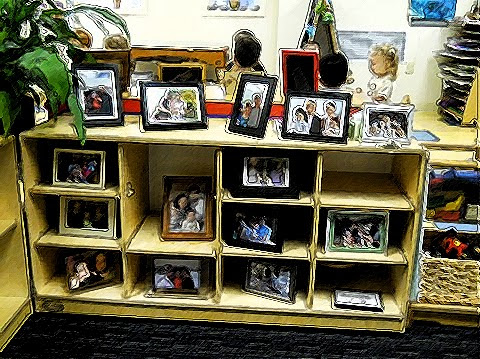
Family photos in many classrooms allow children to get to know each other's families and offer comfort to children when they miss their loved ones.
How do our families count?
When you thought about bringing your child to care, did you think of it as an additive experience or a seperation for your family? What has been your experience here at PTCC?