Showing posts with label anti-bias. Show all posts

Wednesday, May 3, 2017

Anti-Bias Education is Not a Concept or a Skill, it's a Learning Disposition

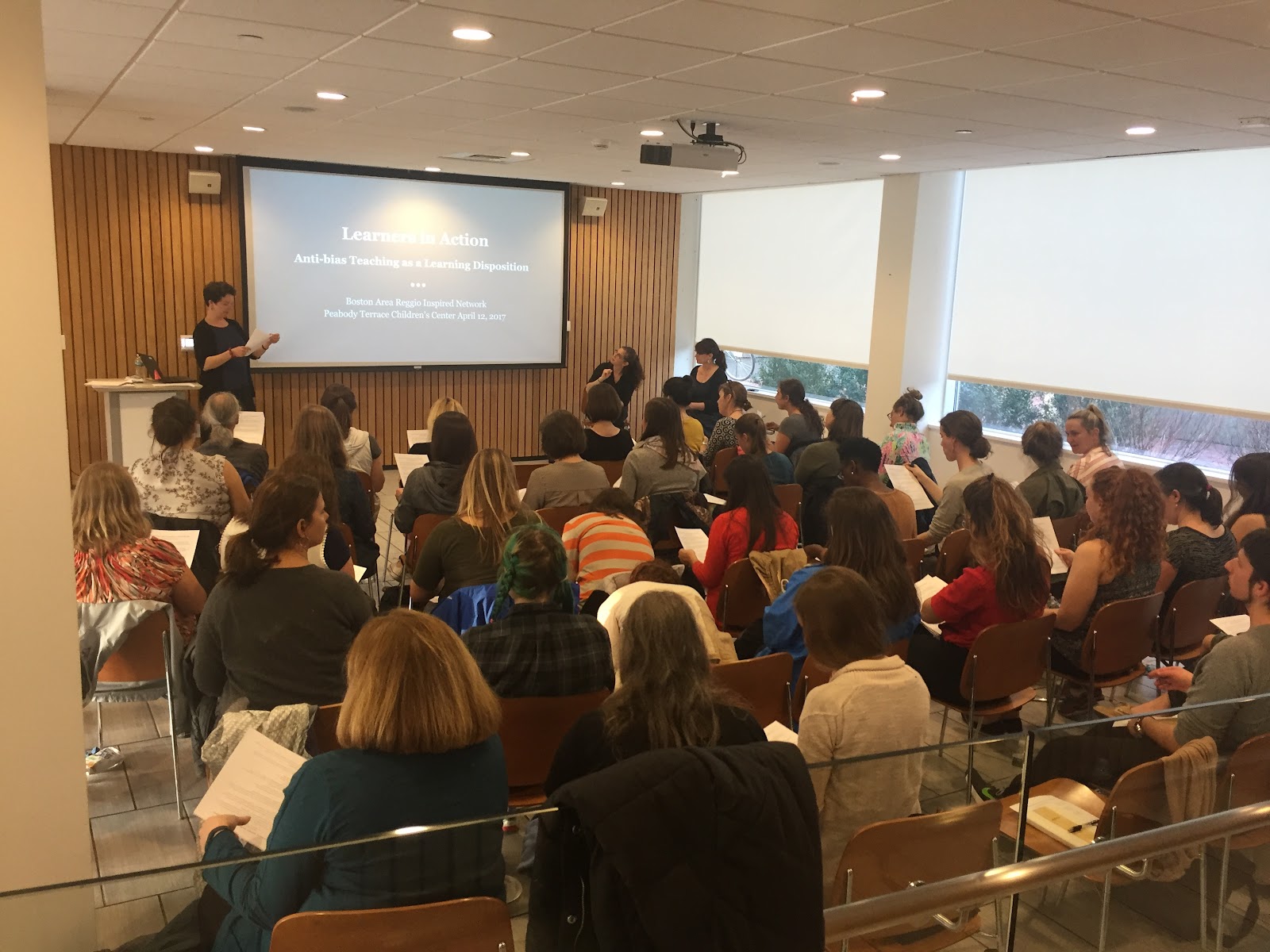
Last Wednesday, we welcomed fifty educators as part of Boston Area Reggio Inspired Network’s 2017 series. We reflected upon how we’ve brought liberatory teaching into our own practice, and planned strategic next steps using Margaret Carr’s structured view of learning dispositions.


Learning Dispositions are “situated learning strategies plus motivation”.
-Margaret Carr, Learning Stories; Assessments in Early Childhood


Teaching and learning are situated within a specific group of people with a variety of identities and within our larger contexts; our classrooms, communities, nation and world. Anti-bias teaching starts out haphazard and ad hoc sometimes but before long we realize our work must be strategic to stay accountable to our goals. We are motivated to do this learning and teaching by its obvious urgency; children’s worldview, culture and safety can be at stake.


“Becoming is better than being”


Carol Dweck’s “process goals” and “performance goals” describe two different approaches to learning, and it is crucial that we are not perfectionists in the work of education for freedom. Dweck researches learners’ orientations to errors and other challenges. Learners with “performance goals” and a fixed mindset want to get it just right without effort. They want to “be” smart or strong, but dislike making mistakes, and feel uncomfortable with the struggle it takes to “become” smart or strong. “Process goal” learners have a growth mindset and seem to enjoy struggle, and recognize that good outcomes; the right answer, for example, or a new skill, come out of hard work and mistakes. They are willing to do what is needed to “become” better.


We can’t wait for anti-bias education until we are ready, worry about achievement or get it right the first time. We can only counter bias through the invaluable process of becoming more knowledgeable, more open, more awake, more willing to act and move through our errors with humility.  Because biases and unfairness are in the world, they are in our classroom and in us.  We will struggle and we must be ready to listen when folks tell us that we’ve made mistakes.


We need a view of learning that sees “development as the transformation of participation” (Carr, again, naturally). These domains take a process orientation for granted and measure that process through a narrative built of observations.


She identifies five domains of a learning disposition:
Taking an Interest,
Getting Involved,
Persisting with Challenge or Uncertainty,
Expressing thoughts and feelings and
Taking Responsibility.
These domains are a perfect way for us to understand our own growth as teachers for liberation.

Learning from History
Many years ago, I asked our mostly white staff to self-identify; whether they knew nothing, something or were experts about anti-bias curriculum. Everyone RAN over to the “experts” part of the spectrum. (I didn’t know what I didn’t know about people’s poor ability to accurately appraise themselves about things they don’t know much about, and I underestimated the personal drama of being asked to do it publicly.) People in the “expert” area explained themselves;  “I have an Asian neighbor.” or “I don’t see color.”

These folks were beginners, but they thought they were experts. I learned from my mistake; this time, we used Carr's domains as an objective yardstick to help us figure out what kind of learning we’ve done and what kind we are headed into.


After a short presentation about our collective journey with anti-bias education at Peabody Terrace Children’s Center, we used a protocol to create our individual narratives of engagement with anti bias education and reflect.


Then, we brought in the key element of feedback. We shared our stories with others and they helped us determine which of the learning domains we were working within. Finally, well-informed, we identified for ourselves what kinds of actions might help us move forward from where we are.


Domains of Learning Dispositions:
Learners taking an interest are developing:
  • A view of self as interested and interesting,
  • Interests,
  • Expectations that people, places and things can be interesting,
  • Abilities and funds of relevant knowledge that support their interests.
Learners getting involved are developing:
  • A view of self as someone who gets involved.
  • Readiness to be involved, pay attention for a sustained length of time
  • Informed judgments about the safety and trustworthiness of the local environment, Strategies for getting involved and remaining focused.
Learners persisting with difficulty or uncertainty are developing:
  • A view of self as someone who persists with difficulty and uncertainty
  • Enthusiasm for persisting with difficulty or uncertainty,
  • Assumptions about risk and the role of making a mistake in learning
  • Sensitivity to places and occasions in which it is worthwhile to tackle difficulty or uncertainty and to resist the routine.
  • Problem-solving and problem-finding knowledge and skills,
  • Experience of making mistakes as part of solving a problem
Learners communicating with others are developing:
  • A view of self as a communicator.
  • The inclination to communicate with other in one or more of the 100 Languages, to express ideas and feelings,
  • Responses to a climate in which learners have their say and are listened to,
  • Facility with one or more languages, familiarity with a range of context specific ‘genres,’ script knowledge for familiar events.
Learners taking responsibility are developing:
  • A habit of taking responsibility in a range of ways, to take another point of view, to recognize justice and injustice, a view of self and others as citizens with rights and responsibilities,
  • Recognition or construction of opportunities to take responsibility
  • Experience of responsibility, making decisions, being consulted, an understanding of fairness, strategies for taking responsibility
(Adapted from table 2.1, in Margaret Carr’s Assessment in Early Childhood Settings: Learning Stories)


As someone who thinks not only about individual development, but also about how our organization grows and changes, these domains also helped me to see which domain our center is exploring. We have firmly established interest, involvement, persistence and communication about anti-bias teaching. We are on the edge of taking responsibility; this is our next frontier. This framework takes for granted a "growth mindset" and in situating teachers' development within the realm of learning dispositions, it is my hope that teachers work to let go of their hangups that come with performance goals.
Does this structure help with some of the feelings of unsettledness, inertia, or hopelessness that sometimes accompany this work?

How could we use this way of understanding with families?

Monday, November 28, 2016

Professional Development For Teachers/ By Teachers/About Teaching

At 9:00 AM, on our annual Day of Learning, 58 educators gazed around a circle expectantly, wondering about how they’d spend their day.
At 9:01 AM, a teacher stepped forward to write a question she wanted to discuss on a big piece of paper. Then another teacher stepped into the circle, then another, each sharing an issue that needed attention. Soon our agenda was full and teachers were off to their first session. No one told them what to do, where to be, or what to work on for the next three hours.

How did this come to be? First,  a little background:
For seven years, our teachers gather with educators from other centers for workshops and a keynote. We appreciate meeting and eating together, being inspired and celebrated. We’ve had some great workshops and a few incredible speakers. We’ve been satisfied, but we’ve also heard that teachers wish they had gotten more out of the day for a variety of reasons. Simultaneously, our directors are trusting teachers more to influence our shared pedagogy and share expertise with one another and others.

This year, we tried something different. We spent our morning in Open Space and our afternoon implementing the plans we’d made. We trusted teachers to co-create their learning the way that we trust children. We had already begun planning this Day of Learning, when I encountered Laurie Calvert's white paper "Moving From Compliance to Agency; What Teachers Need to Make Professional Learning Work." and I was encouraged by her words:
"constructivist theories are grounded in a body of research  that shows people
gain knowledge and meaning from the interaction between their experiences
and beliefs... for real learning to take place, the adult learners must be
both decision makers and the subjects — and agents — of their own learning. "

Harrison Owens invented Open Space Technology  by  to make workshops more like the coffee breaks in conferences, where he saw the most excitement. Open Space has facilitated whole school systems, corporations, unions, NGO’s, neighborhoods and other communities answering questions or solving problems that are big and urgent. Sometimes over a whole week! We sampled hour-long Open Space sessions at past Days of Learning with success and were ready to unleash the power of teacher’s hearts and minds making them the decision makers.
Generally, Open Space organizers propose a broad theme and then participants spontaneously co-create the agenda. Meetings are composed only of people who feel passionately about the topic, so conversations are energetic and lively, and the learning is deep.
Our theme was  “What Would Mr. Roger’s Do?”
In a world of learning standards, digital distractions and injustice…
How do we make room for play?
How do we nurture children's interior lives?
How can we model challenging bias and building a fairer world?
How can we offer children the compassion, humor, attention to detail and radical respect that Mr. Rogers did?”

We shared some of his work with attendees in advance, to whet appetites and educate some of our international staff's who were unfamiliar with Rogers. He and his work were our point of departure and inspiration for the day.

Here are a few of the sessions that teachers convened:
How can we advocate for peace in our classroom while honoring conflict and struggle?

How do we encourage self worth and positive body image in a world that’s constantly telling kids that they are cute?

How should we facilitate and make room for weapon play?

Given the bazillion necessary transitions in ECE classrooms how do we realize rich curriculum?

How can we become collaborators in children’s learning (rather than dictators, playmates, or silent observers) and still do everything we need to do everyday?

Sessions were filled with thoughtful teachers leaning across tables, talking quickly and excitedly or thoughtfully and deliberately, laughing, crying and creating new solutions and ideas. It was incredible to witness and it was facilitated by a very simple structure.

Open Space has One Law and Four Principles. Here's how they looked for us:
“The Law of Mobility” (AKA “The Rule of Two Feet”)
You can come and go at any time. You are obliged to move if you aren’t contributing or benefitting from the session. Pairing freedom and obligation has powerful results:
[In one session about racial justice, children and families] “I felt like I immediately messed up, and I really felt so raw and uncomfortable and I was like, ‘Oh my god, I have to leave because I don’t think I can challenge myself on this right now.’ But then I was like, ‘No no no, you’re staying.’ I could change my mind about that.”

“Usual PD, you have to sit there and keep your eyes open even when it’s boring.. The first session, was a hard topic to talk about. If I wanted to bail for any reason, I could leave and go somewhere else... but I didn’t, actually. I stayed.”

In a group of care-givers, this mandate to take care of oneself and one’s own learning was radical.

Whoever comes are the right people.
A preschool teacher and an infant teacher decided to bring their children together. Our center values cross-class collaboration, but a series of scheduling emails can’t generate the same level of excitement as an unstructured conversation. Instead of working to find commonality, two teachers wondered about the same question and shared inspiration which will inform their shared work.

Whatever happens is the only thing that could have.
Our Day of Learning was three days after the 2016 presidential election. Many teachers were worried about the outcomes for education, their health care, the safety of their bodies or the bodies of their loved ones. They’d been balancing their feelings with the crucial and absorbing work of care-giving. They needed to balance bringing their whole selves to work and leaving some of their strong emotions outside the classroom.

The group grieved, told stories,  shared worries and fears. They took turns witnessing and  supporting one another. When the hour long session was “over”, they knew that another group would be arriving to have a new session, but they were not even close to done. They trusted in the principles and moved their session outside for at least another thirty minutes. After exploring their feelings, the conversation became more solution-oriented.The group named ways to care for themselves and have a healthy boundary and then shared those with the larger group.

When it starts is the right time.
Only two teachers showed up for one session about how to ground curriculum in the natural world. Their talk ranged to a general discussion of the Reggio Emilia approach and both figured they wouldn’t get to the topic that brought them together. Three other teachers arrived twenty minutes later, and it was suddenly clear that the moment was right and their work was more powerful because it started when the conditions were right.

When it's over, it's over.
During our agenda creation, one teacher asked a great question, and others were interested. Later, those interested teachers must have chosen other conversations because the convening teacher stood by her question looking eagerly around. After about ten minutes, she left to find another session that interested her; and she brought the lens of her question with her to other discussions throughout the day. This flexibility comes naturally to many teachers who adapt throughout their work day.

Three hours after that first brave teacher stood up and picked up a marker to begin creating our agenda,  we heard from teachers about the day:
“This felt much more productive and thought provoking than other professional development.”

“This is the best day in my history of Day of Learning.”

“This validates what we do.”

“It felt great to navigate my own learning. There’s usually one agenda, and I could choose my learning today.”

“I really needed this today.”

“I’m grateful to be surrounded by so many people who are thinking critically, and reflecting and questioning and acting.”

After reflecting on our process and offering gratitude and appreciation for one another, we examined the next steps that each session offered. We indicated which we would be willing to spend our time and energy pursuing by adding checks and stars. (Each person got three checks and one star to “spend” to communicate their enthusiasm.) Some of the next steps were:

Creating a “family shelf” tradition to emphasize the idea that “Everyone has a culture.”

A new practice of “refreshing” morning provocations, or offering a new provocation in the middle of the morning.

Developing a habit of trying a few different approaches to offering materials to children.

Writing to legislators about our priorities for families, teachers and children.

Teachers from three different centers will create a blog whose audience will be the general public in order to raise awareness about the importance of social emotional learning in the early years.
Initiating a preemptive conversation about aggressive play styles and narratives with toddler families and teachers BEFORE their children enter preschool.

Each of these next steps COULD have been the outcome of a particularly moving workshop, but organizers would have to choose specifically the right presenters for the sixty teachers in attendance. Our humble, open-hearted director said “My question was “What do teachers really need?” and we answered it; You need time and space to process....” With Open Space, each teacher had the opportunity to grow and learn about whatever was most exciting (or upsetting, or curious...) to them. Staff alumni attended as collaborators and co-thinkers, not “presenters” . Everyone (directors too!) inhabited the roles of learner, witness and teacher flexibly. Teachers were given the afternoon to follow up on their initiatives in their teams, and they spent lunchtime sharing stories of their mornings together.
I recently had the pleasure of seeing James Noonan speak about his dissertation, and his words from a blog post entitled "Professional Development (and Teacher Agency) As We Know It" rang in my head as teachers departed at the end of the day:

"In my research, I asked teachers to tell me about their most powerful professional
learning experience and about a corresponding professional learning experience
that they “would like never to have again.” ... Among good and bad experiences I
found ones that were both expert-led lectures and decentralized learning communities,
school-based and external, content-focused and more cerebral, years-long and hours-long, pedagogically experiential and didactic.... I am increasingly convinced that agency is one
of the most salient distinguishing features of powerful professional learning. Indeed, of the
25 powerful learning experiences I studied, 21 involved some degree of teacher agency. Of
15 corresponding negative learning experiences, 13 were mandated. The contrast, while
certainly not conclusive, was striking and suggests to me that instead of carefully balancing
the scales between agency and compliance it is preferable to tip them toward agency."


Tuesday, January 6, 2015

Everybody Knows; Working with Our Commitment to Anti-Bias Curriculum


In the month of November, we recommitted ourselves to our anti-bias curriculum and teaching for liberation. Four years ago, our staff started a two year exploration into what it meant to create anti-bias curriculum in our classrooms. Teachers examined our biases and our privilege. We looked closely at systems and materials in our center and how they worked to support or counter the biases of our dominant culture. It was a deep, emotional collaboration and those of us here at that time will not soon forget what we learned. There are certain practices, norms and materials at our center that support this kind of teaching, but more important are teacher attitudes, habits and knowledge, so we worked on those in teacher provocations.

We have had some staff turnover since our first investigation of anti-bias curriculum. Many of our newer staff see the word “anti-bias” on our
website, see the poster of Louise Derman-Sparks’ Four Anti-Bias goals (letterpress printed by our atelierista, Katie Higgins-White!) that hangs in every room of our center, and they like the idea of teaching for justice.  None of this helps  these teachers know what to DO. This month we worked to see our work in the context of oppression so that we can make choices that lead to liberation. 

In many ways, teaching for liberation means questioning the things that we “know”.

An example; everybody “knows” it feels good to receive a complement. Complements are a way that many adults greet young children and build a relationship. When we begin to see how we broadcast our own biases, and learn how they affect the identities of children in our care, we want to counter some messages in our work with children. After we learn more we see how we are reinforcing stereotyped messages about gender. 

Suddenly, if we pay attention, we hear our complements differently.  We notice that we may respond to even the smallest babies with complements about their appearance when they think they are female babies and about their actions if we think they are male babies. (A most telling example of this occurs when an adult accidentally misunderstands a child's gender, and makes the "wrong" kind of complement.) We see that we are telling a story to a child about who they are when we complement them for being pretty, having a “cool dress” or being strong or funny. In fact, we’re colluding with most of the media that they’ll consume in telling them this story.

Our anti-bias practice requires teachers to notice these kinds of actions, to think about them, talk about them and try to build a new habit. Now we know that we can greet a child without a complement at all and wait to see what we’d like to say. We know that we are co-constructing children’s world with them, that we have tremendous power and that we can counter the dominant “story” in our culture that girls’ and women’s worth depends on our aesthetic value and that boys’ and men’s worth depends on what they do. We know that we must work to counter this stereotype and that it’s worth doing because it helps children grow up with a sense of worthiness connected to how they are in the world, what they think and what they do rather than how they look or behave.

At the end of the week, I’ll post about our provocations and describe how teachers defined anti-bias curriculum, we practice it at our center, and how we reacted to some stories of teachers and parents dealing with issues of difference and bias.

If you want to follow along, we listened to the firstchapter of an episode of This American Life about classroom discipline entitled "Is This Working?" And read “Holding Nyla” from the endlessly helpful text about doing education for liberation with young children, Rethinking Early Childhood Education, edited by Ann Pelo.

Where is your center on your anti-bias journey? What are you still working on?

Monday, June 30, 2014

Families at the Center, and Children in Public Life

The center where Katie and I work is called Peabody Terrace Children's Center, but we mostly call it PTCC. Peabody Terrace is a collection of towers of graduate student dorms at Harvard University built in the 1960's as "married dorms." This year we celebrated fifty years of child care at Peabody Terrace. While our organization hasn't been around for fifty years, children have been cared for in these spaces for fifty years.

When we talk to our colleagues from Reggio Emilia, they emphasize that their approach is a moral and a political one. They must remind us again and again because it's easy to gravitate toward the beautiful environments, respectful image of the child and use of art media as a thinking tool. And more difficult to think about child care as a political act. Universal child care in Italy was a part of supporting women's right to choose work outside of the home, and part of rebuilding the country after World War II. Child care at Peabody Terrace was part of supporting women's burgeoning role in academia, and the rights of academics to have a home life.

Children learning that mothers' lives can be rich, varied and include more than parenthood is a powerful part of their education about what it means to be a man, a woman, a parent or a teacher, and an integral part of our teaching tradition. In my first year as a teacher here, during a parent meeting about friendship, a mother whose husband is faculty at Harvard shared with us what it felt like to be a child growing up on a college campus in the 1970's, with a mother who was an academic. In these times, our institutions of learning are still learning how to support families, and we are proud to be supporting them.

It's said that this collection of rooms at the bottom of these towers were the first space on Harvard's campus designated for children. This is also a political value that we share with our Italian friends; that children are part of public life. This year we've walked together with children up and down the Charles river hunting for sea monsters, talking with community workers, flying airplanes from upper story windows, visiting the acclaimed American Repertory Theatre or observing the habits of local birds. When we make these sojourns, we are continuing the story of childhood at Harvard, making our learning visible to passers by.

This short article describes a little bit about the history of childcare here at Harvard (and Radcliffe) and our relationship to it. For those of you who follow our blog, it may be helpful for you to know more about the context in which we operate. Check out these photos and how universal some aspects of child care are. Here at Peabody Terrace Children's Center, we let children learn through their play and so we don't look that different on the outside than we did in the 1960's.

Wednesday, December 5, 2012

Boys ironing and girls shooting nerf guns


Many of us have been spending time online or in stores shopping for gifts for loved ones lately. Much has been made of the "gendering" of toys, the color-coded packaging, the narrow boxes of behaviors that boys and girls are welcome to enjoy. The degree to which EVERYTHING is proscribed in this way can make even the most open-minded parent feel funny about shopping for their child in the "wrong" section.

Well, a Swedish toy manufacturer has done something really unusual. They published a catalog (filled with toys made by Toys 'R Us) that has pictures of boys and girls playing together with every toy. Click here to see some images. This was done voluntarily, but, according to the Wall Street Journal's blog, the toy store had been criticized by the national ad regulator for contributing to gender stereotypes with it's catalogs in the past.

Have you bought your child a toy that has been assigned by our culture to the opposite gender? How did that feel to you? How did your friends and family react? I think that changes like this one could take some of the pressure to follow "gender rules" off of us when it comes to getting toys for our children.

I wonder what would happen if we shared these photos with some of our older children. (Preschool teachers? Are you game?)

-Kendra

Wednesday, October 24, 2012

Anti-bias work at the costume shop


At PTCC, we create "anti-bias curriculum". This means that we have four goals to help children counter the biases they encounter in their lives. The four goals are:

1. Each child will demonstrate self-awareness, confidence, family pride, and positive social identities.

2. Each child will express comfort and joy with human diversity; accurate language for human differences; and deep, caring human connections.

3. Each child will increasingly recognize unfairness, have language to describe unfairness, and understand that unfairness hurts.

4. Each child will demonstrate empowerment and the skills to act, with others or alone, against prejudice and/or discriminatory actions.

(These goals were originally written by Louise Derman Sparks in her book "Anti-Bias Curriculum for Young Children and Ourselves" and are excerpted from a pamphlet by the National Association for the Education of Young Children.)

Edit: A thoughtful parent challenged the way  these goals are phrased. He mentioned that it language sounds final, as though once one is finished with these goals, dusts off one's hands and congratulates oneself, even though what we're describing is a life long journey. I want to say thank you for this feedback, and agree. We are never done with this work. 

Teachers and admin staff here at PTCC are always working on these four goals with one another as well! We work hard to see injustice and to listen when someone brings it to our attention and to change it to the best of our ability. Thanks for the feedback!

At PTCC we sometimes summarize these by saying:

1. I'm okay.
2. You're okay.
3. That's not fair!
4. Let's do something about it.

There is SO much to learn about anti-bias work, and about how we form and counter our own and our children's biases. Today, I'd like to share a short video about these issues that  focuses on Halloween costumes.


The "What Would You Do?" series is really enlightening and tackles issues of  interpersonal issues of homophobia, sexism and racism in a way that is easy to talk about with other people.

In this episode, there's so much! We often define our selves and others by what we wear. Questions about gender and sexuality are addressed by moms in just a few subtle sentences. I wonder how their words sound to the child?

When we listen to the last woman who intervenes, I can hear her modeling all four of these goals for the little girl. Can you? I think that this story isn't a simple one, even though a seven minute segment can make it seem that way.

What are your thoughts?
How does your family talk about Halloween costumes?