Tuesday, February 16, 2016

Schema Theory; Following The Threads of Children and Teachers

“There’s a thread you follow.
It goes among things that change.  
But it doesn’t change.
People wonder about what you
are pursuing.


You have to explain about the thread.
But it is hard for others to see.
While you hold it you can’t get lost.”


From The Way It Is by William Stafford


January’s teacher provocations unpacked Schema theory. This theory recognizes repeated patterns in children’s play as threads that connect children’s learning over time. Most of us have encountered a child who throws everything they can, who spends lots of time on the swings learning how to jump off, and who watches an airplane move across the sky. This child might have a “ trajectory” schema. Children who fill buckets or bags and make deliveries may have a “transporting” schema. These two examples are physical presentations of schemas, but someone with a circular or rotational schema may enjoy spinning things (and themselves) and enjoy drawing circles and thinking about how a jet engine, a bicycle pedal or a Ferris wheel works. For some depth on schema theory, look here. For a practical chart to help you start identifying and planning for schemas, check out this chart and remember this is NOT a comprehensive list. There are as many schemas as there are children.

Thinking about children’s play and work this way helps teachers and parents take a new look at repeated play behaviors and see them as constructive, engaged learning actions. (Sometimes adults find themselves stumped or irritated by repeated behaviors and this perspective can help us identify the learning taking place even as the child is pulling all the toilet paper off the roll, or covering their arms and hands with paint.) Teachers can use our knowledge of individual children’s schemas to carefully prepare our provocations to support the ways our children are learning. Story cubes can help a child with a trajectory schema in co-creating a narrative, adding pieces of fabric to the block area might intrigue a child who has an enveloping schema.


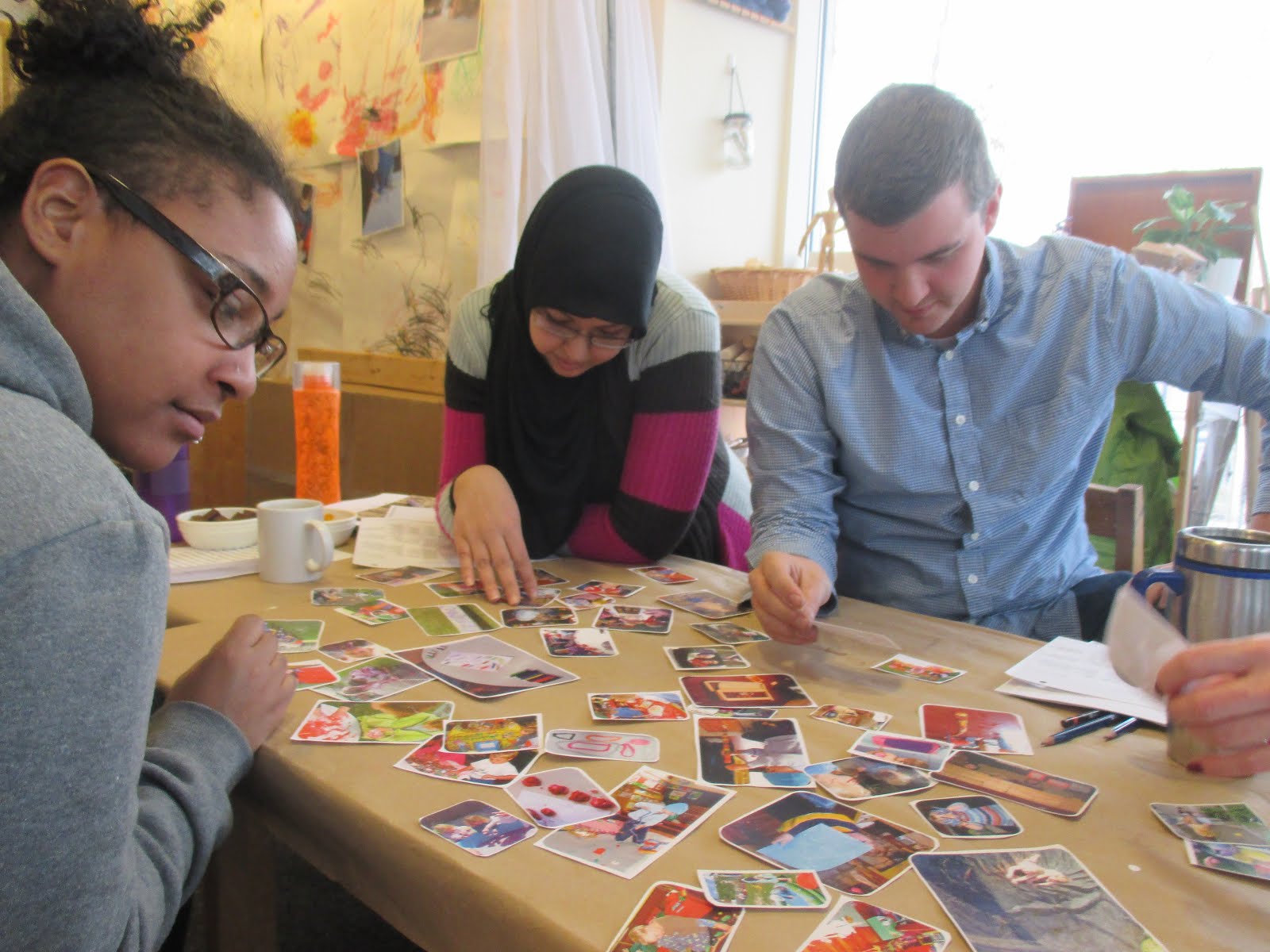
Unlike many topics we explore together, this one was, for the most part, an unfamiliar concept. We did some reading from Getting Started With Schemas by Nikolien van Wijk (a book I bought in New Zealand where schemas are more commonly used to understand children’s play and work), and from other sources. We sorted photographs of children’s play by schema, drew stories of schemas we see every day and as we worked, we talked.

Over four meetings, I began to see threads of common understanding in how teachers constructed this idea of schemas and how they fit into our work. I think that some of these threads may be abstract schemas, habitual ways of considering new ideas. I don’t have enough evidence from these meetings to identify the repeated patterns for individuals but overall I heard teachers folding this new information into their existing expertise in a variety of ways. I’ve grouped them here to demonstrate the many different ways to consider new ideas about our work, and to demonstrate the parallel tracks our professional development and our teaching of young children can take.


Analyzing: Some teachers took apart the theory of schemas, looking at it from different angles.


“How does adult... interest or [action] impact a child’s schema? How does the child react to being seen this way?”


“I sometimes wonder, is that [repeated behavior] keeping them from doing other things? But I guess that is the thing, actually.”


“I’m becoming very aware of children’s and adult’s agendas.... I’m not attuned enough yet to see a pattern, but I see how schemas could help me see children’s agendas more clearly.”


Considering development: Some teachers fit the concept of schemas onto their preexisting knowledge of how children change and grow.


“It’s hard for me to see a schema NOT as something that naturally comes after one stage and before the next.”


“As kids get older it’s easier for me to see how much attention they can give to one thing.”


“How do I learn a child’s schema without being influenced by stages of learning?”


Self-reflecting: These teachers thought a lot about how their emotions connect with what they learned about schemas.


“Why does this behavior bother me? Why does it matter if he fills a bucket every day?”

“This helps me to reframe what I take for granted in children’s play.”

“Developing curriculum in this way challenges me to think about why I say no, make rules.”

“When I can put myself in a child’s shoes, I’m better able to teach. This is another way to do that.”


Questioning: These teachers tend toward big questions, and their learning about schemas catapulted their thinking into philosophical directions.

“What makes different kids develop different schemas?”

“What is the nature of learning?”

“So... schemas are always patterns but patterns are not always schemas, right?”


Strategizing: Some teachers rolled up their sleeves and immediately considered how this theory would function.
“This is a way of watching a child’s focus; not on one idea or activity but across themes, across materials and activities.”

“What a wonderful way to think about redirection... and about continuing in a direction!”

“Kids in my class are fighting, are being powerful and dominating one another. I’m not sure what schemas they’re exploring but I’ll take notes.”

“It’s a way of saying yes, which my team is trying to do right now. We notice and then say "Let’s find a way to make these things happen”.

“It’s a helpful way of getting to know new children.”


It’s important for me to note that these are not transcriptions of conversations. I sifted four different 90 minute conversations into these categories. I looked for patterns in the same way that a teacher looking for schemas will. Sometimes two people with different threads spoke to one another. It was challenging, but teachers here are used to communicating despite differences. Just as children with different schemas can be invited to play together by carefully designing provocations, adults with different approaches to new ideas can be invited to talk about them through careful provocation. The variety of activities (group text study, conversation prompted by quotations, illustrating a narrative, collaboratively sorting photos by schema) provided allowed folks with different preferred threads of investigation to connect.

Self-reflection is a teaching skill. The more we can see our own thread, the better we can find them in the work and play of others. Which of the above resonates with your way of wondering?

How do you see this kind of work happening with the third protagonists, families? What threads of habitual thinking do they hold through a variety of different experiences?

Friday, November 6, 2015

Learning from Experience

Each day I set out materials and plan experiences for children of many different ages. There are always many variables at work during any given visit, and I never know exactly how things will go. Sometimes I am frustrated if the set-up does not prove as inspiring as I had hoped, or if children need a lot of help and reminders to respect the materials that are available.  I start to feel like a failure. However, even in those moments, the children’s actions and reactions hold the seeds for a way out of those feelings, and into more successful set-ups the next time.

Throughout the autumn, each session in the Studio is an opportunity for children from a classroom to familiarize themselves with a particular material, as well as the Studio space itself. For young toddlers, most of this experience lies in “messing about,” where materials are set out with minimal guidance or instruction. Preschoolers and older toddlers will experience this, as well, but may move on to learning particular techniques that will help them to use the material with more finesse.

For example, Preschool Two moved from
open experimentation with clay on tables and on the floor,
to learning about scoring and adding slip,
to opening, pinching, and attaching pieces of clay using the score and slip technique,
to creating sculptures modeled on hydrangeas, black-eyed Susans, and asters set out on the table.

This process required learning from me, my fellow teachers, and the children. Each time a small group worked in the Studio, I learned something about their thinking and understanding of the clay. I learned what aspects of the day’s work they found challenging and what parts they were able to connect to what they had done before. This new knowledge helped me decide what changes I should make when I worked with this group or others.
 
For example, we practiced the method of scratching and wetting the surface of the clay to attach pieces to each other. Since we moved right into this method when we sat down, the children began to join pieces of clay without really shaping them. They weren’t very invested in their work, and they didn’t notice the shape and potential “being” of their clay. I realized that for them to gain the practice and skills I was hoping for, we would have to approach the problem a little differently.
For the following groups, we started not with joining pieces, but with making shapes from the clay. Children were very confident in creating long “snake” shapes, and balls, and soon they had many pieces to choose from. Now was the time to work in the joining process. The children already had their pieces shaped, so joining them together became an opportunity to form something new. The experience this time around was much richer. Nava and Everett both began to experiment in forming symbols from their clay pieces. M. made several snakes that she lined up “like a train.” Phineas joined his snake shapes into a single long path that curled around his board.

Encouraged by this, I incorporated this successful process into the following week, where children spent time opening a large piece of clay together, creating a communal base that they could then add pieces onto using the same techniques we had been practicing.

The creations that children came up with were amazing! Their blocks of clay transformed into sidewalks, then houses, then waterparks! They began to attach their clay in more careful and intricate ways, creating bridges and waterspouts. One group – featuring Justin, Phineas, and F. – decided very early on that they wanted to create some sort of building together.

“I’m making sewers,” Justin said as he dug holes near the bottom of the mound, “I’m making a place to catch the rain so the house doesn’t get ruined.”
Phineas began to attach a long snake near the top, “This is the thing that makes the lightning so it doesn’t hurt the house.”

When we reached our session of recreating flowers in clay – our chance to put all of our knowledge of this material together as we examined these specimens of the natural world – I could see the children’s previous experiences come into play. At first they made the parts of their flower – sometimes the stem, sometimes the petals or leaves – before thinking about how they would join them together. Luke, who was making a black-eyed Susan, rolled a single long snake that he broke into smaller pieces for his petals. Phineas worked to shape his leaf for the same plant so that it “bends” just like the one on the real plant.  

Some children, like Nava, E., and Luke, sought to make their flowers stand up, while others lay them flat on their boards – each technique bringing its own unique challenges. They carefully went through the steps – score, wet, push together, and smooth – for each piece that they joined, clearly invested in making something that would hold together.

Many of the children began with the black-eyed Susan as their muse – the flower they declared to be the “easiest” to make. One particularly satisfying moment for me as a teacher was when Everett and Phineas had each finished this flower and decided to “try” to make another – the hydrangea – with its small, round petals. Everett even went on to do the “hardest one,” the aster, complete with “all of those spiky leaves.”

Thinking back to our first attempts at attaching clay pieces to each other, I was grateful for what the children had taught me in teaching them. Working alongside them, I had learned to slow down, think first about shaping the clay, then about how it should fit together, before moving on to the actually joining process. The children’s growing confidence in their work was a testimony to their own learning, as well as my own.

Each class is broken into many groups and each group comes for the same general experience in the Studio. But I know I would not be doing my job as a teacher if I offered each group exactly the same experience. I am always so grateful to the first group that comes, because they help me to see what works and what doesn’t about how I have planned, arranged, and introduced the day’s session.

Sometimes the smallest tweak in a set-up can make it more inviting, and the slightest re-structuring of a material’s presentation can help children to embark on a new relationship with it. Those moments of so-called failure can often be the best moments for learning, because they force you to think even more deeply about your own reactions and the reactions of the children you observed, just as the tumbling down of a child’s clay structure invites them to consider new and better ways to build it. Art educator Jessica Hoffman Davis believes that one of the best arguments for keeping arts in our schools is that they offer “the chance to have daring, edgy, generating, and important encounters with failure… For artists, mistakes open doors for their work.” I would say that perhaps the same goes for teaching. Teaching is not (and should not be) about getting everything right the first time. It is about the “generative” process of learning from and growing through our failures, and seeing them for the amazing teachers they are. 

"In Defense of Failure" by Jessica Hoffman Davis, EdWeek, October 8, 2003.

Tuesday, September 29, 2015

"It was delightful to play. I should do this more."

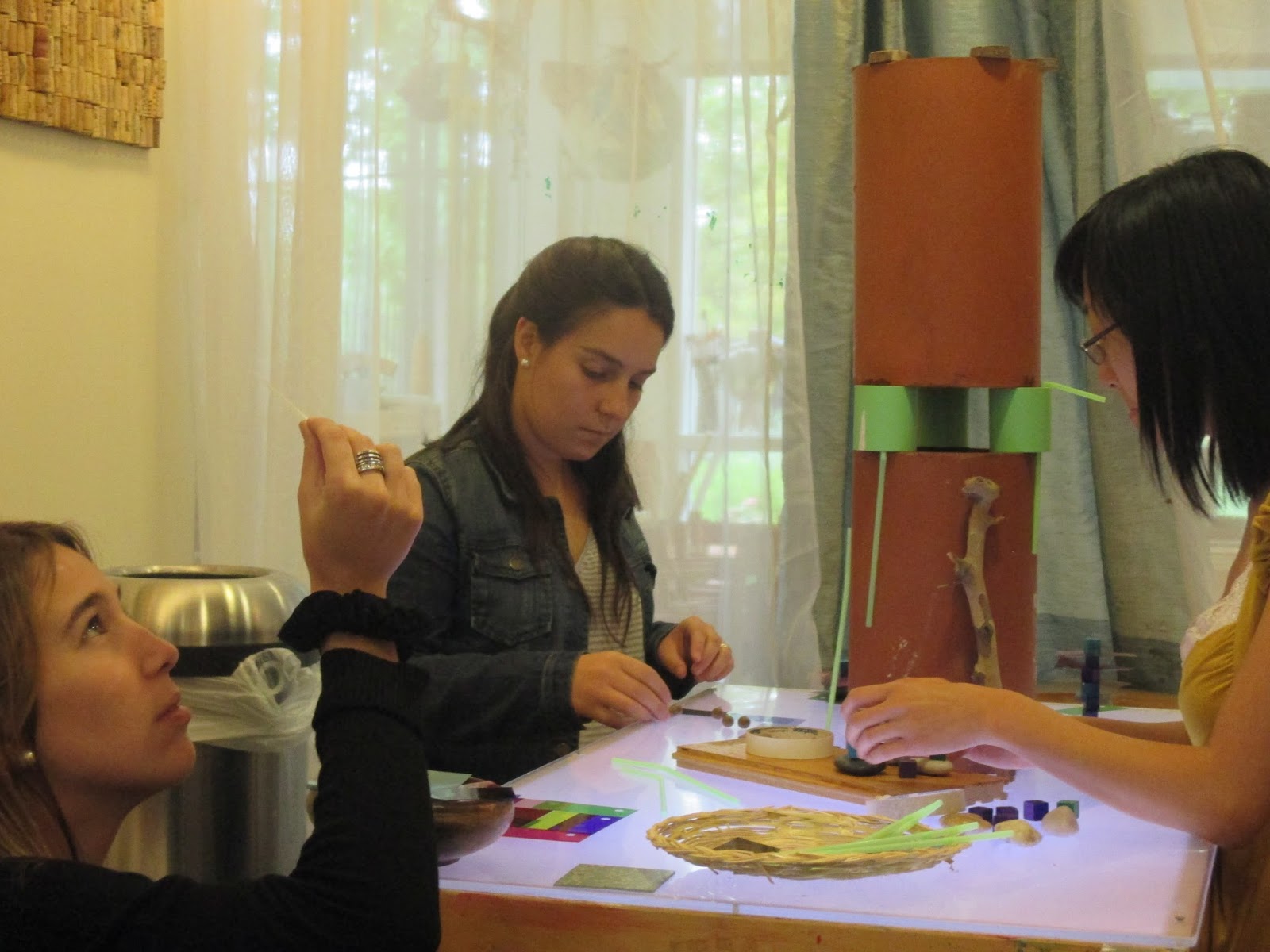
We just finished our first set of “teacher provocations” for the year. During these four weekly workshops, teachers
  • developed their own relationships with some of the more open-ended “loose parts” we’ve made available this year
  • gave and received immediate feedback on their work
  • practiced thinking about provocations and materials through the lens of our “Materials Values”
  • got an opportunity to play and take on different roles with one another

This year, our center-wide intention is to “explore our relationships with materials through research”. August’s teacher provocations provided opportunities for teachers to research through direct experience, observation and reflecting with a protocol. Our time together had four parts which relates to the cycle of inquiry that we use to drive our curriculum; provocation, play, reflection and provocation.

Provocation.


I invited the first three teachers who arrived to step behind a curtain and set up a provocation from an array of loose parts that were provided. Teachers at these provocations are from all over the center, so they had to decide what age(s) to design for, and often had multiple provocations to serve a variety of ages.

Later one of them told me; it was just like in the mornings at school: 
"I noticed my desire to quickly do it so we could get done and we could come and sit down with the rest of you."

Other teachers told us they felt inspired by setting up with one another. They improvised and then were inspired by one another. Many had to play with the materials a little bit as they set them out. "I had to construct and deconstruct a little bit before I could set things out."

While they worked, other teachers arrived and we reflected on our experiences with materials so far this year. We used “Rose, Thorn and Seed” to describe a positive observation, a challenging or painful observation and something that we’re looking forward to. These reflections are specific to the first few weeks of the year, and capture a moment of excitement and transition.

Rose:
Serena, a floater teacher "It's visible, the intention that went into choices of materials in each classroom...the simplicity in classrooms. It's refreshing and it puts the focus on relationships."


Cynthia: Our room represents everything we wanted it to, and it consistently looks cool and interesting. The materials are being used everyday.
Thorn:

Emma: We are still in the exploration phase, so there can be micromanaging to make sure things are used properly.


Kerry: Our napping schedules are making it hard to be in the classroom together and use materials on the light table for example.

Seed:
Carmel: I'm looking forward to incorporating the music and dance background these children have from [last school year] in what we're doing with materials.

When our “provocateurs” were through, they joined us. Three more teachers volunteered to...

Play!


The provocations and the play varied widely over the four weeks. Teachers explored with their senses, constructed two and three dimensional creations, created kinetic sculptures, catapults, ramps and devised collaborative and competitive games. While three teachers played, the rest of us observed and took notes.

Dolores: It was delightful to play. I should do this more.

One teacher noted that observation was easier in this setting, she had nothing else to track or do. We wondered how to make our time in classrooms feel this way. 

We also noticed that as observers in this contrived scenario we didn't interact at all. In a classroom with children we might offer materials as a way to reinforce our concept of the provocation, or pick up acorns rolling across the floor. In some ways this teacherly behavior may have helped the players, and in a lot of ways, it may have interrupted or subtly restricted the play. It was a good experiment for all.
We then sat together and used the "See, Think, Wonder" protocol to examine our observations. We this tool use often, and we considered what kind of learning and exploration was present in the play we witnessed, and planned to support it. 

We SAW 

  • blowing, dumping, crushing, throwing, building, balancing, shaking, examining, sucking an acorn through a tube
  • the irresistible draw of the light table. Even when the materials weren't specifically translucent, the table pulled players in
  • one group finishing their work before moving on to another part of the provocation, others  jumping back and forth
  • collaboration play a role in each group of players, but the amount and quality of the collaboration varied widely. (In one group, only when the action of moving something heavy REQUIRED cooperation did the group work together. In another, teachers competed with one another in a catapult game; and celebrated one another successes.)
  • teachers collect items from one table or offering and bring them to another table or part of the provocation. This is something that can sometimes frustrate preschool teachers, but they saw that even adults who create provocations were drawn to use materials in ways that appealed to them.
We THOUGHT
  • one teacher thought she recognized that the different players had play styles that related to what she knew of their personalities
  • it might be interesting to have kids play with the same materials in the same provocation that teachers did
  • one person's work influenced the next person who worked there
  • open-endedness led to creativity and collaboration
  • Katie records our thoughts.
  • teachers seemed most drawn to aesthetically pleasing materials
We WONDERED
  • how children's creativity impacts our planning; children will follow an acorn on the floor and next to the wall and start playing there; abandoning the project they were doing when the acorn dropped
  • how we can set up provocations cooperatively (teachers enjoyed doing this)
  • how the presence of authorities/observers impacts play

Finally, equipped with our observations, thoughts and questions, three more teachers stepped behind the curtain to create provocations based on our observations and intentions to extend the play we saw.

It was satisfying each week for the larger group to check out these "next step" provocations (unfortunately we didn't have time to play with them). They often solved a "problem" that came up during play, or they set up an experiment to test a theory, or answer a question. The second provocations were refined, clearly related to and inspired by the intial provocations, but with a new style and a different sense of purpose.

This time together allowed us to celebrate where we are right now, and to practice skills that support us as we help children "think what they need to think in order to learn what they want to learn" (Verbs, by Tom Hobson). Many teachers used this provocation with families at parent night in one way or another; to give them the opportunity to play, and to see first hand the cycle of inquiry we use to plan child-centered curriculum. They also helped us to get some new information about the loose parts and other open-ended materials that we've been using this year; the kind of information we can only get through direct experience, careful observation and collaborative reflection.

Where do you get direct experience that informs your work?

How often do you get to play?


Thursday, June 4, 2015

Building Skills, Building Confidence, Building Comraderie

Too tricky, or not too tricky,
that is the question.

Nathan, Kevin, and Kai are builders extraordinaire. They build on the floor and on tabletops. They build amazing cities using blocks both big and small.

When Seana told me about the city-building these three were working on, it immediately sparked an idea – a observational “city drawing” walk around Cambridge.  We would bring sketchbooks and thinking markers as we walked around in search of interesting buildings and other pieces of architecture that might inspire them. Observational drawing walks are some of my favorite things to do with children – I love opportunities to connect with our greater community – so I was pumped!

For our first walk, it was just me, Nathan, and Kai, because Kevin was out that day. As we began walking, one of the first things the boys noticed was the footbridge that crosses the Charles River near our school. We sat down on a bench so we could observe and draw. While Kai began work on the bridge right away, Nathan did not even take the cap off of his marker. Instead, he pointed out things about the bridge, especially the lights.

“The bridge has lights on it. Did you know at night it’s dark, so the red lights show you when not to go and the green lights show you where you should go… look, see the lights? Do you have room for the lights?”
Do you want to draw the lights of the bridge?” I asked Nathan.
He shook his head, “That’s too tricky for me.  I want to draw something easy.
What makes it tricky?” 
Look there are so many parts to it. I can’t do all of those.”
“What if we started with just one part? Which part would you do first?”
“Nah, it’s too tricky.”

Similar conversations occurred at several other points on our walk. While Nathan was comfortable drawing street signs and other “easy” things he saw, when it came to drawing something as complex as a building, he felt overwhelmed. As a teacher and an artist, I felt an internal struggle. Nathan was clearly drawn to the different street signs we saw –he was constantly pointing them out – so should I let him keep drawing these without pushing him to take on one of the “tricky” things? My finer feelings rebelled against this. After all, isn’t it part of my job, as a teacher, to challenge my students, and to help them through those moments of frustration in surmounting that challenge? The question then became, “How can I help Nathan to move out of his comfort zone with his drawing and find confidence in taking on a “tricky” task?”

The opportunity came when we crossed a second footbridge over a road. As we sat down on some concrete benches, Kai immediately pointed out a building he wanted to draw and set to work. Nathan looked around, considering a construction site in view. He began to make some strides as he started to draw parts of the site with prompting from me – a ladder first, then some of the beams around it. After this, however, he returned to drawing the signs he saw, including one that pointed to the bridge we had walked over.

Maybe you could draw the bridge, too?” I suggested.  Nathan shrugged, “It’s too tricky.” “It might seem very tricky now, but as we get more and more practice, drawing tricky things gets easier and easier,” I said. “I know that,” he said.  I smiled and turned around to face the bridge, “So let’s try it! I will help you think about what you need to do to draw that bridge.”

We sat side by side, looking at the bridge. “What is the shape of that bridge? That might be a good place to start,” I suggested.  Nathan drew an arching line to represent the bridge. I looked at his drawing, then back at the bridge. “Yes, that shape looks a lot like the part that we walked down,” I said pointing at the bridge’s curve.  "Let’s see, what else does the bridge have on it? What helped us as we walked over?” Um, the railings?”He added these, too, as well as another section of the bridge that we had walked on.  “What else do you see?” I asked, to which he answered, “I don’t know.” I looked again, saying, “Whoa, I see something under the bridge that I wouldn’t expect to be there.” Nathan followed my gaze, exclaiming, “Doors! That’s so weird! And a window in between!” He began to add these to his drawing. Kai, who was still hard at work adding multiple windows to his own drawing, looked over at Nathan’s work in progress, then at the bridge. “You need some stairs,” he suggested.  Nathan added some lines on one side for the steps. “How about that?” Kai nodded, “That’s good. You’re doing it!” Nathan looked back at his work, “It’s kind of like a ladder. Done!”  “Wait, the other side, too!” Kai reminded him. “Oh yeah!
I held up Nathan’s finished bridge so he could see it in comparison to the real thing. “What do you think?” I asked. “Good,” he said, smiling.


. . . . . .


Kai's drawing of the "100 Building"

We went on a second walk a little over a week later, with Kevin and Seana joining us this time. Instead of venturing along the river, this walk took us into the neighborhoods along Banks Street and down Mt. Auburn Street.  Our first stop was to draw the area around what Kevin called, “the 100 building.” Kevin and Kai both set out to draw the building itself, while Nathan once again demurred, returning to his old saying, “That might be tricky, I might look for something easier for me.” 

However, rather than simply choosing a street sign, he decided to draw the garage that was next to us, with its large doors and emergency light. After he finished, he decided to move on to drawing a street sign, which he identified as a “no parking” sign. Rather than just drawing a line and a rectangle, as he had on our last trip, he began to add some details of the sign itself – an arrow and the words “NO PARKING.” Unfortunately, his first sign was too small to hold all of the letters, so he started over on a fresh page, making use of Seana’s suggestion that he write the words first and draw the sign to fit them. As he worked to decipher the order of the letters, Kevin and Kai both began to chime in to help him. “Is the next one an R?” Nathan asked, “Yep, it is an R, and then a K, like my name,” Kevin replied. 

We saw many other interesting sights along the way, including a church with a crucifix on the front, which Nathan described as a man “made of stones, holding a bridge, and dancing.” But our final stop was one of the most interesting. It was the Harvard lampoon building, which is not only situated on its own in the middle of the street, but is also architecturally very striking, with a rounded front, stained-glass windows, and flag poles protruding above the door. Nathan’s first remark upon seeing it was, “What a beautiful door!” As Kevin described it, “It’s funny to me, because it’s not very high. That’s a short building (next to it), but this one is even shorter, and it’s right in the middle of that road.”


All of the children recognized that drawing this building was going to be a challenge. There were so many parts! And what an odd shape! I sat next to Nathan, wondering what would happen as he tried to draw it – would he refuse, denouncing it as “too tricky?” Would he limit himself to drawing just the door, window, or some other small “easy” part? After looking at the building in silence for a moment, he asked, “Can I draw just the round part? With the door and the little window and those poles?” He was referring to the front of the building, which was rounded in shape. I was elated.  “That sounds like a great plan. Where do you want to begin?” He moved from the base upwards, adding in one piece of the building’s façade after another, until he came to the “flamenco” at the top. “I don’t know how to draw it, can you help me?” Before I could even offer, Kevin, who had already finished his drawing of the building, jumped in. Using his hands, he illustrated the lines that Nathan should make to construct the body, neck, and beak of the bird. “Like this,” he would say, pointing his hand up, then slowly bending it forward into a curve. Nathan watched Kevin’s hands carefully, mimicking them with his marker on the paper. Once he had finished, we packed up our notebooks and markers, and began the walk back. Almost immediately, the three of them joined hands and Nathan declared, “Let’s sing ‘Fly me to the moon!’” They walked joyfully back to school, with Nathan leading them in singing the song continuously the whole way. 
. . . . . . .
I am so proud of Nathan for taking on my initial challenge of drawing the “tricky” bridge, as well as for continuing to broaden his drawing skills in the second visit. At one of our most recent professional development day, we talked about how everyone can struggle with a “little hater” inside our heads, telling us that what we do is not, and never will be, good enough. I know that I often have to guard against just such a voice, pushing through moments of creative self-criticizing that prevent me from trying anything, success or failure. I think Nathan was struggling with his own “little hater” during these walks, and I appreciate that he was willing to fight back against this voice in his head, with the help of his teachers and his peers. I also appreciate that the process of helping Nathan in these moments allowed me to reflect on the type of teacher I want to be - a support and a sounding board who nonetheless will hold you accountable to your own best abilities - and what I hope for the children I am teaching – self-confidence and a willingness to take risks. I hope that I can continue to be this type of teacher for Nathan and the other children I work with throughout the center.

Kevin's drawing of the Harvard Lampoon
I am also proud of Kai and Kevin, who both found the time and energy to not only work on their own drawings, but to provide Nathan with the support he needed to finish his. From offering him ideas for his bridge, to helping him with the letters for his sign, to describing how to draw the bird on his building, they showed genuine interest and investment in his work, as well as in his skills as an artist. Their walk back together felt like a celebration of their collective successes, as well as for their friendship and care for one another as individuals.

Nathan's drawing of the Harvard Lampoon
This experience has also given me a chance to reflect on what it is we offer children when we invite them to think about things through multiple media. As I said at the beginning, these children are all very comfortable working with the three-dimensional and geometric material of blocks as a way to create cities and buildings. In some ways, this might be easier than drawing a city or a building, because, with the blocks, they are creating something three-dimensional with something three-dimensional. It was clear that trying to represent real, physical buildings (and bridges, etc.) through the medium of drawing presented some real challenges. I really was asking the children to think about the buildings in a different way, stretching not only their drawing skills, but also their understanding of perspective, scale, and proportion, to name a few. They were expanding their repertoire, using the dispositions of builders, architects, artists, and designers, all at once.

Kai's drawing of the Harvard Lampoon
One of the next steps I am eager to try (and which Nathan himself suggested) is to try to recreate their drawings using three-dimensional materials. As we return to a material that these three children feel like “experts” with, I wonder how we can continue to challenge and support each other in our work? Will these buildings still feel tricky? Or will they be easy to build? I can’t wait to see!


How do you silence your “little hater” and take on something you thought was “too tricky”?