Wednesday, October 16, 2013

Talking and Joining In: Tips for Infant Parents

How should I act when I join my infant in the Studio? 
How can I be a part of their exploration without disrupting their investigation? 
Here is our Center’s culture around
talking about children’s work and taking part in the activity

in a child-centered way.

Talking about children’s work
Each and every material offers an infant so many new sensations to explore! Sometimes this can feel overwhelming – perhaps the newness is unsettling or maybe the material’s texture is unexpected and startling. Our best tool for understanding what they think about the medium in front of them is observation. Take a moment to watch the way your child is using the material. Is he interested in the feeling of it? The sound it makes? The different ways he can manipulate it? After your child has had time to work on their own, offer some observations about what you notice, and suggest some possibilities for furthering their interest.
“You really like to shake these materials with big movements!”

“I notice you really like to bring the paper to your mouth. Would you like to try this thick, heavy paper so you can mouth it longer?”

“That was so surprising to me when that happened! What do you think about that?”


Joining in the activity
Art materials can be so enticing, you just want to play  with them, too! The trick is, how can you join in alongside your child without the focus shifting to what you are doing rather than what they are doing? Babies need time and space to test out these materials for themselves, so sit back and allow them to get comfortable before offering anything new.

Take a moment to look at the children’s work. How is your child using the material? Is he feeling it with his hands? With his feet? Try interacting with it in the same way that he is.

After your child has had time to interact with the materials as they are, enact some simple changes on one of the things at hand. Crumple a piece of paper up, or twist it like a rope. What will your child make of this transformation?

If you notice some other materials that you think your child might enjoy, move them closer. Does your child reach for them? Do they hold his interest? Is he more interested in what he already has?


Similar posts are available for parents of toddlers and preschoolers

Friday, October 11, 2013

Talking and Joining In: Tips for Toddler Parents

How should I act when I join my toddler in the Studio? 
How can I be a part of their exploration without disrupting their investigation? 
Here is our Center’s culture around
talking about children’s work and taking part in the activity

in a child-centered way.

Talking about children’s work
For many toddlers, the material is an experience – an opportunity to feel and move and try new things. While older toddlers with more words might begin to describe what they are doing or even what they are drawing, wait for them to identify their work rather than assuming it might be representational. Questions like “What is that?” sometimes make children feel as though their artwork has to be something.  Take a moment to watch the way your child is using the material. Is she interested in the feeling of it? The movement of it? The tools she has? Ask some questions or offer some observations about what you notice.
“How do you use this tool? What is this for?”

“What does it feel like on your fingers?”

“I’m so curious about that! Can you tell/show me more?”

Joining in the activity
Art materials can be so enticing, you just want to play  with them, too! The trick is, how can you join in alongside your child without the focus shifting to what you are doing rather than what they are doing?  So much of a toddler’s work is about their ever increasing independence, so give them room to test and try with minimal direction.

Take a moment to look at the children’s work. How is your child using the material? Is she feeling it with her hands or using a tool? Try interacting with it in the same way that she is.

If a child asks you to paint something for them, encourage them to try, or, if they aren’t yet doing representational work, talk with them about the lines, shapes, or textures of what they are thinking of.
If they hand you a brush or tool, make sure they have one, too. Try painting together on the same surface using the same strokes.

Similar posts are available for parents of infants and preschoolers.

Tuesday, October 8, 2013

Talking and Joining In: Tips for Preschool Parents

How should I act when I join my preschooler in the Studio? 
How can I be a part of their exploration without disrupting their investigation? 
Here is our Center’s culture around
talking about children’s work and taking part in the activity

in a child-centered way.

Talking about children’s work
It can be tempting to ask, “What is it?” However, the “what” is often less important than the “how.” Chances are, if a child is working on something representational, she will tell you about it even if you use open-ended questions. A great way to understand a bit more about what the child is thinking is to spend some time watching them work, identifying aspects of their process or painting that you find particularly interesting, and following with observations and questions like:
“How did you make so many different marks with the same paint?”

“You added a new color! What happens when it touches the others on your paper?”

“I’m so curious about that! Can you tell me more?”

Joining in the activity
Art materials can be so enticing, you just want to play  with them, too! The trick is, how can you join in alongside your child without the focus shifting to what you are doing rather than what they are doing? By turning the attention of the child to what we as adults are capable of, we intrude on their experience of the material. This can feel disempowering when their young hands can't make the perfect shape the way an adult's hand can, or when their idea becomes secondary to yours. So, instead…

Take a moment to look at the children’s work. What do you find most interesting? Ask the child whose artwork you examine, “How did you make this shape? Can you teach me?”

Notice the way the child is moving the brush, and use that as a guide for how to move yours. “I want to try swirling my brush around and around, just like you.”

If a child asks you to paint or make something for them, say, “I want to see how you would paint one. What shape do you think we need first?” 


How do you think these ideas compare to the ways in which you talk and interact with your child around art activities at home? Are there any pieces of this you might try to use? 

Similar posts are available for parents of infants and toddlers.

Friday, September 20, 2013

Paper and Problem-Solving

When I brought down a bag of papers for our youngest infants to explore in their classroom, there was a wide variety of shapes and sizes - crinkly, refracting mylar; fragile tissue paper; smooth butcher paper; long, crumpled diaper table paper; letter-sized drawing paper and watercolor paper.

While many of the other papers were bigger, more noisy, or more colorful, this last piece - the (relatively) small rectangle of thick watercolor paper - became the most intriguing for me, and for one of the infants, Morgan. 

Morgan first noticed this page after she had spent several minutes grabbing, squeezing, and mouthing some of the diaper table paper. It was easy for her to grab this paper anywhere and hold it up to her face, crinkling it as she needed in order to put her mouth around it. However, on her first attempt to pick up the watercolor paper, Morgan discovered that she could not use the same techniques to pick it up. The paper was so stiff, it did not bend or crumple easily in her hands. In order to pick it up, she had to search out the edges of the paper, grip them, and keep a tight hold as she lifted the paper.

Next came the problem of how to maneuver the paper for tasting. At first, Morgan tried bringing the paper flat up to her face. However, the paper pressed against her face while remaining flat - she could push her mouth against it, but not around it. She couldn't taste and suck on the paper the way she wanted to. Again, she had to work through several trials of rotating the paper and pulling at its edges before she was able to bring a corner to her mouth. Satisfied, Morgan mouthed the paper for a minute, then began to re-examine the paper, searching for a different place to taste and try. After much trial and error, she succeeded in folding the paper and half. Holding the paper closed, she then brought the folded spine of the page to her mouth to tray out. 

Watching Morgan's investigation of this particular paper, I thought of how different an infant's understanding of this page was from an adult's. Although this paper was thicker than most of the paper we adults use in our daily lives, it was more similar in size and appearance to the computer paper we so often print and write than most of the other papers available to the infants that day. Adults' experiences with long strands of diaper paper, big sheets of butcher paper, and swaths of mylar are undoubtedly much more limited than those we have with single sheets of white, 8.5x11 paper. Yet, for Morgan, this particular format required far more manipulation in order for her to answer the series of questions, "How do I hold this? Now how do I pick it up? Now how do I taste it?" than the others did. While the others were bigger, longer, more fluid, and seemingly unwieldy, this rectangle was actually more unwieldy for Morgan. Also, as her teacher, Sarah, pointed out, the piece of paper was quite large from her perspective, and it required her to position it carefully if she wanted the paper low enough to rest her mouth on it. 

In broader terms, Morgan's interaction with this paper seems to me a very physical example of examining a problem from different angles in order to come to a solution. Morgan was literally investigating the many angles and perspectives of the paper, and through this process, she was able to discover the best ways to mouth it the way she wanted to. It also speaks to something that our pedagogista, Kendra, shared at our Center's Parent Night - babies are moving through the cycle of inquiry (asking a question, proposing a theory, testing the theory, revising the question) all of the time!  

Reflecting on Morgan's paper experiment, I am reminded of how important it is to take the time to investigate the many sides of a problem. If you don't turn it over in your mind, you may never fall upon the solution that eludes you at first. If you don't turn a piece of paper over in your hands, you may never have the satisfaction of tasting it for the first time. 


Wednesday, September 4, 2013

Some Questions (and Answers) about Project Work

This year, our center is interested in supporting project work on a new level. In light of this, it seems important to take a closer look at the term project work and what it means in the context of our practice as a Reggio Emilia-inspired childcare center. So, without further ado, here are:

Some Questions (and Answers) about Project Work

What is project work?
Project work is a long-term, in-depth investigation of a question, idea, or theme that engages a small group of children and a teacher. It can begin from any number of places and it ends with a celebration of the group’s work together. Teachers invite children who have shown interest in the subject of study or who feel like a good fit socially. From there, the project group returns again and again to their area of interest, re-investigating their questions and re-representing their theories through multiple media in order to gain new perspectives on their thinking. Parents are invited into this work through teachers’ documentation, as well as through shared conversations about the project’s progression and possibilities for parent contributions.

How does it start?
The development of project work is not set or static. Our colloquial understanding of the term "project" may include a clear beginning, middle or an end like a construction project or an art project, but we are describing something in development. We use "project" in relation to the Italian term “proggetazione.” In Reggio Emilia, children work on projects like this without a clear end in sight, with only a challenge or a question to define them. In The Hundred Languages of Children, project work is “not child-centered or teacher-directed, [but rather] child-originated and teacher-framed…. On the other hand, the curriculum could be teacher-provoked and then child-engaged” (248). We look forward to this kind of collaboration among children and teachers. As children begin to develop theories about a piece of the world around them, their teachers are alongside them, helping to identify those theories and possible ways to test and refine them. Project work may arise from a single chance encounter, or it may originate out of continual patterns of interest and behavior that are only noticed over the course of time. Teachers notice an interest in children that holds possibilities for expression, collaboration or transformation, and decide with their teaching team what might be starting place for a project.

How does a project group form?
Teachers create a group to surround the original player(s) who inspired the project work. They select children who are particularly interested or invested in this particular problem, theme, or material, those who might fulfill a particular social role in the group, or who might have particularly interesting theories or experiences to add. They – together with one collaborating teacher - become a project group.

How does it progress?
A project group will develop special times to meet all together to talk about and work on their shared investigation. The teacher will communicate clearly to children about these special times, why they are meeting, and what they are going to think about on that particular day. These times might be spent in the Studio, taking time to represent and re-represent children’s ideas through the languages of multiple media; on a walk to visit a place that is tied to their investigation; in a specially designated part of their classroom for a group conversation to generate ideas; or in other ways.

Although the project group is made up of a particular set of individuals, it does not exist in a vacuum. The teacher brings observations of the group to the members of her or his team in order to parse out what the children’s focus point is, what theories they have developed, and what questions they are asking. Together, the team of teachers thinks about how to further challenge children’s thinking, providing them with a new perspective or lens on their work. The teacher will also invite the parents of the children involved to think about the project’s progression, offering them an opportunity to contribute to the project. Teachers use documentation as another means of communicating what has been happening to their fellow teachers, to families, and to other children in the classroom. In addition, the children of a project group might share their work with the rest of their peers at moments when they need fresh perspectives, more information, or an additional audience to appreciate their hard work.

How does it end?
Projects do not necessarily have an end goal when they are first conceived. Often a shared goal is developed over the course of much work and thinking together. When a shared goal is reached, this can often signify the end of the project, and the group takes this opportunity to celebrate their hard work together in a meaningful way. This idea of celebration would also be part of a project that does not necessarily have a final product, but finds its end through the solving of a problem or a general feeling shared by the children and teacher. Such celebrations pay homage to the work and commitment of the group, recognizing the journey they have taken together.

Why try it?
As Ann Pelo writes in “Try It Out and Test It”: Children as Researchers, “We wanted to strengthen in the children the dispositions to linger with questions, to take new perspectives, to collaborate, to stick with an undertaking even when their assumptions are challenged – the dispositions of researchers.” What better way to honor the children in our care than to provide them with opportunities to develop such powerful dispositions?   


 Pelo, A. (2009). "Try it out and test it": children as researchers. Research Exchange, September/October, 51-55.

Wednesday, July 24, 2013

A Burst of Bloom Ensues

"Like the soil, the mind is fertilized while it lies fallow, until a new burst of bloom ensues." - John Dewey, Art as Experience

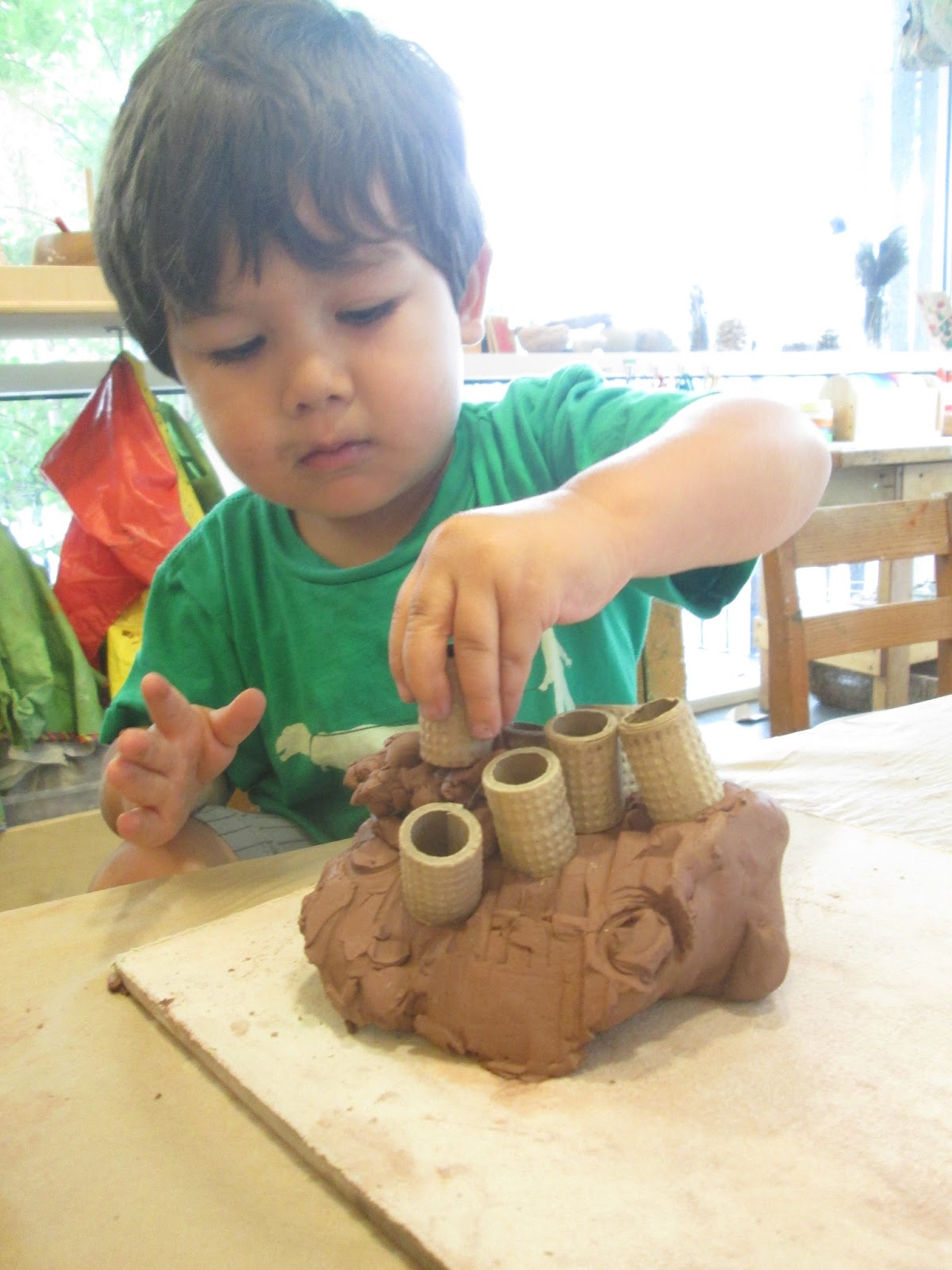
The "new burst of bloom" that inspired this post came from a young toddler, Yoshi, during his most recent visit to the Studio.

At the beginning of the year, during our clay exploration, Yoshi was often more interested in the opportunity that the Studio afforded him for having conversations with adults than in the provocations set out in the space. He loved to ask questions, point out what he saw in the room or out the window, and stay close to the teachers in the room. Although I knew that one piece of this was Yoshi's social nature and general interest in the goings-on of the adults in his life, I also wondered whether the clay, as a material, was less interesting to him than something else might have been.

Fast forward several months to the present:

Yoshi's Studio group has now returned to the clay. When they last entered the Studio, they found one table covered with paper and various drawing implements, and one table housing several boards topped with pieces of red clay. They had access to open shelves with clay tools for them to get as they need, as well as many beautiful and strange objects arranged on other shelves around them.

After a brief stop at the drawing table, Yoshi moved to the clay and began to work. He found a wooden clay hammer, which he used to give his clay a texture of bumps. He then found a long, thin tool to poke holes deep into the clay. On the back shelves, he found an array of recycled plastic parts, which he pushed into the clay, removed, and rearranged. When some of his friends discovered buttons on a shelf, he gathered some of these to add, followed by some small, recycled tubes. With each iteration of clay decoration, he would say, "Look," standing back to proudly survey his creation, before returning to work on it. He spent over thirty minutes absorbed in concentrated effort with these materials.

Those thirty minutes reminded me how important it is that we, as adults and as teachers, not close off the possibilities of children's interests and explorations. Yes, through our observations and the time we spend with them, we are able to understand facets of a child's personality, tastes, and learning. However, these are not static, and should not be written off as such. To use another quote of Dewey's, "The self is not something ready-made, but something in continuous formation through choice of action." All of us - adults and children alike - make choices that add to our experience, our knowledge of the world, and our potential actions at future choosing points. The choice we might make at one juncture is often quite different from that which we make at another, and it is the process of "continuous formation" that occurs between these points that is responsible for this difference.

Among the many inspiring ideas that Kendra has shared from her visit to the schools of Reggio Emilia in Italy, one that stood out to me was that of the "relaunch" - the revisiting of a thread of investigation that lost steam earlier in the year. This classroom's return to clay strikes me as something of a relaunch, and Yoshi's response in particular suggests that he now sees far more potential in the clay than he did the first time around. How glad I am that we returned to this medium and provided Yoshi with the chance to show us his new ideas! We will never learn what a child is capable of if we assume we already know.


Do you have any ideas of an activity, a medium, or an idea to "relaunch"?

Looking back over the past year, where have you seen "bursts of bloom" happen for the children in your life?


Monday, July 15, 2013

Building Habits of Mind

“We’re real artists.”
The Studio can be many things to many people. For Preschool 2, it became a place to explore and practice painting. We started out with watercolors, which allowed us to practice washing our brushes between colors and mixing colors together in the empty spaces on our palettes. Some children continued with watercolors for many sessions, experimenting with what it looked like to draw with sharpies before adding color. Other children explored acrylic and tempera paints, while still others tried out oil pastels alone and in combination with watercolors.

After so much time to experiment, practice, and refine their skills, these children were coming to understand the principles of these media just as artists do. With this in mind, we, the teachers, decided to offer up a provocation around the idea of taking time on a painting or drawing, the way artists do. In the end, all of the children spent at least two Studio visits working on their piece, and many requested a third time to finish. At the beginning of our second session with our paintings and drawings, we held group critiques. Children had a chance to share what they liked about each other’s paintings, ask questions about them, and provide their peers with suggestions about how to make their paintings even more beautiful (which the artist could choose to incorporate if they wished). Here are a few examples of the final, finished work of the children, alongside the words of their peers from the critique session. 


IAN’S PAINTING: My House and Family with a Rainy Sky
Ariv: I like the house. I like the roof, because it’s a different kind of shape.
R: I like the Christmas tree, even though it is blue, not green.
M: I like the people, because it reminds me of my family.
R: Why did you paint the sun blue?
Ian: Because it’s beautiful and someone can see that.
Ariv: Why is the Christmas tree blue?
Ian: I saw a Christmas tree outside and is blue. I have in my house.
Ariv: He should work on the clouds. [They were just black at the time.]
R: And add some umbrellas for the rain.

GAIA’S PAINTING: A Swirl and a Person
J: I like the snake… it’s like a sleeping snake.
Gaia: It’s not a snake, it’s a road.
Nina: I think I like the girl, because Gaia painted the inside and not the outside.
Katie: I wonder what you will add to your painting now.
Gaia: I will add more colors.
NINA’S PAINTING: Houses and a Castle along a Road with a Story about a Princess who Lived There
Gaia: I like the flowers. I like that she did two of these same.
[B. and J. point to the flowers, too.]
J: I think you could paint that sun.
ARIV’S PAINTING: A Truck, a Rocketship, a Stop Sign
R: I like the stop sign and the yellow in between.
M: I like the green part, because my mom likes green.
R: What is the yellow?
Ariv: That’s to keep the wheels together.
R: Why is it not attached to the truck?
Ariv: It’s magic and the car is using it.
R: Why are there little thingies inside the wheels?
Ariv: Those are telephones.
R: Spikey ones?
Ariv: Those are… they keep strangers from coming in.
Katie: I wonder if you are going to add something new.
R: Like people.
Ariv: No. I might make the hands very long on accident.
R: Just remind yourself you need short hands.

Sometimes, the Studio is about learning a new technique or discovering a new material. Sometimes it is about exploring a particular theme or idea. I also see it as a place for children to expand their ways of thinking about the world and about their place in it. It is a place where we are given uninterrupted time to investigate something very closely, and so it is also a place where we can practice and hone our skills as investigators. To me, this indicates the refining of “habits of mind,” which are defined by Arthur Costa as “a disposition toward behaving intelligently when confronted with problems, the answers to which are not immediately known… It suggests that as a result of each experience in which these behaviors were employed, the effects of their use are reflected upon, evaluated, modified and carried forth to future applications.”

In the instance of the Preschool Two painting and pastel exploration, we began by building our understanding of the materials themselves – acquiring a set of particular “tools” that could be drawn upon and referenced in future. We then moved towards the practice of planning out our work – thinking about what we wanted to represent before we began and what elements were important to include. We then began to develop an understanding of our artistic creation of an extended, ongoing process that could draw inspiration from all around us. Our paintings were not simply the result of sitting down to paper and paint or pastel, they were the product of hard work, of thought and inquiry, of evaluation and re-evaluation, of our own ideas as well as the ideas of others. Children developed new means of extending their work, and they began to look at it in a more reflective way. If a child reached a point where they felt “done” working, rather than moving their piece straight to the drying rack, they took some time to walk around, looking to the work of their peers and the beauty in their environment for inspiration. During critiques, children listened respectfully to the comments and questions of their peers, and they felt able to incorporate the suggestions they were given as they saw fit. In turn, the children offering their opinions on another’s work seemed to be really thinking about the artwork before them.

“We’re real artists,” B. said during his second session with his painting. I do feel that this process of returning to and re-examining our work with care has helped to foster many of the habits of mind employed by artists, but I also believe that these practices will be useful to the children in many future instances where “the answers are not immediately known.” I believe that one of the miracles of art – in its viewing or its making – is its ability to inspire us to look more carefully and with deeper intention at the world around us, and I felt that these young artists were experiencing this alongside me during our visits together.

What habits of mind do you feel the children were employing through this experience?
What habits of mind do you feel are most helpful or important to you in your life?


Reference: Costa, A. & Kallick, B. Describing 16 Habits of Mind. Retrieved from http://www.instituteforhabitsofmind.com/resources/pdf/16HOM.pdf