Wednesday, July 24, 2013

A Burst of Bloom Ensues

"Like the soil, the mind is fertilized while it lies fallow, until a new burst of bloom ensues." - John Dewey, Art as Experience

The "new burst of bloom" that inspired this post came from a young toddler, Yoshi, during his most recent visit to the Studio.

At the beginning of the year, during our clay exploration, Yoshi was often more interested in the opportunity that the Studio afforded him for having conversations with adults than in the provocations set out in the space. He loved to ask questions, point out what he saw in the room or out the window, and stay close to the teachers in the room. Although I knew that one piece of this was Yoshi's social nature and general interest in the goings-on of the adults in his life, I also wondered whether the clay, as a material, was less interesting to him than something else might have been.

Fast forward several months to the present:

Yoshi's Studio group has now returned to the clay. When they last entered the Studio, they found one table covered with paper and various drawing implements, and one table housing several boards topped with pieces of red clay. They had access to open shelves with clay tools for them to get as they need, as well as many beautiful and strange objects arranged on other shelves around them.
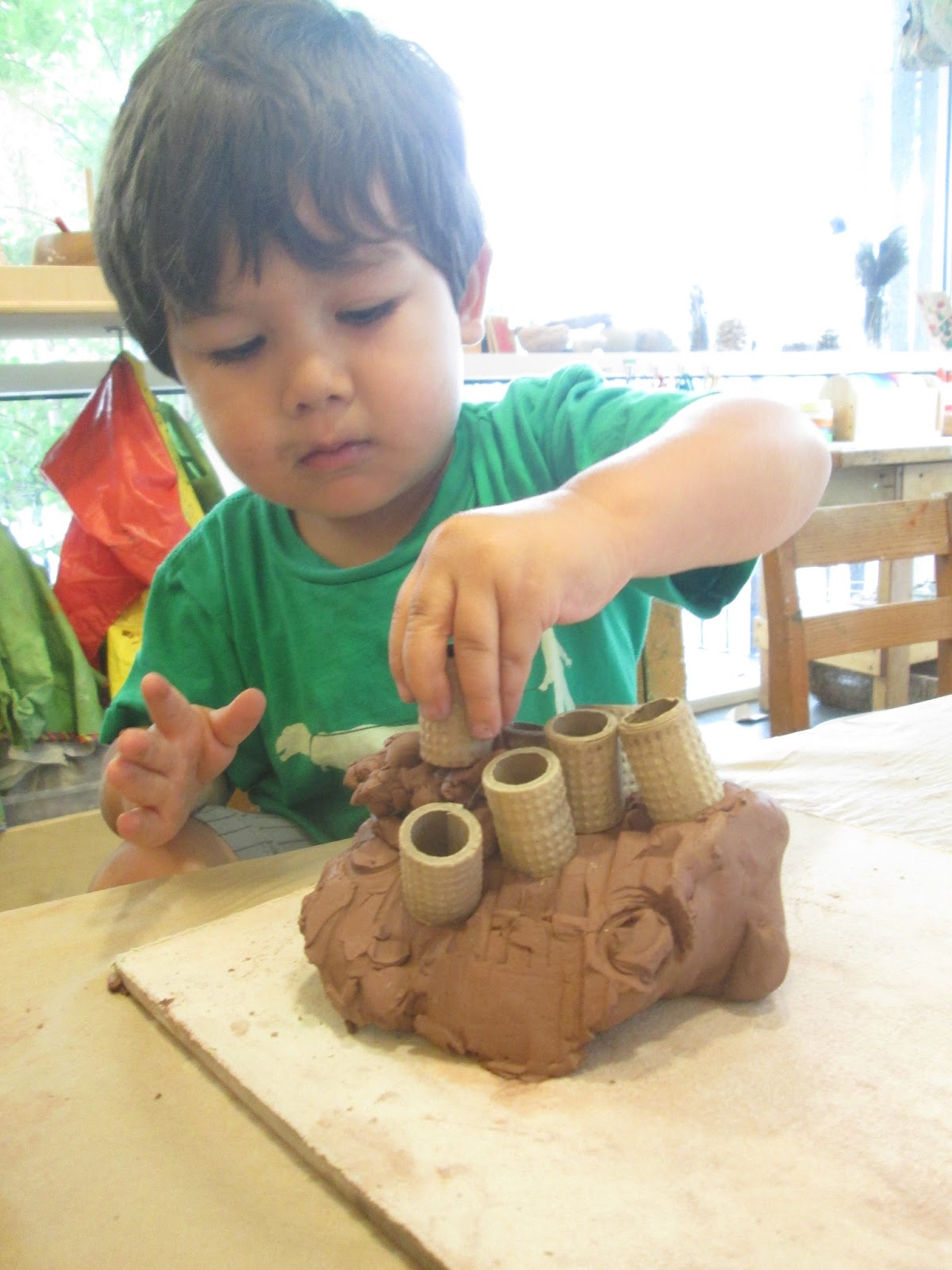
After a brief stop at the drawing table, Yoshi moved to the clay and began to work. He found a wooden clay hammer, which he used to give his clay a texture of bumps. He then found a long, thin tool to poke holes deep into the clay. On the back shelves, he found an array of recycled plastic parts, which he pushed into the clay, removed, and rearranged. When some of his friends discovered buttons on a shelf, he gathered some of these to add, followed by some small, recycled tubes. With each iteration of clay decoration, he would say, "Look," standing back to proudly survey his creation, before returning to work on it. He spent over thirty minutes absorbed in concentrated effort with these materials.

Those thirty minutes reminded me how important it is that we, as adults and as teachers, not close off the possibilities of children's interests and explorations. Yes, through our observations and the time we spend with them, we are able to understand facets of a child's personality, tastes, and learning. However, these are not static, and should not be written off as such. To use another quote of Dewey's, "The self is not something ready-made, but something in continuous formation through choice of action." All of us - adults and children alike - make choices that add to our experience, our knowledge of the world, and our potential actions at future choosing points. The choice we might make at one juncture is often quite different from that which we make at another, and it is the process of "continuous formation" that occurs between these points that is responsible for this difference.

Among the many inspiring ideas that Kendra has shared from her visit to the schools of Reggio Emilia in Italy, one that stood out to me was that of the "relaunch" - the revisiting of a thread of investigation that lost steam earlier in the year. This classroom's return to clay strikes me as something of a relaunch, and Yoshi's response in particular suggests that he now sees far more potential in the clay than he did the first time around. How glad I am that we returned to this medium and provided Yoshi with the chance to show us his new ideas! We will never learn what a child is capable of if we assume we already know.


Do you have any ideas of an activity, a medium, or an idea to "relaunch"?

Looking back over the past year, where have you seen "bursts of bloom" happen for the children in your life?


Monday, July 15, 2013

Building Habits of Mind

“We’re real artists.”
The Studio can be many things to many people. For Preschool 2, it became a place to explore and practice painting. We started out with watercolors, which allowed us to practice washing our brushes between colors and mixing colors together in the empty spaces on our palettes. Some children continued with watercolors for many sessions, experimenting with what it looked like to draw with sharpies before adding color. Other children explored acrylic and tempera paints, while still others tried out oil pastels alone and in combination with watercolors.

After so much time to experiment, practice, and refine their skills, these children were coming to understand the principles of these media just as artists do. With this in mind, we, the teachers, decided to offer up a provocation around the idea of taking time on a painting or drawing, the way artists do. In the end, all of the children spent at least two Studio visits working on their piece, and many requested a third time to finish. At the beginning of our second session with our paintings and drawings, we held group critiques. Children had a chance to share what they liked about each other’s paintings, ask questions about them, and provide their peers with suggestions about how to make their paintings even more beautiful (which the artist could choose to incorporate if they wished). Here are a few examples of the final, finished work of the children, alongside the words of their peers from the critique session. 


IAN’S PAINTING: My House and Family with a Rainy Sky
Ariv: I like the house. I like the roof, because it’s a different kind of shape.
R: I like the Christmas tree, even though it is blue, not green.
M: I like the people, because it reminds me of my family.
R: Why did you paint the sun blue?
Ian: Because it’s beautiful and someone can see that.
Ariv: Why is the Christmas tree blue?
Ian: I saw a Christmas tree outside and is blue. I have in my house.
Ariv: He should work on the clouds. [They were just black at the time.]
R: And add some umbrellas for the rain.

GAIA’S PAINTING: A Swirl and a Person
J: I like the snake… it’s like a sleeping snake.
Gaia: It’s not a snake, it’s a road.
Nina: I think I like the girl, because Gaia painted the inside and not the outside.
Katie: I wonder what you will add to your painting now.
Gaia: I will add more colors.
NINA’S PAINTING: Houses and a Castle along a Road with a Story about a Princess who Lived There
Gaia: I like the flowers. I like that she did two of these same.
[B. and J. point to the flowers, too.]
J: I think you could paint that sun.
ARIV’S PAINTING: A Truck, a Rocketship, a Stop Sign
R: I like the stop sign and the yellow in between.
M: I like the green part, because my mom likes green.
R: What is the yellow?
Ariv: That’s to keep the wheels together.
R: Why is it not attached to the truck?
Ariv: It’s magic and the car is using it.
R: Why are there little thingies inside the wheels?
Ariv: Those are telephones.
R: Spikey ones?
Ariv: Those are… they keep strangers from coming in.
Katie: I wonder if you are going to add something new.
R: Like people.
Ariv: No. I might make the hands very long on accident.
R: Just remind yourself you need short hands.

Sometimes, the Studio is about learning a new technique or discovering a new material. Sometimes it is about exploring a particular theme or idea. I also see it as a place for children to expand their ways of thinking about the world and about their place in it. It is a place where we are given uninterrupted time to investigate something very closely, and so it is also a place where we can practice and hone our skills as investigators. To me, this indicates the refining of “habits of mind,” which are defined by Arthur Costa as “a disposition toward behaving intelligently when confronted with problems, the answers to which are not immediately known… It suggests that as a result of each experience in which these behaviors were employed, the effects of their use are reflected upon, evaluated, modified and carried forth to future applications.”

In the instance of the Preschool Two painting and pastel exploration, we began by building our understanding of the materials themselves – acquiring a set of particular “tools” that could be drawn upon and referenced in future. We then moved towards the practice of planning out our work – thinking about what we wanted to represent before we began and what elements were important to include. We then began to develop an understanding of our artistic creation of an extended, ongoing process that could draw inspiration from all around us. Our paintings were not simply the result of sitting down to paper and paint or pastel, they were the product of hard work, of thought and inquiry, of evaluation and re-evaluation, of our own ideas as well as the ideas of others. Children developed new means of extending their work, and they began to look at it in a more reflective way. If a child reached a point where they felt “done” working, rather than moving their piece straight to the drying rack, they took some time to walk around, looking to the work of their peers and the beauty in their environment for inspiration. During critiques, children listened respectfully to the comments and questions of their peers, and they felt able to incorporate the suggestions they were given as they saw fit. In turn, the children offering their opinions on another’s work seemed to be really thinking about the artwork before them.

“We’re real artists,” B. said during his second session with his painting. I do feel that this process of returning to and re-examining our work with care has helped to foster many of the habits of mind employed by artists, but I also believe that these practices will be useful to the children in many future instances where “the answers are not immediately known.” I believe that one of the miracles of art – in its viewing or its making – is its ability to inspire us to look more carefully and with deeper intention at the world around us, and I felt that these young artists were experiencing this alongside me during our visits together.

What habits of mind do you feel the children were employing through this experience?
What habits of mind do you feel are most helpful or important to you in your life?


Reference: Costa, A. & Kallick, B. Describing 16 Habits of Mind. Retrieved from http://www.instituteforhabitsofmind.com/resources/pdf/16HOM.pdf  

Wednesday, July 3, 2013

"There are always things we learn when they ask questions of us"

Throughout the year students and teachers from around the world visit our center. Each year we host a group from Iceland, one from Japan and one from Singapore. We discussed this with Lella Gandini when she visited a few months ago and she asked 
"And why do they come?"
"Because we say 'Yes'?" said my director, Katy with a smile.
"and you say yes because there are always things we learn when they ask questions of us."

Of course, Lella is exactly right. We learn from their questions and from seeing our center through their eyes. Today I visited with some students of early childhood education from Singapore. They work at centers with the same age range that we do. It was a joy walking around with twelve young women as they peeked into classrooms, sat down to play with children, pored over our documentation, and pointed out details of our environment to one another.

Here are some highlights of our conversations together today:
  • I learned that it is very common for centers to be open there between 7 am and 7 pm daily "or longer, if they have parents who work late" said one of the students.
  • They were struck by the fact that we had male teachers. After some conversation about this someone asked if male teachers were allowed to change diapers, and told me that this was not allowed in their centers even in the rare cases that they have a man working there. "They can only teach a class, like maths." This is interesting, because of course, although male teachers are "allowed" here in the US, they are not the norm, and we have to work hard to recruit male teachers because we believe that children benefit from having men and women in nurturing roles in their lives. The students were all excited because they believe that child care teachers should be men and women, they'd just never seen a male teacher before.
  • After watching a dad spend snack time with his child's class during an extended drop off time, students asked questions like: "How long are parents allowed to stay in the morning?" and "How many days during the year are parents invited to visit the classroom?" It was clear to these students that we welcomed families, and it felt a little unfamiliar to them, but they were excited about it, too.
  • The students were lucky to come just days after our annual Showcase, so we had extra special and extra large pieces of documentation all over the center. They compared what they saw to the report cards that they issued to families at this time of year, and said that they saw "the whole story of each child" when they looked around our center. They marveled at pieces of documentation that welcomed families' collaboration. A couple who were familiar with Learning Stories were happy to see something familiar.
  • They were surprised that we don't take showers each day. Singapore, they told me, is so hot that children take a shower between lunchtime and naptime to cool off before they rest. The recent weeks have been so muggy, I felt envious when I heard this.
  • They were touched by how children talked together. "The children are so encouraging with one another!" they said.
  • They asked about our dress code, and were surprised that we are allowed to wear shorts to work.
  • "It is obvious how children's work is valued here." one said, reading the stories of the children of Toddler 1 North.
  • "Children must walk in and think 'This is the place where I belong!' every day." said one student.
Teachers also learn just from having visitors in their classrooms, not from what they say, but from their very presence. The observer effect in a classroom is one that usually results in straightening our backs, looking around at our classroom and imaging what another sees. I'm happy that in our center, this usually results in a sense of satisfaction for teachers, and an opening of blindspots.

How does it feel when people visit your classroom or workplace? Have you visited our center? What was your experience?

Monday, July 1, 2013

How do we honor children's hard work?

We might honor it in the moment by observing it, commenting on it, and supporting it. When I see a child has spent time with an idea or a creation - thought about it, struggled with it, maybe had to make changes -  rethink some of its aspects - I want them to know that I was a witness to the process.

We might honor it later by taking time to reflect on what we observed. In reflecting, I feel I am peeling away the layers of the moment, seeking out the glimmer of insight that first drew my attention. I take a second look again at what I sa, turning it over in my minds, like a puzzle box. I search for its intricacies, for its angles, for its potential. I try to use it as a window into children's minds - their understanding of the world's mysteries. More importantly, perhaps, I try to draw back the curtain to look beyond what they know and seek out what it is they want to know.

We might honor it through documentation. I find it liberating to set my thoughts down on paper, sharing all of my musings with children, teachers, and families. It allows me a sense of pride in my work, on the one hand. On the other, it opens up possibilities for further reflection and a sharing of knowledge. Displaying my interpretation of an encounter, I am inviting the community to share in a conversation.

We might honor it by offering further provocation. Mother, art educator, and blogger, Rachelle Doorley writes, "Children who set up their own problems are invested in the process of learning and are motivated to see a project through completion." I constantly strive to offer children provocations that will present them with potentially interesting problems - problems that they will want to work hard and long to solve. I want to follow along with them as they question and probe and discover, and I continue to ask my own questions as we take the journey together. My provocations are one way of saying, "I have been trying to listen to what you are telling me. I'm not sure I am understanding it completely, but here is one idea I had. What do you think?" 

We might honor it with celebration. Right now, our center is preparing for a grand celebration of the past year - our third annual Showcase - and teachers and children alike are so excited for the chance to share  our work with families and friends. Of course, celebrations do not always have to be on such a large scale. Just a few weeks earlier, a group of toddlers held their very own special exhibit during their Studio time, to celebrate all of the hard, focused work they have done together this year. Maddy, Max, and Jordan have been coming to the Studio together, along with their classroom teacher Cathy, since September, and they have continued to use clay as their primary medium, even when nearly all of the other Studio groups branched off into new directions. With each visit to the Studio, this group of children has continued to build on what they had worked on previously, developing a unique, complex, shared vocabulary. Together, these children moved from flattening clay by pressing and peeling if off their boards, to tossing it in the air over and over to shape it into a "baby head," to building up castles from a shared block of clay, to adding glass pebbles (which they named "peekies"), wires, and water to make their creations "more stable." The Studio now houses an entire shelf of their clay sculptures, which were part of the inspiration for our exhibit. 


While parents hear about these bi-weekly Studio sessions through Cathy's documentation, they have not had many opportunities to visit the Studio to see the work first-hand. We decided to create just such an opportunity, setting aside a Studio time for a private exhibition of the children's work, words, and process for the parents to visit. We also decided to offer the adults a chance to learn from their children, working alongside them with the clay, peekies, and wire that they know so much about. 
 The exhibit, which was attended by the mothers of all three children, proved a wonderful celebration of the trio's hard work. Maddy, Max, and Jordan were extremely excited to show their moms their creations, and even more excited to show them how to work with the clay. As conversations developed around the clay and its uses, the children were always ready to answer any questions the adults posed.

Scarlet (Max's mom): How do I take clay off, Max?
Max: You just grab it.
Maddy: I need more water. Here's a brush.
Shawna (Maddy's mom): How should I use it?
Maddy: You have to wipe it on the clay like this, then poke like this. Bump bump bump.
Leigh (Jordan's mom): Why are we adding water?
Jordan: To make it sticky. 
This special celebration gave these children a unique opportunity to share an important piece of their year at our center with some of the people who matter most to them. Watching their interactions with their moms and the clay through the lens of my camera, I was struck by how self-sufficient they were, and how easily they were able to solve any problem they ran into with minimal prompting. One moment, in particular, stood out to me, making me realize how much these children had taken on the role of the teacher in this situation. As Maddy began to rub the surface of her wet clay castle with her hand, she turned to Shawna, asking her questions that we often will ask children: "How does it feel on your hand? Do you like how it feels?" 

This process of exhibiting the long-term work of these three children is what prompted me to think about all of the different ways we can honor children's work through our practice. I felt as though this particular even allowed for a very special form of honoring that I was able to share with the children and their parents on a more personal level. The fact that the children later suggested having a "dad's day" at the Studio too makes me think that this must have been a powerful experience for Maddy, Max, and Jordan, as well.

How do you see yourself honoring children's work?
What great feats have you celebrated with your loved ones or with the people you work with? 
What do these celebrations mean to you?

Thursday, June 27, 2013

Questions, Spaces and Stories; How We Illustrated Our Image of the Child This Year


This month our weekly provocations are opportunities for teachers to tell us about their team's innovations. We are hoping to share practices that other teams may want to try, and the methods of innovation - how we come to new ideas and fold them into our work. 

Our annual intention is to reflect upon our "Image of The Child" and how it appears in our environments, documentation and curriculum. This week, all three innovations demonstrated our trust in children and our eagerness to know more about what they are playing, working and thinking about.


The Question of the Day 
Erin shared with us the way that her preschool class uses the“Question of the Day.” She and a colleague learned this technique from a teacher at the Advent School . Each day in Preschool 1, kids and their families stop at a clipboard. The adult reads the question and the child answers it.  The question ranges from "How are you feeling?" or "How did you get to school today?" to "How do trucks work?" or "What happens when you go to the doctor?"

The Question of the Day offers:
  • A ritual at the entrance to the classroom. A daily and immediate reminder that school is a place where we stop to think and where our voice is heard.
  • A way to model for families how we honor children’s words by writing them down without comment or correction. This can be a struggle for some parents who have developed a habit of helping their child figure out a correct answer. This question is one where teachers always want to hear children’s unedited thinking. 
  • An engine for curriculum, putting children's theories about the world onto paper where they can be looked at together, extended, challenged and fleshed out. 
  • Another way to know children more deeply. As Erin told us "It helps you see how each child thinks over time. Somebody always has this fantastical, long poetic answer, and somebody else has this clear cut answer you would find in a book." 
Teachers asked some great questions. Tracy asked "What would you do, if someone didn't speak English?" Erin assured her that they invite families to translate the question into another language and to write their answers in that language, with or without translation. They also sometimes draw pictures. 

Transforming a Classroom Environment. 

Over the last year a lot of construction has been happening around us. As a result, all of our classrooms moved into a modular building for six months or so and then moved out again into their own spaces.This was a chore, of course, but it was also a great opportunity to look at our permanent spaces when they were empty and to learn from living in a different space. This experience profoundly affected Tracy, Monica and Miwako, and they used what they learned to shift the space in their room to everyone's benefit.


There were some changes that the teaching team made in their modular room that were based on necessity.
  • Because their new space was so open,  each area of the room flowed into another.  "It was this vast square." Tracy said. Teachers observed that with less divisions, children moved their play fluidly from one area to the next.
  • The only tiled area of the classroom was near the entrance, so this is where they put the mini-atelier. Our first impression when entering the room was filled with beauty and focused work.
When the class returned to their old space, the teachers kept these serendipitous changes with great results. 
  • This classroom structure had been static for many years, and teaching teams sometimes found traffic jams, or had problems when many children wanted to work or play together. Taking some inspiration from the more open classroom in the modular, the teachers created space for dramatic play and blocks to share one large space. Tracy told us that the space contributed to more intricate, collaborative play.
  • The more centralized atelier attracted children to creating their props for their play. It's old location, in the back corner of the classroom usually attracted children who wanted a quiet experience, but the new space is usually occupied by children in the throes of some dramatic adventure, or intense recreation.

It's clear that children, teachers and family all feel at home in the new arrangement. The team used their observations to reflect on what was working in one environment and then adapted it to another. Surprise! The same process that helps us plan curriculum can help us plan our environments too!

Image credit below.

Infant South adopted the Learning Story convention and stream-lined their documentation.

At our center, teachers have a great deal of agency in deciding how they want to make the life of their classroom visible through documentation. Lise's team was ready for a change. She said "It felt like the old format was quite a long process of busy work, sifting through several weeks of photos, feeling compelled to put as many photos as possible because they were there, and feeling like there was not enough time to go in-depth. I wanted to think in-depth about children. I wanted to highlight our role as researchers, rather than summarizers. I'd heard of Ben Mardell's idea of writing Zooms.  It's a way of looking closely, but they didn't feel quite right. We talked to Kendra, and said 'Here's what we want: Photos and observations go to families, we invite families to respond, we as teachers keep learning from our documentation'. Kendra said, it sounds like Learning Stories might be just what you're looking for." 

As soon as Infant South started using this method, they adapted it to suit their specific team. 
  • They chose to address their writing to the families of the babies instead of to the babies themselves.
  • Danielle, Lise's teammate, started using the "See/Think/Wonder" protocol to guide her reflections, and her team followed suit. "See is the observation, Think is our own thinking that includes knowing ourselves, our knowledge of development, and of an individual child. Wonder is questions we write at the end. I started writing those questions directly to parents. This has felt really successful and manageable....We've gotten a similar depth from parents. We send them out once a month and people write back. 
  • The team worked over the first few months to balance "coverage" with just following their curiosity about their observations. Now they each write a few stories each month (so each child gets at least one monthly) post them all at the same time.

I really admired the bold, long-term, reflective process this team took to figuring out how to best document their classroom in a way that served the needs of children, families and the team.

Improving Our Practice Without Adding More.
As our teachers take on more and more depth in their work, it can feel overwhelming because it feels like adding to what we already do. Learning stories, a more open classroom, and the Question of the Day have helped these teams go deeper into their research, their curriculum and in their relationships with children and their families without feeling overwhelmed. Rather than adding another thing, these innovations made space and smoothed out old ways of doing things.

Here were some of the ways these teams worked to bring in these new practices to their classrooms:
  • They looked outside of themselves; Erin visited the Advent school, the Preschool 2 team moved to the modular, and the Infant South team asked me if I had any idea.
  • All three teams discussed the change before it happened and then reflected on how things were going, making changes in some cases.
  • They connected this one aspect of their work to the broader themes in their classroom and the center.
  • They communicated with families about the new aspect of their work through email, signs and documentation. All three classrooms have heard from families that they are excited about these innovations.
If you're a part of our center, what's your take on Learning Stories, Preschool 2's environment and the Question of the Day? If you're not, do you have any advice to share about innovating at work?


yours truly,
Kendra

Friday, June 21, 2013

More posts are coming...

Hello everyone,

Please consider this blog post a space holder. Katie and I each have posts in the works, but because we're being super careful about checking with folks before we post about them, we don't have anything to share with you just yet.

This whole process is still feeling new and exciting to us.

Please feel free to leave a comment on this (or any) post to let us know what you think of the blog, and how we're using it.

See you next week with more stories of children, teachers, families and what we're learning.

-Kendra

Monday, June 10, 2013

Working with an Installation

Our older preschool classroom had a wonderful opportunity to work with the artist Zoë Blatt, a student in the Arts in Education program at the Harvard Graduate School of Education and one of three current artists in residence at Project Zero down the road. Zoë created a beautiful installation for the children to interact with. With its combination of flowing threads, colorful blocks, woven nests, and flowering shapes, the children all found something wondrous to explore.


The children came in three small groups, and I was struck by how differently each group worked with the materials at hand. The first group was particularly interested in the hanging yarn - some combination of children was always walking through the pieces, exclaiming at how soft and funny they felt.

The second group nearly all became involved in building an elaborate creation using the blocks, woven nests, eggs, and twirly shapes they called "octopuses" and "spiders." Ian said, "The eggs are all people.... this [nest] is a house hat - it looks like a real hat." 

The third group were particularly interested in the eggs and nests. They noticed that the eggs felt strange to the touch - not like a real egg. Gaia dedided, "I'm gonna take the nest... I'm gonna put it in the tree." When some of the eggs fell out, a game was sparked. "Oh no," Gaia said, laughing as she and her friends gathered up more eggs into the nests, "The eggs are gonna break! I'm gonna hide it. I'm gonna hide it somewhere in a tree." 

The next day, Zoë joined six of the children in the Studio, where they had access to the same materials she had used. Zoë's provocation was for the children to create something they wished to add to the installation.

Ariv and Ian each decided to make a rainbow attached to the top of a stick. The rainbows were made of pipe cleaners curved and taped together.


Ian: This is for spin. I'm gonna put this rainbow on the tree so someone cant touch and spin it. 
Ariv: This is my rainbow and there's a button and pipecleaners. The button makes the rainbow even better. 

Susan and L. both worked on different climbing structures. L. first drew and colored a plan of a slide, then taped down pipe cleaners over her drawing, using the same colors of tape that she had colored with. Susan's popsicle-stick, tape, and pipe cleaner creation included many sides for climbing on and a pole to slide down.


A. decided to make a nest, taking a moment to examine a photo of the nests Zoë had made before beginning. "Hey, those nests are made out of string! I can do that. The pom poms can be the eggs." 

B. found that carrying out his plan to make a block was tricky to accomplish, given that so many of the materials available were malleable things like string and tape. At last, he used paper and popsicle sticks to create a "block-shaped" rectangle that he could hold up.


These creations will be added to the installation, which has been relocated to Project Zero. We are hoping to organize a field trip for the preschoolers to visit the new site and see their pieces on display.


This was such an exciting experience, not only for the children, but also for me. As an alumni of the Arts in Education program, I was happy to be able to help Zoë to set up and carry out her installation project. Much in the way that the children were pleased and enlivened by the opportunity to share their work at the end of their Studio visit, I was also proud to be able to share a bit of my work here at PTCC with Zoë and other people involved at Project Zero, including my former professor, Shari Tishman, who joined us in the Studio.

Part of what makes moments like this - work that brings us into contact with our greater community - so important is that they allow us all the chance to share parts of ourselves - our questions, our ideas, our art, our jobs - that are important to us. We offer them up to people who we may not know very well at all, and we ask them to honor, respect, and answer. It is a very powerful feeling, to commence such a relationship. I am so curious to see what will happen when we take the next step and the children see their work displayed in a slightly more public place.