Showing posts with label Clay. Show all posts

Monday, May 4, 2020

Extended Encounters: Part II

**This post is the second in a series about our three-month material investigation. To read more, go to the first post here.**

A Portal to Possibilities
In almost every classroom, the longevity of our exploration allowed the materials to not be simply a focus in the room, but a catalyst for other important work by children and teachers. It often served to highlight, support, and sustain larger questions, which might not have been visible without our intense observation and thinking about the original material in question. 


“Wood was present in our classroom in many forms and discussed in team meetings. I am less sure if it provided a lens for getting to know each other or a rich focus for the class. We definitely had fun. 
Early on we had a few conversations about the sensory experience of wood - what it looks like, feels like, smells like. However the children in P1 seemed more interested in what you could do WITH wood, and TO wood, than in the intrinsic qualities of wood itself. Children often used sticks in dramatic play indoors and outdoors… They used wood as a background for activities such as building, sorting, and counting… Combining wood with other materials such as string and wire and tape offered opportunities for children to create new things... They were excited to collect sticks on the river walks and on the playground, and to use tools such as drills and saws with wood... It seemed to me that their interest was in the experience of using the tools themselves, and less about how they could use tools to discover more about wood."
- Loren, Preschool 1


“The Natural Materials area in our classroom seemed like the place where the children came together and did a lot of coordinated play as well as side by side play…. These open-ended materials showed me about each child and how they thought, what their interests are and what excites them. C was all about cooking and using her imagination, M loved to sort, and R liked to bring other materials such as trucks or blocks to the Natural Material area to create something different. For me having the Natural Materials in the classroom brought this classroom together, from the children that moved up from Infant North to new children that started this year, to all the teachers.”
- Caroline, Toddler 1 North


“... I never would have guessed [the natural materials] could be used so many ways… seeing [them] used as placeholders for food, being carried around the room… and the joy of using the things they had grown in the garden…"
- AJ, Toddler 2 North


“Our investigation of loose parts has been so transformative in my thinking and even in my everyday life. I love the planet and feel that we should find value in our environment. I was not expecting this investigation to bring me more insight in my everyday thinking when we started, but surprisingly it has extended out in what I have been observing in the community I live and participate in… Loose parts are an intricate part of our classroom identity and opened a bigger question for me and my team about "how do things/people/community fit together?" I believe that this is a concept that is at the core of humans, our identity, and the need to connect. I am surprised that that is what I found from the experience, and I love that it has bent my thinking. This world is made of loose parts and we can get philosophical and say so are all individual people, we are searching for a sense of belonging and acceptance, not in spite of but because of our miss matched attributes.”
- Aleksandra, Infant North

“As we started to amass natural materials the children began to think about categorization and where and who the objects "belonged" to.  We created a natural materials shelf for our classroom and the children sorted the objects to place on the shelf.  During their play they would often return to the shelf to gather materials they needed.  The theme of belonging has since been an ongoing thread in our classroom that children, teachers, and families are exploring through multiple facets of our curriculum.  Our natural materials investigation was therefore a catalyst for a much deeper dive into questions such as:
"Does it belong?"
"How does it belong?"
"How do you come to belong? (to a group, game, place, community)"
- Amanda, Preschool 2

“We started off with a very large, nondescript clay block and a few hand tools. As weeks passed children’s interactions with the clay changed. I was intrigued, observing the changing relationship of each child with the clay as well as how their relationships with each other evolved when working with the clay together.... In their early introduction to clay the physical act of working at changing the block of clay seemed to be their main goal… As the clay chunks became smaller and more easily moved by the children we started to observe more individualized clay exploration. It became apparent when each child claimed chunks or slabs on their own they named, with pride, a specific creation such as “pizza”, “tree” “pasta”. As a group, they influenced each other more and began to migrate to the same play concepts and ideas while the individuality of their clay objects became an extended social experience… Eventually the small parts and tools used to alter the clay started to become something more... Patterns created from using materials emerged and took on their own meaning. The clay investigation came full circle. In the Studio small parts were hidden deep in a clay block by half of the class. The other half went to the Studio on another day and worked at extracting the pieces their friends had hidden, using tools, both side by side and together, for a common goal.”
- Janet, Toddler 2 North

“In the beginning of the year, [we] introduced a few of the natural materials by creating still lifes... As the year progressed we decided to challenge the children by having them create their own still life and draw it. One thing that surprised me about this investigation was how focused the children became and the pride that [this experience] instilled in their work. What brought me joy during this investigation was how the children then started taking pictures of their own work - I believe this investigation of the material helped them to gain confidence in themselves.”
- Ally, Preschool 2

Wednesday, April 29, 2020

Extended Encounters: Reflecting on our long-term material investigations

“A first encounter for children with materials… is a necessary step in children’s process of knowing. Through such encounters and explorations, children build an awareness of what can happen with materials, and adults build the ability to observe and support the significance of each particular experience.”
-        Giovanni Piazza, “Materials, Relationships, and Languages,” in ed. Gandini, Hill, Cadwell, and Schwall, In the Spirit of the Studio, p. 13.
-----------------------

How do we build a relationship with a material? What can we gain by continuing to engage and re-engage with a material over an extended period of time? These were some of the questions at work for both teachers and children this year as each classroom embarked on a three-month-long material investigation together.
At the start of the year, each classroom chose a specific type of material (light, paper, loose parts, clay, natural materials, paint, or fabric) to explore, signing on to have that material present in their classroom every day and be part of their documentation, reflection, and curriculum planning for the next three months. Five classrooms chose natural materials, one chose paper, one chose clay, and one chose loose parts, and away we went!
Our material investigation was by no means an easy undertaking. It required stretching, growing, learning, and disequilibrium on the part of teachers and children. The same way that children often express frustration as they learn a new skill or grapple with a new concept, many teachers found themselves challenged to think differently about their material and its possibilities. 
Different classrooms took different approaches to this project – some classrooms set themselves a focus from the start, while others explored more openly, waiting for an interesting question or idea to arise. Some materials came with particular challenges that necessitated flexible thinking and collaboration on the part of teams. For many classrooms, the material itself provided a lens or portal through which other threads could be explored. In a few cases, however, the natural material itself proved the catalyst for going deeper, encouraging the children and teachers to learn more about that material’s unique possibilities. 
Many of our teachers took time to reflect on their experience with this long-term investigation, using the following prompts as a starting point:
  • How did your understanding of the material and its possibilities change over time?
  • How did children's interactions with the material change over time?
  • What was surprising or challenging to you during the investigation?
  • What brought you joy during the investigation? 
Excerpts from their reflections are collected here under the groupings of “overcoming challenges,” “a portal to possibilities,” and “going deeper” in order to share one facet of our work with you. Of course, there is always overlap, and there are cases where teachers’ words could fit into any of these categories. In each case, I used my best judgement to put them under the heading that seemed the best fit. Thank you for reading and please share any of your own thoughts and experiences from this investigation!
- Katie
----------------------------------------------------------------------------
Overcoming Challenges
Many challenges arose for different teachers over the course of this work - some expected and some not. Sometimes it was a challenge to find the right approach to the material in order to engage both the children and teachers in the exploration. In other cases, the material itself necessitated flexible thinking around issues, such as how to use it safely with young children. 


“It was hard at the beginning to include a material that none of us were quite interested in. Over time, though, the children's interest in this material evolved to another unexpected way of usage: Space. Children demonstrated awareness of the material as a tool to create a physical space and define it, moving the paper as a "stage" to sit, jump or play on it, or using it to hide. This was amazing to see. It brought me joy to realize the many ways and uses the children gave to sheets of paper.”
Connie, Toddler 1 South


“At first, I thought that the children would show interest in the properties of paper by exploring it in ways that included trying to rip it, crinkle it and scrunching it up into a ball. I was surprised to see that the children rarely did any of those things and would only engage with the paper when teachers initiated the paper play… The challenge for me was that I didn't know what the next steps would be after making paper. It was challenging to continue to have to think about this material that the children seemingly weren’t interested in - and I think that the teacher's lack of consistent of enjoyment with the material also played a huge part in it as well….I think that the dynamic between the children and paper, and each teacher's investment in this material investigation shifted when I hung the Tyvek paper up in the corner. It led to thoughts about space and prosocial behaviors amongst the children. This was exciting! It felt harmonious to be able to combine the paper investigation with a thread that was so prevalent in our room.”
Myra, Toddler 1 South


“Exploring natural materials in Infant South has been both invigorating and just a bit worrisome. It has been a learning experience when it comes to offering babies materials that are safe. But mostly it’s been fun to watch what they do with leaves, how we offer leaves and how they have been studying the myriad of leaves. It's been such a joy to watch how our babies have shown how long the process of exploring one material can go on for.” 
Dilcia, Infant South


“Something I found challenging was... diving deeper into our seed pod focus of our natural materials. We had some photos of seed pods but we never got around to doing anything else with the thought. Another challenging thing... We had a plan to crack open some acorns a few more times with T2 but because it’s considered a choking hazard, we had to stop. Unfortunately, something out of our control...However, at my old center, bringing any materials from outside or from home was never even heard of and I was told we weren't allowed to (along with many other things we weren't allowed to do).” 
Kelsey, Toddler 1 North 


“Throughout this emotional time [the start of the year], clay was offered during each morning and afternoon provocation….Almost immediately, the clay became food… Each child seemed to find comfort and safety with this thread…. [However} after a few months of their exploration of cooking and clay, the idea seemed to fizzle. I was frustrated because it felt like we hadn’t done enough. It seemed like other rooms had found their “thing” and were taking their material investigation further and further each day. It wasn’t until Ivonne brought up the idea that, “children will explore something until they find an answer, or will give up because they have lost interest” that I was really able to reflect on our use of clay. Did the children let go of the cooking idea because they finally felt safe and secure in the classroom? Were they able to accept the idea that their parents would come back at the end of the day? Was cooking a way for them to connect, share and learn alongside their peers, despite their big emotions? 

These were questions I wanted to find answers for. So, I observed. I watched the children come into the classroom each morning, happier and happier as each day passed. I listened as parents told us “She spent the entire weekend missing school and wanting it to be Monday!” I learned from the children that not all questions have clear answers - sometimes you have to stop looking to find it.” 
- Imy, Toddler 2 South 


“At the beginning the kids didn’t really know what to do [with the natural materials]… they mostly didn’t really use them. What brought me joy was, as we left them out, they used them more and more, and they used them lots of different ways.” 
- Kerri, Toddler 2 North 


“Our interactions with the material first started off very simple with a slab of clay on the floor. Children would break off pieces of the clay and call it pasta, pancakes, or waffles, perhaps mimicking what they had eaten for breakfast before coming to school… After some time exploring the idea of cooking, and adding natural materials, interest started to fade away from the clay, so we decided to change how it was presented… to help them re-engage with the clay… but we had no such luck. At this point, we were feeling a bit stuck, but we then started to think about the element of surprise, and hiding/finding objects [in the clay]. We first started to do this just in the studio, bringing one group to the studio to hide objects and one group to find objects. Through this we noticed that children started to become curious about loose parts, so in our team meeting we talked about bringing loose parts to the classroom. Once this was done, children started to re-engage with the clay, and we observed children build (vertically and horizontally), hide, make marks, and so much more.”
Kate, Toddler 2 South


“Not that it was a competition, but I'm not sure who has enjoyed our material investigation more; the babies or me. I obviously love natural materials, and I was excited to share my enthusiasm with our babies, families, and teammates. I was a bit intimidated at first, however, because I am not used to delving into an investigation right away, especially when we are so focused on just getting to know our babies and help them eat and sleep. But having a focus on a type of material, even if I didn't really get to observe it in action every day, still helped me get to know our babies through their individual styles of exploration….[sometimes the material itself] was ancillary to the relationship building that was happening at the forefront of their exploration. I learned about how an ongoing material investigation like this is not just about them learning about the material; everything that comes out of it is valuable.”
Amara, Infant South


“In the beginning of our investigation, hearing the term ‘loose parts’ made me wonder what that really means. I have been taking out some loose part materials to investigate over the past years, but I had not really intentionally thought about how much a loose part can be used in different ways and how children would investigate this specific material differently than others...I also struggled to set up the classroom with only loose parts - I still find myself taking out blocks and other materials that I never thought would be considered loose parts. But I learned that anything you find is considered to be a loose part.”
Gladys, Infant North 

Friday, November 6, 2015

Learning from Experience

Each day I set out materials and plan experiences for children of many different ages. There are always many variables at work during any given visit, and I never know exactly how things will go. Sometimes I am frustrated if the set-up does not prove as inspiring as I had hoped, or if children need a lot of help and reminders to respect the materials that are available.  I start to feel like a failure. However, even in those moments, the children’s actions and reactions hold the seeds for a way out of those feelings, and into more successful set-ups the next time.

Throughout the autumn, each session in the Studio is an opportunity for children from a classroom to familiarize themselves with a particular material, as well as the Studio space itself. For young toddlers, most of this experience lies in “messing about,” where materials are set out with minimal guidance or instruction. Preschoolers and older toddlers will experience this, as well, but may move on to learning particular techniques that will help them to use the material with more finesse.

For example, Preschool Two moved from
open experimentation with clay on tables and on the floor,
to learning about scoring and adding slip,
to opening, pinching, and attaching pieces of clay using the score and slip technique,
to creating sculptures modeled on hydrangeas, black-eyed Susans, and asters set out on the table.

This process required learning from me, my fellow teachers, and the children. Each time a small group worked in the Studio, I learned something about their thinking and understanding of the clay. I learned what aspects of the day’s work they found challenging and what parts they were able to connect to what they had done before. This new knowledge helped me decide what changes I should make when I worked with this group or others.
 
For example, we practiced the method of scratching and wetting the surface of the clay to attach pieces to each other. Since we moved right into this method when we sat down, the children began to join pieces of clay without really shaping them. They weren’t very invested in their work, and they didn’t notice the shape and potential “being” of their clay. I realized that for them to gain the practice and skills I was hoping for, we would have to approach the problem a little differently.
For the following groups, we started not with joining pieces, but with making shapes from the clay. Children were very confident in creating long “snake” shapes, and balls, and soon they had many pieces to choose from. Now was the time to work in the joining process. The children already had their pieces shaped, so joining them together became an opportunity to form something new. The experience this time around was much richer. Nava and Everett both began to experiment in forming symbols from their clay pieces. M. made several snakes that she lined up “like a train.” Phineas joined his snake shapes into a single long path that curled around his board.

Encouraged by this, I incorporated this successful process into the following week, where children spent time opening a large piece of clay together, creating a communal base that they could then add pieces onto using the same techniques we had been practicing.

The creations that children came up with were amazing! Their blocks of clay transformed into sidewalks, then houses, then waterparks! They began to attach their clay in more careful and intricate ways, creating bridges and waterspouts. One group – featuring Justin, Phineas, and F. – decided very early on that they wanted to create some sort of building together.

“I’m making sewers,” Justin said as he dug holes near the bottom of the mound, “I’m making a place to catch the rain so the house doesn’t get ruined.”
Phineas began to attach a long snake near the top, “This is the thing that makes the lightning so it doesn’t hurt the house.”

When we reached our session of recreating flowers in clay – our chance to put all of our knowledge of this material together as we examined these specimens of the natural world – I could see the children’s previous experiences come into play. At first they made the parts of their flower – sometimes the stem, sometimes the petals or leaves – before thinking about how they would join them together. Luke, who was making a black-eyed Susan, rolled a single long snake that he broke into smaller pieces for his petals. Phineas worked to shape his leaf for the same plant so that it “bends” just like the one on the real plant.  

Some children, like Nava, E., and Luke, sought to make their flowers stand up, while others lay them flat on their boards – each technique bringing its own unique challenges. They carefully went through the steps – score, wet, push together, and smooth – for each piece that they joined, clearly invested in making something that would hold together.

Many of the children began with the black-eyed Susan as their muse – the flower they declared to be the “easiest” to make. One particularly satisfying moment for me as a teacher was when Everett and Phineas had each finished this flower and decided to “try” to make another – the hydrangea – with its small, round petals. Everett even went on to do the “hardest one,” the aster, complete with “all of those spiky leaves.”

Thinking back to our first attempts at attaching clay pieces to each other, I was grateful for what the children had taught me in teaching them. Working alongside them, I had learned to slow down, think first about shaping the clay, then about how it should fit together, before moving on to the actually joining process. The children’s growing confidence in their work was a testimony to their own learning, as well as my own.

Each class is broken into many groups and each group comes for the same general experience in the Studio. But I know I would not be doing my job as a teacher if I offered each group exactly the same experience. I am always so grateful to the first group that comes, because they help me to see what works and what doesn’t about how I have planned, arranged, and introduced the day’s session.

Sometimes the smallest tweak in a set-up can make it more inviting, and the slightest re-structuring of a material’s presentation can help children to embark on a new relationship with it. Those moments of so-called failure can often be the best moments for learning, because they force you to think even more deeply about your own reactions and the reactions of the children you observed, just as the tumbling down of a child’s clay structure invites them to consider new and better ways to build it. Art educator Jessica Hoffman Davis believes that one of the best arguments for keeping arts in our schools is that they offer “the chance to have daring, edgy, generating, and important encounters with failure… For artists, mistakes open doors for their work.” I would say that perhaps the same goes for teaching. Teaching is not (and should not be) about getting everything right the first time. It is about the “generative” process of learning from and growing through our failures, and seeing them for the amazing teachers they are. 

"In Defense of Failure" by Jessica Hoffman Davis, EdWeek, October 8, 2003.

Friday, March 7, 2014

Paper, Light, Clay: Open Studios Thus Far


So far this year, I have offered four Open Studios (one with paper, two with light, and one with clay), inviting families into the Studio to play with and explore these materials with curious minds and eager hands alongside their children. This has been the most successful series of Open Studios I have hosted in my time as atelierista, which leads me to examine my own hopes for these precious afternoons I spend with families and what has made them so special this year.

The Open Studio for families is a great tradition that was begun by my predecessor, Viki, as a way of offering parents (and grandparents, uncles, aunts, etc.) an opportunity to share an experience in the Studio with their child. As Kendra has discussed before, our philosophy hinges on families as partners in our teaching and important members of our school's community; the Open Studios that I host every other month or so are one way in which I strive to welcome families into the Studio.  They give families a chance to learn a bit more about this space, some of the materials we explore here, and what their child in particular will do in this space, with this set up.

Last year, I wrote this post about our first Open Studio as part of our clay exploration. I was wondering how I could use these special afternoons as a way of also inviting parents into our pedagogical practice and encouraging them to consider some of the same questions we ask while working with young children. My solution to this question for this year has been to ask the families who come to the Open Studios to first read these pieces about exploring art materials alongside infants, toddlers, and preschoolers. I also try to have short versions of these available as handouts and to have poster versions up (although I admit I ran out of time to prepare these things for the latest one). In addition, I post questions to guide our thinking around the room, along with sticky notes and pens for adults and children to record their answers. Here are a few of the questions and answers from each Studio:

"How can you change paper using just your hands?"
"Wrinkling, ripping, waving, scrunching."
"Twisting, tearing, zig-zag, throw in the air."


"What did you learn about paper?"
"It makes a good wrestling mat."
"It makes big noises when you kick it and hit it."
"You can pick up REALLY big pieces." 

"(How) can you alter light?"
"'Blue on it, now black on it... green there!' Simon noticed changing light most when he was moving cellophane and drawing on the light table."
"Shadow is formed when light is blocked. There is heat, too when light is produced."

"What did you learn about light?"
"Light comes down down on it, like this." 
"K. learned that light comes in different shapes." 
"You can mix colors even without paint."

"What makes clay special?"
"You can change it many times."
"You can use it over and over again."
"You can play with it and use it for fun."
"I love the way it feels when I squash it in my hands."
"It involves all the ancient elements: earth, air, fire, metal, water."

Some of these answers came from adults, some were children's answers, and a few were a combination of the two. In every case, it seemed as though answering the questions helped to put some of our own learning and the learning we were witnessing in others into words.

In addition to these questions that I posed, I heard the parents themselves asking more questions of their children as they worked, and many of them were open-ended and inviting: What does this paper sound like? Where is that light coming from? How did you make that with the clay? Parents also asked me about the materials they encountered, questions that seemed to suggest an interest in potentially extending these experiences into their homes:  How do you get these ideas for provocations? What kind of lights are these? What type of clay is this? Where can I get some? 

I also noticed parents asking open-ended questions using their actions, rather than their words. A father turned and quietly watched what another child's work, inviting his daughter to look at the discoveries of this child.  A mother with her infant child gently brought some rope lights to her lap, running her hands over them as she held them within reach of her son. A father rolled a simple ball of clay, offering it to his daughter to see what she would do with it.

These meetings in the Studio together have also offered parents from multiple classrooms the opportunity to meet and converse with one another about subjects other than just the material. By the end of each Open Studio, many of the adults in the room have met someone new and shared a conversation with them about their children, their experiences in Cambridge and at PTCC, or their interests outside of here. I remember one of the sessions with light occurred right before Thanskgiving; as the children and parents spread and scooped sand into trays on the light table, the discussion shifted to the subject of the holiday, the traditions of the different families, and the many ways of cooking turkey. You often hear that art can bring people together in unexpected ways, and I think this is an instance of one of them.

Throughout these evenings, I was struck by the care and attention that parents were paying to their children, and the attention that adults and children alike were paying to the materials set out before them. One parent observed that the questions I asked were much more focused on the "how" ("How are you using it?" "How did you do that?" "How did it change?") of the material rather than the concrete question of "What are you making?"; I felt that the people present at the Open Studio were also embracing these "hows" rather than the "whats." I was also amazed at the attention they were paying to each other, the negotiations that happened within this shared space, and collaborations that sometimes grew out of this. I am so grateful to work in a community full of people of all ages who are invested in the work we do and are willing to learn more about it through the "hands-on" setting of these Open Studios.

Looking forward to the next Open Studio (most likely in April), I am wondering:

- What else might I offer parents to give further insight into our work as a center and my work as an atelierista?

- What should we explore together next?

Wednesday, July 24, 2013

A Burst of Bloom Ensues

"Like the soil, the mind is fertilized while it lies fallow, until a new burst of bloom ensues." - John Dewey, Art as Experience

The "new burst of bloom" that inspired this post came from a young toddler, Yoshi, during his most recent visit to the Studio.

At the beginning of the year, during our clay exploration, Yoshi was often more interested in the opportunity that the Studio afforded him for having conversations with adults than in the provocations set out in the space. He loved to ask questions, point out what he saw in the room or out the window, and stay close to the teachers in the room. Although I knew that one piece of this was Yoshi's social nature and general interest in the goings-on of the adults in his life, I also wondered whether the clay, as a material, was less interesting to him than something else might have been.

Fast forward several months to the present:

Yoshi's Studio group has now returned to the clay. When they last entered the Studio, they found one table covered with paper and various drawing implements, and one table housing several boards topped with pieces of red clay. They had access to open shelves with clay tools for them to get as they need, as well as many beautiful and strange objects arranged on other shelves around them.

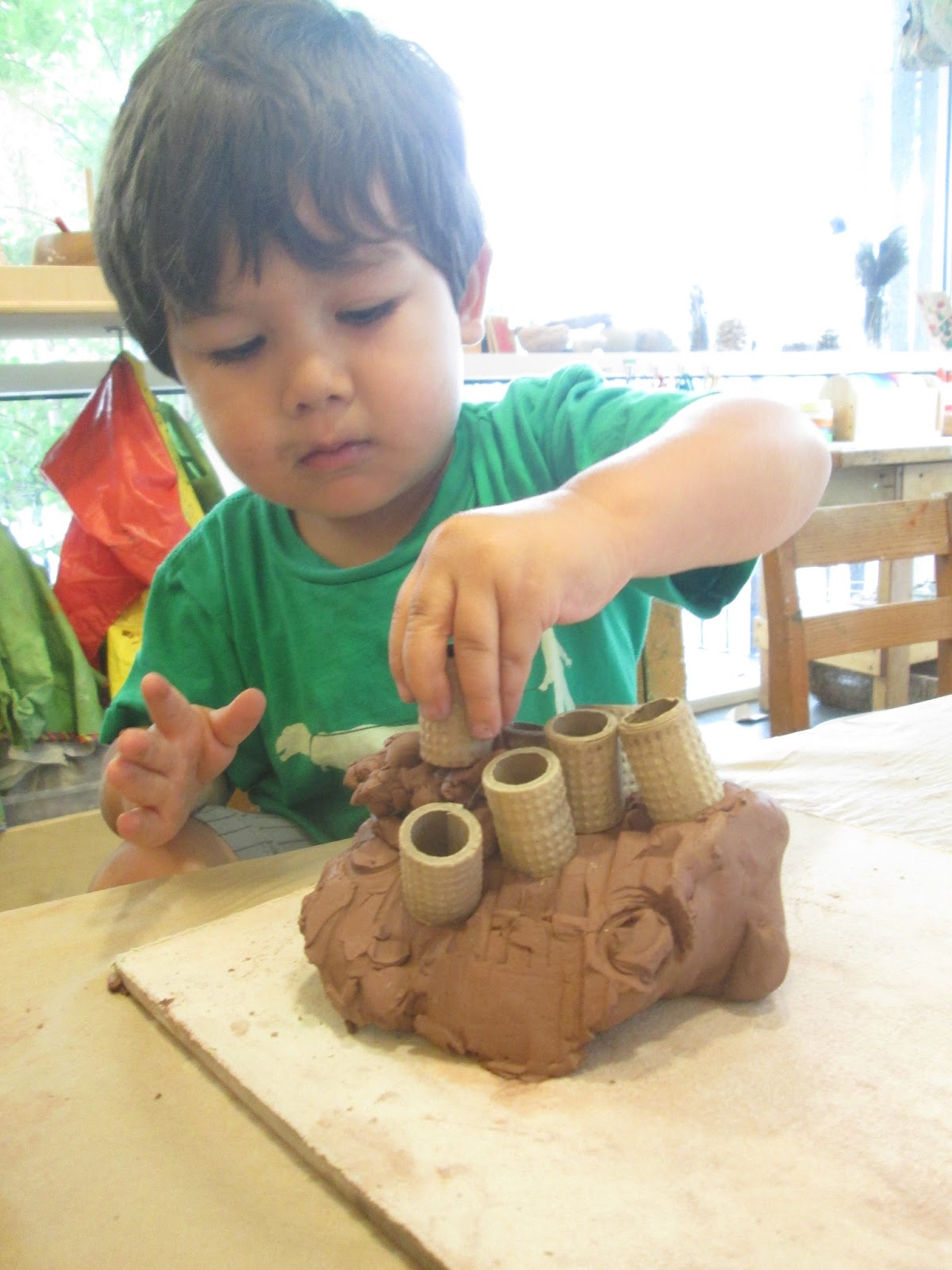
After a brief stop at the drawing table, Yoshi moved to the clay and began to work. He found a wooden clay hammer, which he used to give his clay a texture of bumps. He then found a long, thin tool to poke holes deep into the clay. On the back shelves, he found an array of recycled plastic parts, which he pushed into the clay, removed, and rearranged. When some of his friends discovered buttons on a shelf, he gathered some of these to add, followed by some small, recycled tubes. With each iteration of clay decoration, he would say, "Look," standing back to proudly survey his creation, before returning to work on it. He spent over thirty minutes absorbed in concentrated effort with these materials.

Those thirty minutes reminded me how important it is that we, as adults and as teachers, not close off the possibilities of children's interests and explorations. Yes, through our observations and the time we spend with them, we are able to understand facets of a child's personality, tastes, and learning. However, these are not static, and should not be written off as such. To use another quote of Dewey's, "The self is not something ready-made, but something in continuous formation through choice of action." All of us - adults and children alike - make choices that add to our experience, our knowledge of the world, and our potential actions at future choosing points. The choice we might make at one juncture is often quite different from that which we make at another, and it is the process of "continuous formation" that occurs between these points that is responsible for this difference.

Among the many inspiring ideas that Kendra has shared from her visit to the schools of Reggio Emilia in Italy, one that stood out to me was that of the "relaunch" - the revisiting of a thread of investigation that lost steam earlier in the year. This classroom's return to clay strikes me as something of a relaunch, and Yoshi's response in particular suggests that he now sees far more potential in the clay than he did the first time around. How glad I am that we returned to this medium and provided Yoshi with the chance to show us his new ideas! We will never learn what a child is capable of if we assume we already know.


Do you have any ideas of an activity, a medium, or an idea to "relaunch"?

Looking back over the past year, where have you seen "bursts of bloom" happen for the children in your life?


Monday, July 1, 2013

How do we honor children's hard work?

We might honor it in the moment by observing it, commenting on it, and supporting it. When I see a child has spent time with an idea or a creation - thought about it, struggled with it, maybe had to make changes -  rethink some of its aspects - I want them to know that I was a witness to the process.

We might honor it later by taking time to reflect on what we observed. In reflecting, I feel I am peeling away the layers of the moment, seeking out the glimmer of insight that first drew my attention. I take a second look again at what I sa, turning it over in my minds, like a puzzle box. I search for its intricacies, for its angles, for its potential. I try to use it as a window into children's minds - their understanding of the world's mysteries. More importantly, perhaps, I try to draw back the curtain to look beyond what they know and seek out what it is they want to know.

We might honor it through documentation. I find it liberating to set my thoughts down on paper, sharing all of my musings with children, teachers, and families. It allows me a sense of pride in my work, on the one hand. On the other, it opens up possibilities for further reflection and a sharing of knowledge. Displaying my interpretation of an encounter, I am inviting the community to share in a conversation.

We might honor it by offering further provocation. Mother, art educator, and blogger, Rachelle Doorley writes, "Children who set up their own problems are invested in the process of learning and are motivated to see a project through completion." I constantly strive to offer children provocations that will present them with potentially interesting problems - problems that they will want to work hard and long to solve. I want to follow along with them as they question and probe and discover, and I continue to ask my own questions as we take the journey together. My provocations are one way of saying, "I have been trying to listen to what you are telling me. I'm not sure I am understanding it completely, but here is one idea I had. What do you think?" 

We might honor it with celebration. Right now, our center is preparing for a grand celebration of the past year - our third annual Showcase - and teachers and children alike are so excited for the chance to share  our work with families and friends. Of course, celebrations do not always have to be on such a large scale. Just a few weeks earlier, a group of toddlers held their very own special exhibit during their Studio time, to celebrate all of the hard, focused work they have done together this year. Maddy, Max, and Jordan have been coming to the Studio together, along with their classroom teacher Cathy, since September, and they have continued to use clay as their primary medium, even when nearly all of the other Studio groups branched off into new directions. With each visit to the Studio, this group of children has continued to build on what they had worked on previously, developing a unique, complex, shared vocabulary. Together, these children moved from flattening clay by pressing and peeling if off their boards, to tossing it in the air over and over to shape it into a "baby head," to building up castles from a shared block of clay, to adding glass pebbles (which they named "peekies"), wires, and water to make their creations "more stable." The Studio now houses an entire shelf of their clay sculptures, which were part of the inspiration for our exhibit. 


While parents hear about these bi-weekly Studio sessions through Cathy's documentation, they have not had many opportunities to visit the Studio to see the work first-hand. We decided to create just such an opportunity, setting aside a Studio time for a private exhibition of the children's work, words, and process for the parents to visit. We also decided to offer the adults a chance to learn from their children, working alongside them with the clay, peekies, and wire that they know so much about. 
 The exhibit, which was attended by the mothers of all three children, proved a wonderful celebration of the trio's hard work. Maddy, Max, and Jordan were extremely excited to show their moms their creations, and even more excited to show them how to work with the clay. As conversations developed around the clay and its uses, the children were always ready to answer any questions the adults posed.

Scarlet (Max's mom): How do I take clay off, Max?
Max: You just grab it.
Maddy: I need more water. Here's a brush.
Shawna (Maddy's mom): How should I use it?
Maddy: You have to wipe it on the clay like this, then poke like this. Bump bump bump.
Leigh (Jordan's mom): Why are we adding water?
Jordan: To make it sticky. 
This special celebration gave these children a unique opportunity to share an important piece of their year at our center with some of the people who matter most to them. Watching their interactions with their moms and the clay through the lens of my camera, I was struck by how self-sufficient they were, and how easily they were able to solve any problem they ran into with minimal prompting. One moment, in particular, stood out to me, making me realize how much these children had taken on the role of the teacher in this situation. As Maddy began to rub the surface of her wet clay castle with her hand, she turned to Shawna, asking her questions that we often will ask children: "How does it feel on your hand? Do you like how it feels?" 

This process of exhibiting the long-term work of these three children is what prompted me to think about all of the different ways we can honor children's work through our practice. I felt as though this particular even allowed for a very special form of honoring that I was able to share with the children and their parents on a more personal level. The fact that the children later suggested having a "dad's day" at the Studio too makes me think that this must have been a powerful experience for Maddy, Max, and Jordan, as well.

How do you see yourself honoring children's work?
What great feats have you celebrated with your loved ones or with the people you work with? 
What do these celebrations mean to you?

Friday, January 25, 2013

Building a Nest, Building a Culture


I want to take you back to December 13th, 2012. A group of preschoolers had finished their work for the day on a ceramic sign for their classroom. As they still had some time left in the Studio, they used some leftover clay to work on their own individual experiments. A few minutes in, T. decided, "I want to make a nest. Can you help me make a nest?" F. echoed him. "I want to make a nest, too."

Their seemingly simple request actually held a lot of meaning for me, and for them. These children had embarked on a clay exploration last year, and the result had been a deep investigation of the creation of baby birds/eggs and nests to house them in. One artifact of this process was a set of plans or recipes for making these forms, which helped the children remember the steps that they and their friends had previously deemed necessary for success. 


I still had these recipes in the Studio, hanging from a hook on our clay shelf. As I turned to reach for them, thinking I could offer them as one way to make a nest, F. added, "I need a plan to make a nest." I turned around to show him what I was holding. "Is this the plan you mean?" "Yes! I need the one that shows a nest." "I need one, too," said R., who had also been a part of last year's nest-and-bird making. M. and A., who had not tried nest-making before, were also interested in this idea and came close to look at the plans. 

The children examined the plans, carefully following each step, stating aloud the work they had to do: "Make a ball, poke a hole, then pinch"..."I need mine bigger so I'm pinching more"..."Here's my baby. Let's see if it will fit." R. in particular made an entire family of birds, which necessitated an especially large, open nest. With this complete, she then created one big, one medium, and one small egg, crafting a separate nest to fit each size.


Why has this interaction stayed with me so strongly that I still feel the urge to write about it over a month later?  

Two words: History & Culture

These two words are, of course, inextricably linked, for without the building blocks that a history provides, it is impossible for a culture to develop. For me, the plans are a piece of history - of my history as a teacher here, of these children's history in the Studio, of the medium of clay and the way it has been used here. They are, as I said before, artifacts that speak to an important journey. The fact that the children remembered and asked for these tools in their work nearly a year later suggests the establishment of a culture - a culture of planning and looking back to what we know and have learned in order to achieve a goal. The practice of "making a plan" is, in fact, used in many of the classrooms here. A plan helps children to slow down and focus their ideas, thinking hard about what exactly they are working towards and all of the steps, parts, and pieces necessary to fashion it. It holds them accountable throughout the process of construction, but it also acts as a testament to their hard work when the project is completed. Integrating this idea of plan-making into the everyday work and play of classrooms and schools helps to build a culture where thoughtfulness and follow-through are key, and where each step of the creative process is honored.

This particular encounter in the Studio also speaks to the way in which a long-term relationship with a material helps to foster a culture, as well. In this particular instance, the children's combined knowledge of nest-making and their greater level of expertise with clay allowed them to bring their ideas to fruition more easily and with more accuracy than would have been previously possible. For instance, R.'s nests have become more complex - custom-made to fit the problems she poses for herself - because she has had time to develop her understanding of space and volume as well as her confidence in working with clay. 

This story reminds me of how important it is to look back at where we are coming from and to continue to practice with the tools we have appropriated in our travels. Something we might think had already served its time might prove useful at some future point. It also makes me think of all the ways that we craft our own cultures in the many spheres of our lives through the roots of the unique histories and the artifacts we carry with us. 

My wonderings are: 
What culture do you perceive in your school, at your work, in your home? 
What is the culture that you strive to inculcate, and how does your history help to inform this ideal?

Tuesday, December 11, 2012

A Conversation about a Castle, A Reflection on Fairness


A group of older preschool children have been working hard to build a castle out of clay.
During our last session in the Studio, the following conversation unfolded.

R.: Excuse me, Susan, Ian, Nina, E., can I make a bridge on that castle?
Nina and Susan say “Yes”. E. and Ian say “No”.

Katie: Why not?
Ian: It goes down.
E.: Because it might fall down.

Katie: Can you show us where you want the bridge to go?
R.: (points to a space across the top of the castle.) Can I make it go this way, E. and Ian?
Both: No!

R.: Why?
Katie: Why?
Ian: No, because that's like a sky.
E.: Because it will fall down inside.

Katie: Maybe you could show us what you want the bridge to look like?
R.: (to me) Can I use your clay?
Katie: Sure
R.: Is it okay if I do something like this? (She draws lines on the clay and holds it up for everyone to see.)
E.: Yes, that's okay.
Ian: No.
R.: Why?
Ian:  no answer
Katie: Well, now we have three votes that say yes, and one for no. If we are voting, it's okay. 

As R. began to draw the lines for her bridge, Ian seemed hesitant as to whether or not to accept them at first. However he began to nod his head and point to other places he thought the bridge could extend to.

This happened over a week ago and continues to resurface in my thoughts. Even in the interaction, I wondered about my words and my influence on the situation, about the values I was upholding in moderating the moment. Specifically, I’m thinking about fairness and all of the possible ways to present a decision or action as "fair."

Why Did I Suggest a Vote?

I suggested voting as a way to answer R.'s question as to whether or not it would be okay about making the bridge. Later, I wanted to analyze why I jumped to using this form of problem-solving rather than allowing the conversation to continue until everyone felt happy with the agreement.

Time Pressure
First, I recognized in myself a feeling of pressure about time. Studio only takes place once a week for forty-five minutes, which means that these children have a limited amount of time to work on their projects each week. Although I knew that hashing out the issue would be very valuable on multiple levels I also worried that if I didn't help to resolve things quickly, they wouldn't be able to make any progress on the castle.
This is reasonable of course, but looking back I wouldn’t prioritize time if I had it to do over again. Next time, I think I’d give the children time to resolve their issues, even if that did mean we would have to wait until the following week to enact our decision.


The Power of No
By the end of the conversation I was unsure whether Ian's continual "no" was rooted in a true aversion to the idea of the bridge or whether it was rooted in the power of saying "no" in the face of so many saying "yes." I wish I had waited to ascertain this and let R. try to work more closely with Ian to try to achieve a compromise before I offered a solution. Even if his ideas had revolved more around power than around the actual bridge question, I would have liked to hear the discussion the children's discussion about this.

The Majority Rules
Finally I knew that these children were familiar with voting and had suggested it as a problem-solving method before. But now I wonder if this was the right way of handling this particular argument.

Is Voting Fair?

Now I wonder why, in a bigger context, this idea of voting rose to my mind (and comes up elsewhere in our school) as a means of solving disputes "fairly."

On the one hand, voting is an essential part of America's political problem-solving system. It is what we hold up as being a fair way of making a single, united decision for a large group of people. Perhaps, because of this, it is ingrained in those of us who grow up here that voting is a fair and just way of making decisions and resolving disputes.

On the other hand, voting compromises the feelings of the individual for sake of the majority. Decisions are reached more quickly without having to appease every dissenting voice. When I think about it this way, voting feels less than fair to me, and it is not the ideal tool I would like to give children for solving their problems.


So, what would I prefer to advocate?
  • I think of the consensus-building exercises we have undertaken as a staff this year, where we have worked together to reach an agreement "we can live with" about issues like the possible adoption of a school-wide playground policy.
  • I think about the ways in which we constantly try to provide children with a sense of their own autonomy in as many aspects of their lives as possible, including decision-making.
  • I think about the fact that, even though there is a necessity for schedules here, there is also a lot more breathing room here than these children may encounter in other settings of their future lives.

I think that I would like to make more space for children to undertake the hard, sometimes grueling process of consensus-building, even at the expense of time and action. I would like them to feel in their hearts that fairness is important, that it can be hard, but also that it is attainable. And I would like to be a teacher who supports them in discovering this. I suppose I have found my new year's resolution!

What do you notice about the conversation I documented?
What perspectives do you have about fairness and problem-solving?

Do you ever find yourself interfering in a similar way, and how do you react in those moments?