Showing posts with label video. Show all posts

Thursday, December 11, 2014

Conversations with Nature: Preschool One Explores Natural Materials

“We often forget that WE ARE NATURE. Nature is not something separate from us. So when we say that we have lost our connection to nature, we’ve lost our connection to ourselves.”
                                                                                   ― Andy Goldsworthy

Autumn in New England is full of natural beauty – from golden leaves floating to the ground to acorns nestled in the grass to branches blown free by the winds.  These objects call out to be touched, gathered, collected, and children often do just that. Pockets that were empty before the trip to the playground return crammed full of bark and twigs and stones. Long sticks are brandished like swords and left unwillingly beside the door until they can be used again. These things entice us, draw us in, and call to our creativity. They are one of the hundred languages, and, if we make space, we can speak through them. This is Preschool One’s story.  

Rivers and Tides
We began our work with natural materials in the Studio by watching pieces of the documentary, Rivers and Tides.  This documentary features the work of artist Andy Goldsworthy, who creates beautiful installations – some in museums, but many of them outside – using entirely natural materials. I love this documentary because it not only showcases Goldsworthy’s breathtaking creations, it also shows his process. You can see his attention to detail in finding the perfect piece to add to his creation, as well as his frustration when one of his projects collapses midway.

I projected the video on the wall without sound, occasionally prompting children’s conversation with questions, such as “What does that remind you of?” or “What do you think he is using?” Here are some of their thoughts about what they witnessed*:


Alisa – It’s a snake.
Y. – Did you know there’s paths like that?
N. – Maybe it’s a drawing.
Justin – Maybe it’s lava.


E. – Hey all those are blowing away from the snake.
Justin – There’s something inside them – a sea snake.


A. – We see ice.
F. – His hands are cold.
Y. – What is he making? He’s eating it. Ew.
E. – It’s cuz all the other pieces are just like it and he can stick the pieces to the pieces.
All – BRAVO (when he finally sticks his last piece of ice).
N. – It’s a snake tree.


Justin – Maybe he’s making a nest.
Arnaud – Maybe he’s making a nest out of trees.


A. – I think he is making a house for him. He’s using stone.
Justin – Looks like a pile of rocks.
Gus – Maybe it’s melting – now.


Alisa – It’s a web.
Y. – You know why it’s not a web, because there’s a hole on a stop sign.
F. – Why is there a hole there?
Y. – Maybe so it can be a stop sign.

The Building Process
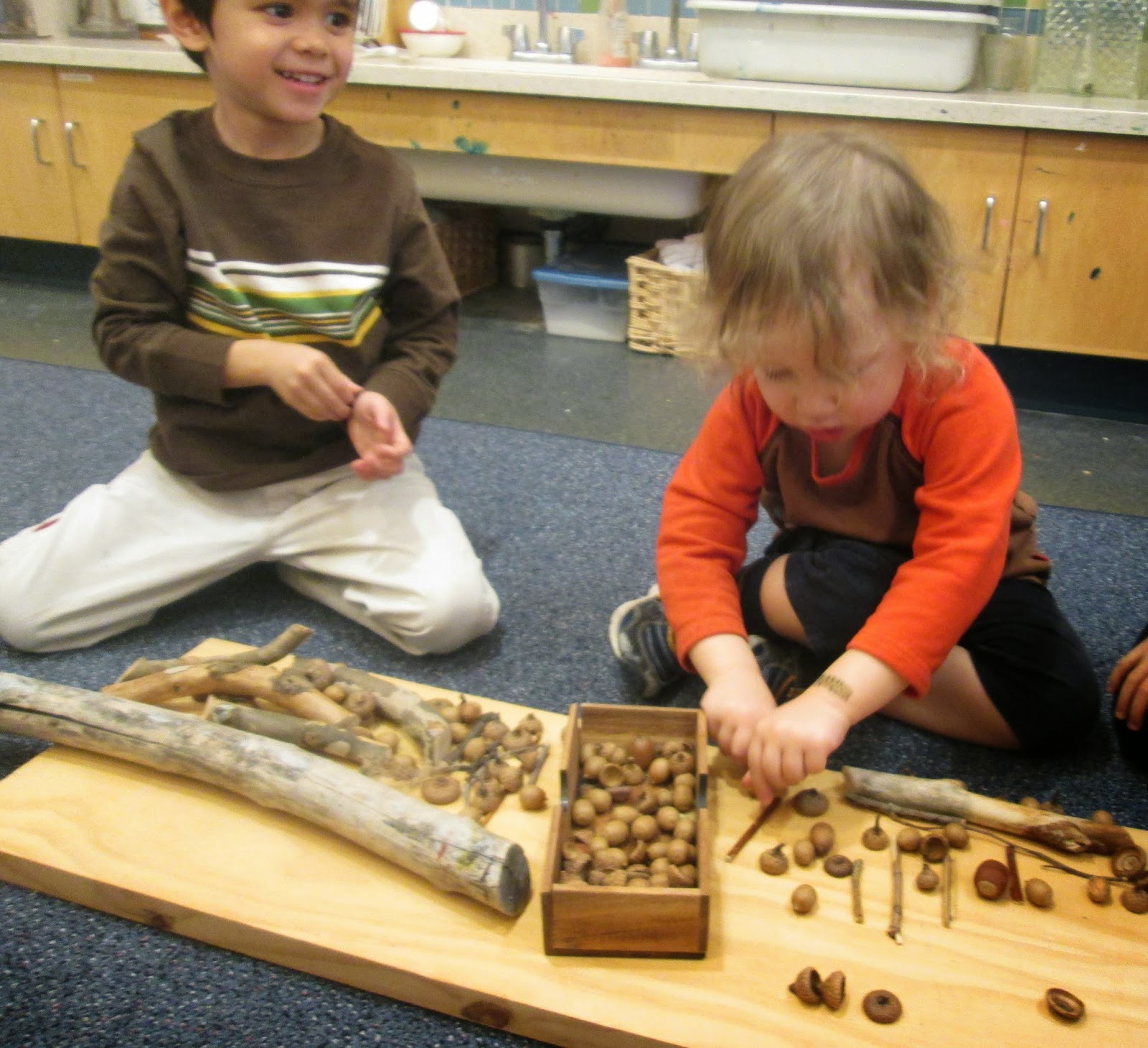
Following the video clips, I moved away the projector, spreading out several work surfaces on the floor, as well as baskets filled with many of the same materials that the artist had used. As children began building, I could see ways in which Goldsworthy’s work directly influenced their designs and their methods. Their great care in building creations using sticks, rocks, pine cones, acorns, and leaves seemed to echo the deliberation and concentration we had witnessed in the video.


As Gus surveyed the materials, he asked, “Can I make like he did?” beginning to collect sticks for a “nest.” Later, when he wanted to make one of the sticks stand up, “like a tree,” he made use of a glass jar as a stabilizing device. When A. laid out a small circle of rocks, she said, “I made what he made. I saw he made a hole with rocks, so I made a hole with rocks.” El. created a long line using all of the rough-edged rocks available. Arnaud and Justin built intricate traps, where each acorn cap or stick had a job to do.  N. enjoyed making matching stacks of things, such as a series of tree ring towers. Phineas overlapped a series of sticks, which he described as “just a design.”  E. worked to cover the entire surface of the different squares of wood set out alongside the materials. She would search for the perfect rock to fill each space, creating an orderly mosaic of materials.

Questions of Scarcity
I noticed that order and space became very important for many children over the course of the visit – lining up a series of sticks that were big enough to stretch across two other sticks like a bridge, filling a small square with only smooth stones… This meant that many conversations arose around the issues of scarcity – not having enough to finish a project you had begun – and stockpiling – holding on to many things in order to use them for future projects. Such conversations are part of the preschool milieu – how do you share space and resources with 15 (or, in this case, 4) other kids? The unique piece of this Studio experience was that this was a space dedicated to using just these particular materials, leaving more room for these discussions to happen. In many cases, the children discovered that their worries about someone else taking “all” or “too many” of something were unfounded, or that they really did not need all of the pieces they had been fighting to keep. For instance, when Gus was working to create his “tree,” the glass jar he wanted was full of sticks. He quietly sat down by the jar and began to empty it out. A. and E., who were working nearby, watched him.

A.: Oh no, he’s taking everything!
E.: Oh no, and I need sticks!
At this point, Gus left with the jar, leaving a pile of sticks on the floor.
E.: Oh, he just took that jar.
Katie: Did he take everything?
A.: No, he left those.
Katie: All he needed was the jar, so he left the sticks for you.
E.: That was nice of him. I guess I only need a few sticks.

Where the River Meets the Sea: The Big Picture
Through this experience, the children gained practice in appreciating, using, and re-using these natural materials. Treated as loose parts, the possibilities of sticks, rocks, and leaves multiplied, while children’s concerns over quantity and ownership gradually diminished. My wish is that this way of being can extend beyond the classroom into the greater natural world, where we can recognize forests, mountains, rivers, and more as treasures held in common, worth defending to be appreciated again and again by generations, rather than used up for the sake of one. We are the stewards of the earth, and we are charged with the task of passing that stewardship on. The best way I can think to do this is to help children engage with nature, cherish it, and not merely preserve, but share it in good faith. 

*The pictures featuring Goldsworthy's work are screenshots from Rivers and Tides.

Monday, December 2, 2013

Waiting for the potty IS our curriculum! Thinking about our hidden curriculum with videos

A beloved colleague said the above when teachers complained about the parts of the day that seem to take time away from learning. What he meant was that young children are learning from every experience in our care, and that the ways that we choose to care for them are another way of teaching. These moments are part of the "hidden curriculum", and provide an opportunity for us to learn about ourselves as people and as teachers. When we look at how we help children with their coat, or sing a song to them we learn about who we are, which informs how we teach. 


We spent a few weeks examining our hidden curriculum so that we can shift our practices and allow even incidental moments to be informed by our highest values and our best thinking. Each week, a different group of eight teachers came together and read an excerpt from the first part of Parker Palmer's brilliant essay "The Heart of a Teacher".

Here is a little of the wisdom teachers and staff shared in reaction to this piece:

Katy: When something doesn't go well, we pick it apart, "Why is it hard?" When something is going well, we rarely reflect on it and think "What did we do well?" so we can remember that. This is true in supervising staff as well.

Sarah: I really resonated with the second paragraph. It took me a long time to realize that everyone who is a teacher feels stupid or worthless or that they're not good at their job sometimes. Sticking with the cycle long enough, I've gotten to more self-compassionate practice. I'm a flawed person and I'm a good teacher.

This week, we considered transitions, which make up a big part of our day, by watching teachers and children transition together.

We started with a ten second video by way of introduction. Sara, a toddler teacher, walks with three children to a play yard. Afterwards, I asked the group "What are these children learning in this moment?"


  • to stay together (They are all holding hands.)
  • that the destination is exciting ("Here we are! Yay!")
  • there are many ways to get there (for example, waddling like a penguin)
  • learning about Sara as a teacher, her sense of humor... if I were with her I'd feel safe
  • they know to hold hands, they know they can leave their room together and get somewhere fun together
These are the kinds of things that all children are learning when we don't realize that we are teaching. Sara is a master teacher and she was teaching these children as she skipped and celebrated with them in this tiny moment. I believe that the more that we watch each other and ourselves teach, the more we practice paying attention, the less our curriculum is hidden and the more children are learning the kinds of things we want to be teaching.

We spent the next hour or so watching three videos: a toddler 1 class getting ready to go outside, a toddler 2 class waking up and getting ready to go outside and finally a preschool classroom cleaning up their classroom. Teachers had three protocols to choose from to focus their thoughts as they watched. One was about limited resources; tracking time, space and attention and how they were allotted. The next was grounded in our Reggio Emilia inspiration examining the role of the teacher, the role of the child, and the role of the environment in the clip. Finally, Some teachers used a list of Howard Gardner's multiple intelligence to see what kind of learning was taking place.

Monica: I noticed that even though they were running back and forth and doing other things, they were trusted by their teachers. the kids who needed attention, they got the attention they needed

Mari: I was thinking about our Reggio inspiration...the image of the child, the trust. Each [of the children] were focused on something different, touching  a basket, looking out the window, looking at [the class next door through the window]. This was a situation where it could be chaotic for a teacher "Don't' touch that! Come here! Your coat, and here's your hat!"  

Sarah: There was a lot of room for intra-personal learning, one kid is lying on his or her mat, taking care of themselves, waking up. Phineas is given the choice to eat inside or outside, when he is frustrated they say "I just didn't hear you, it's not a big problem." Teachers helping children learn who they are as individuals.

Debbie: I was struck by the kinesthetic part... that once they got their coat on, they weren't just sitting on the bench, they were running through. There was energy that was all allowed and encouraged.

H: I noticed the role of the teacher: I liked all the questions, asking for teamwork, asking "Can you show me where this goes?" instead of just picking it up.
_____________________________________________________
Athletes watch videos with their coaches to really see the way that their bodies work, the consequences of their choices as they work. We use videos in our professional development for the same reason; to notice things from the outside that we can't from the inside. Our center values collectivity, so we watch videos together. 

The ones we watched were all taken in one hour last week, we didn't prepare for them in any way. I just showed up with a camera and asked permission and teachers graciously assented. Every time I share video of a teacher to other teachers I'm humbled by the willingness of the watched to share themselves and by the gratitude, sensitivity and recognition offered by the watchers.