Showing posts with label dispositions. Show all posts

Wednesday, May 3, 2017

Anti-Bias Education is Not a Concept or a Skill, it's a Learning Disposition

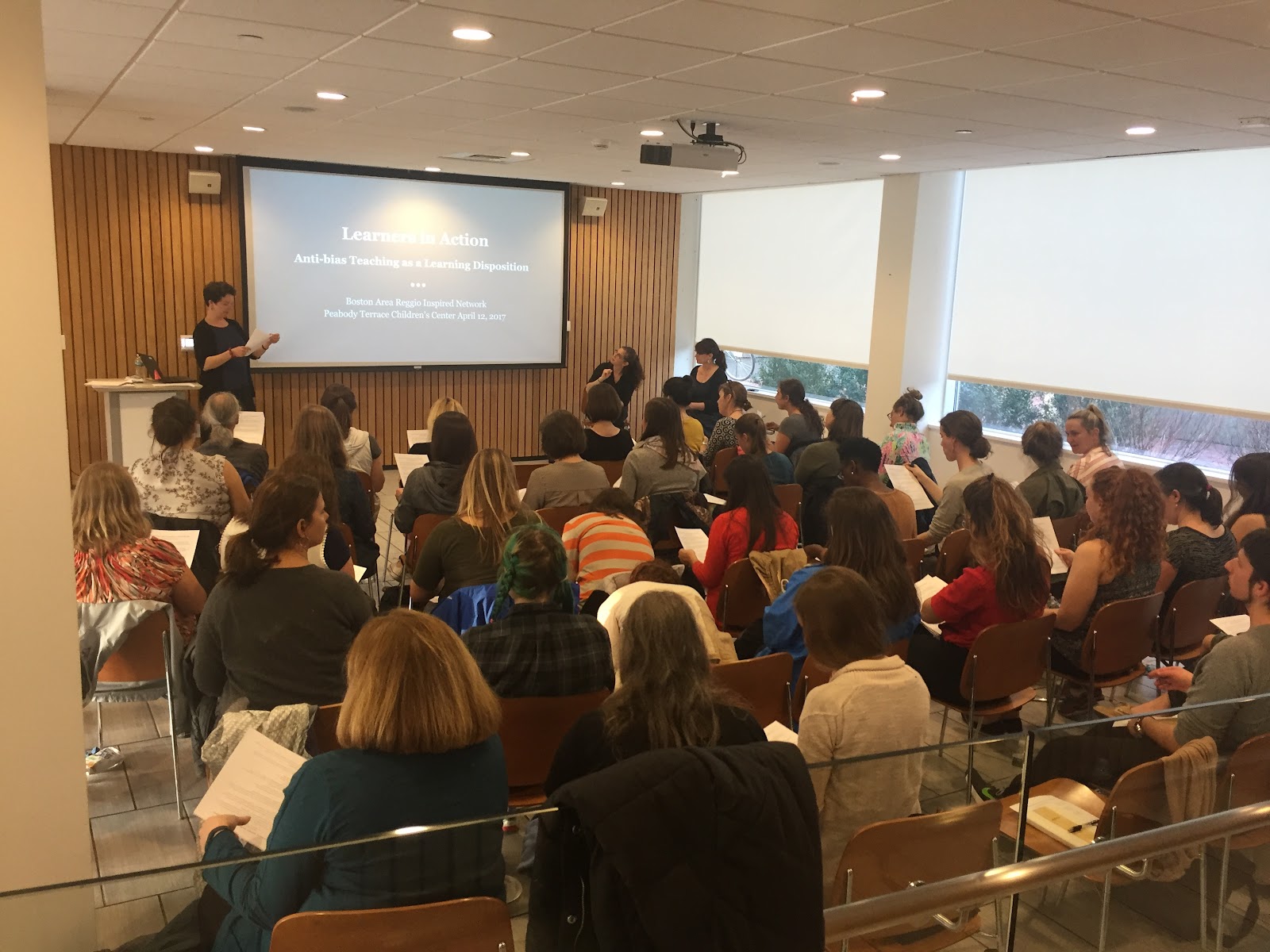
Last Wednesday, we welcomed fifty educators as part of Boston Area Reggio Inspired Network’s 2017 series. We reflected upon how we’ve brought liberatory teaching into our own practice, and planned strategic next steps using Margaret Carr’s structured view of learning dispositions.


Learning Dispositions are “situated learning strategies plus motivation”.
-Margaret Carr, Learning Stories; Assessments in Early Childhood


Teaching and learning are situated within a specific group of people with a variety of identities and within our larger contexts; our classrooms, communities, nation and world. Anti-bias teaching starts out haphazard and ad hoc sometimes but before long we realize our work must be strategic to stay accountable to our goals. We are motivated to do this learning and teaching by its obvious urgency; children’s worldview, culture and safety can be at stake.


“Becoming is better than being”


Carol Dweck’s “process goals” and “performance goals” describe two different approaches to learning, and it is crucial that we are not perfectionists in the work of education for freedom. Dweck researches learners’ orientations to errors and other challenges. Learners with “performance goals” and a fixed mindset want to get it just right without effort. They want to “be” smart or strong, but dislike making mistakes, and feel uncomfortable with the struggle it takes to “become” smart or strong. “Process goal” learners have a growth mindset and seem to enjoy struggle, and recognize that good outcomes; the right answer, for example, or a new skill, come out of hard work and mistakes. They are willing to do what is needed to “become” better.


We can’t wait for anti-bias education until we are ready, worry about achievement or get it right the first time. We can only counter bias through the invaluable process of becoming more knowledgeable, more open, more awake, more willing to act and move through our errors with humility.  Because biases and unfairness are in the world, they are in our classroom and in us.  We will struggle and we must be ready to listen when folks tell us that we’ve made mistakes.


We need a view of learning that sees “development as the transformation of participation” (Carr, again, naturally). These domains take a process orientation for granted and measure that process through a narrative built of observations.


She identifies five domains of a learning disposition:
Taking an Interest,
Getting Involved,
Persisting with Challenge or Uncertainty,
Expressing thoughts and feelings and
Taking Responsibility.
These domains are a perfect way for us to understand our own growth as teachers for liberation.

Learning from History
Many years ago, I asked our mostly white staff to self-identify; whether they knew nothing, something or were experts about anti-bias curriculum. Everyone RAN over to the “experts” part of the spectrum. (I didn’t know what I didn’t know about people’s poor ability to accurately appraise themselves about things they don’t know much about, and I underestimated the personal drama of being asked to do it publicly.) People in the “expert” area explained themselves;  “I have an Asian neighbor.” or “I don’t see color.”

These folks were beginners, but they thought they were experts. I learned from my mistake; this time, we used Carr's domains as an objective yardstick to help us figure out what kind of learning we’ve done and what kind we are headed into.


After a short presentation about our collective journey with anti-bias education at Peabody Terrace Children’s Center, we used a protocol to create our individual narratives of engagement with anti bias education and reflect.


Then, we brought in the key element of feedback. We shared our stories with others and they helped us determine which of the learning domains we were working within. Finally, well-informed, we identified for ourselves what kinds of actions might help us move forward from where we are.


Domains of Learning Dispositions:
Learners taking an interest are developing:
  • A view of self as interested and interesting,
  • Interests,
  • Expectations that people, places and things can be interesting,
  • Abilities and funds of relevant knowledge that support their interests.
Learners getting involved are developing:
  • A view of self as someone who gets involved.
  • Readiness to be involved, pay attention for a sustained length of time
  • Informed judgments about the safety and trustworthiness of the local environment, Strategies for getting involved and remaining focused.
Learners persisting with difficulty or uncertainty are developing:
  • A view of self as someone who persists with difficulty and uncertainty
  • Enthusiasm for persisting with difficulty or uncertainty,
  • Assumptions about risk and the role of making a mistake in learning
  • Sensitivity to places and occasions in which it is worthwhile to tackle difficulty or uncertainty and to resist the routine.
  • Problem-solving and problem-finding knowledge and skills,
  • Experience of making mistakes as part of solving a problem
Learners communicating with others are developing:
  • A view of self as a communicator.
  • The inclination to communicate with other in one or more of the 100 Languages, to express ideas and feelings,
  • Responses to a climate in which learners have their say and are listened to,
  • Facility with one or more languages, familiarity with a range of context specific ‘genres,’ script knowledge for familiar events.
Learners taking responsibility are developing:
  • A habit of taking responsibility in a range of ways, to take another point of view, to recognize justice and injustice, a view of self and others as citizens with rights and responsibilities,
  • Recognition or construction of opportunities to take responsibility
  • Experience of responsibility, making decisions, being consulted, an understanding of fairness, strategies for taking responsibility
(Adapted from table 2.1, in Margaret Carr’s Assessment in Early Childhood Settings: Learning Stories)


As someone who thinks not only about individual development, but also about how our organization grows and changes, these domains also helped me to see which domain our center is exploring. We have firmly established interest, involvement, persistence and communication about anti-bias teaching. We are on the edge of taking responsibility; this is our next frontier. This framework takes for granted a "growth mindset" and in situating teachers' development within the realm of learning dispositions, it is my hope that teachers work to let go of their hangups that come with performance goals.
Does this structure help with some of the feelings of unsettledness, inertia, or hopelessness that sometimes accompany this work?

How could we use this way of understanding with families?

Thursday, May 12, 2016

Our Neighbors, The Robins Have Some Eggs!


 We have watched as a pair of robins built and then rebuilt their nest.   
Now the mama is sitting on her eggs each day, and in a week or so, there will be babies!

This nest is outside the piazza window of the building where our youngest children spend their time. After a toddler built herself a step out of large box to better see the nests, I put a sturdy stepping stool beside the huge window and now anyone who can walk and climb a ladder can get a little closer to see the robins care for their eggs. 
Watching animals in their natural habitat helps us build empathy, curiosity and our powers of attention. We learn about natural systems and that humans are only one species among millions of others. These dispositions of naturalists will serve children over their whole lives.


“Our work as teachers is to give children a sense of place — to invite children to braid their identities together with the place where they live by calling their attention to the air, the sky, the cracks in the sidewalk where the earth busts out of its cement cage….


When we talk about the natural world, we often speak in generalities, using categorical names to describe what we see: "a bird," "a butterfly," "a tree." We are unpracticed observers, clumsy in our seeing, quick to lump a wide range of individuals into broad, indistinct groups. These generalities are a barrier to intimacy: a bird is a bird is any bird, not this redwing blackbird, here on the dogwood branch, singing its unique song.”
(Ann Pelo, A Pedagogy for Ecology. Rethinking Schools, Summer 2009)


Monday, March 14, 2016

The Mightiness of the Pencil, Crayon, Pastel, and Marker

“Drawing is the discipline by which I constantly discover the world.”
- Frederick Franck

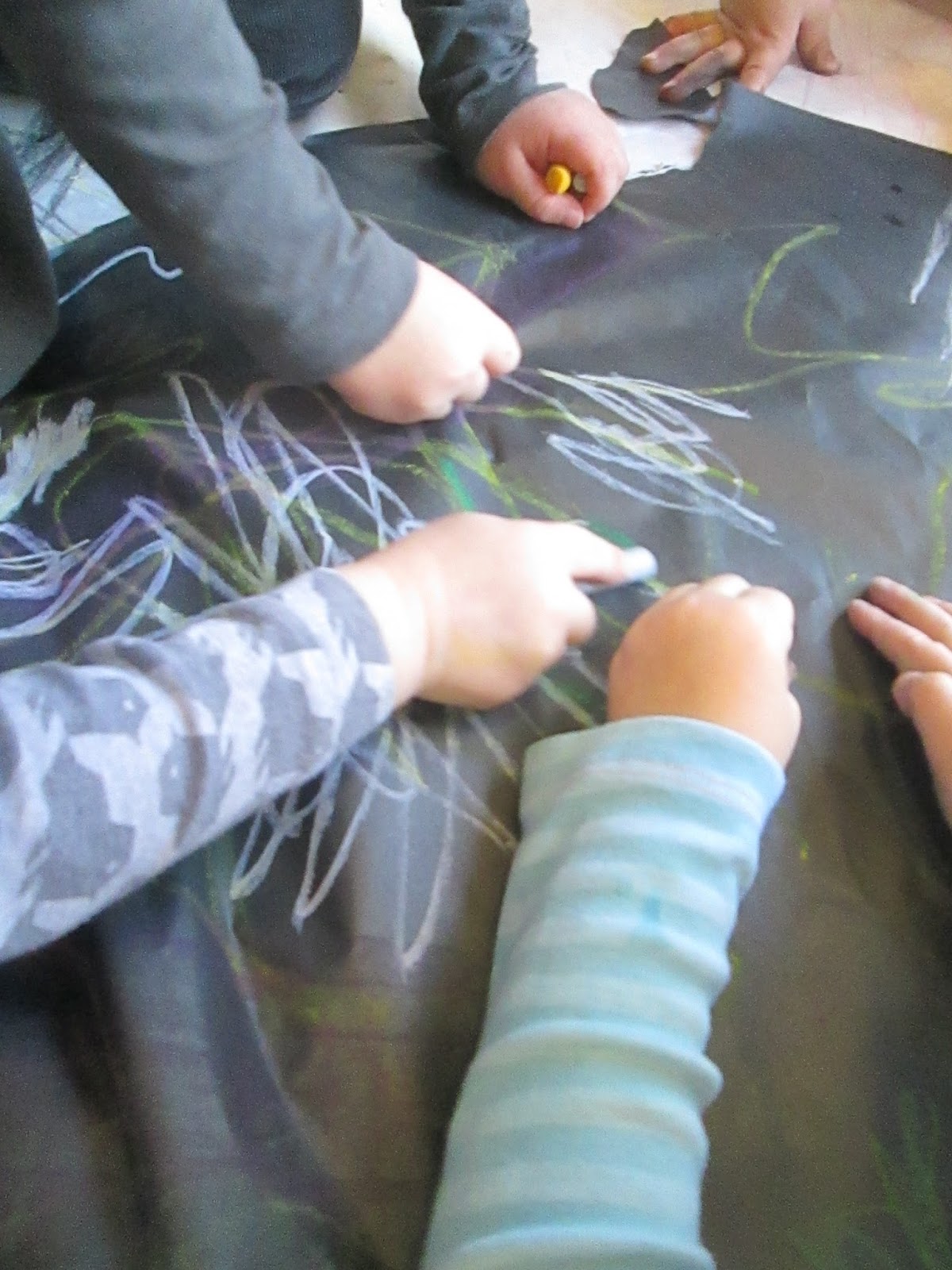
For over a month, children across our center have been coming to the Studio to draw. They have been drawing with a variety of materials - from markers to pencils to pastels - and they have been offered a number of provocations. The results have been by turns energetic, controlled, colorful, monochromatic, expansive, minimalist, exploratory, expressive, abstract, and representational. Working with children of all ages as they continue to explore the world of drawing caused me to reflect on why this process is so powerful, and has been throughout human existence. For most artists, even those who work in three-dimensional or technological forms, drawing is a necessity. In the case of James Castle, an artist who was born deaf, drawing became the means of communicating his inner life. It is, in many ways, an essential "language" for us as human beings. 

This leads me to wonder:
What does drawing offer to young children? 


Drawing works a variety of important muscles – the grip of the fingers, the flexing of the wrist, the bending of the arm. It helps to build fine motor skills, but it can also be an outlet for gross motor movements. 

Drawing translates their movements into creation - each gesture leaves behind a trace. If your arm moves in a circle, your mark also curves round and round. Pushing your drawing tool straight forward leads to a sharp, straight line. A pencil in each hand means twice as many marks appearing on your paper. Many fast, back and forth movements leave a tangle of zigzags on the page.


Drawing invites children to work as individuals to bring their ideas to life – they conceive their own concept, they choose their own materials, they determine the composition. If they return to the same work over and over again, they come to recognize the drawing as their own.


Drawing offers children opportunities for collaboration – they find space alongside each other to work on the same surface, they share materials and ideas, they discuss, dispute, and compromise. 


Drawing invites children to make connections – they connect the lines and shapes they create with the world around them, with symbols, with movements, with each other. Drawing from life - whether doing portraits, self-portraits, landscapes, or still lifes - invites them to look closer at sights they see every day, to notice and appreciate their nuances. 


Drawing helps children enter into multiple literacies – they imagine their series of squiggles becoming words, they see lines connecting to form letters, they begin to draw representationally. Zigzag lines across a paper become a letter written to parents being missed. Three dots remind someone of their symbol, or a curved line looks like the S in someone's name. 


There are surely more things to add to this list - these are simply the ones that come to my mind when I think of the power of drawing. 

What additions would you make? What does drawing offer the young children in your life? What does it offer YOU? 


Tuesday, February 16, 2016

Schema Theory; Following The Threads of Children and Teachers

“There’s a thread you follow.
It goes among things that change.  
But it doesn’t change.
People wonder about what you
are pursuing.


You have to explain about the thread.
But it is hard for others to see.
While you hold it you can’t get lost.”


From The Way It Is by William Stafford


January’s teacher provocations unpacked Schema theory. This theory recognizes repeated patterns in children’s play as threads that connect children’s learning over time. Most of us have encountered a child who throws everything they can, who spends lots of time on the swings learning how to jump off, and who watches an airplane move across the sky. This child might have a “ trajectory” schema. Children who fill buckets or bags and make deliveries may have a “transporting” schema. These two examples are physical presentations of schemas, but someone with a circular or rotational schema may enjoy spinning things (and themselves) and enjoy drawing circles and thinking about how a jet engine, a bicycle pedal or a Ferris wheel works. For some depth on schema theory, look here. For a practical chart to help you start identifying and planning for schemas, check out this chart and remember this is NOT a comprehensive list. There are as many schemas as there are children.


Thinking about children’s play and work this way helps teachers and parents take a new look at repeated play behaviors and see them as constructive, engaged learning actions. (Sometimes adults find themselves stumped or irritated by repeated behaviors and this perspective can help us identify the learning taking place even as the child is pulling all the toilet paper off the roll, or covering their arms and hands with paint.) Teachers can use our knowledge of individual children’s schemas to carefully prepare our provocations to support the ways our children are learning. Story cubes can help a child with a trajectory schema in co-creating a narrative, adding pieces of fabric to the block area might intrigue a child who has an enveloping schema.


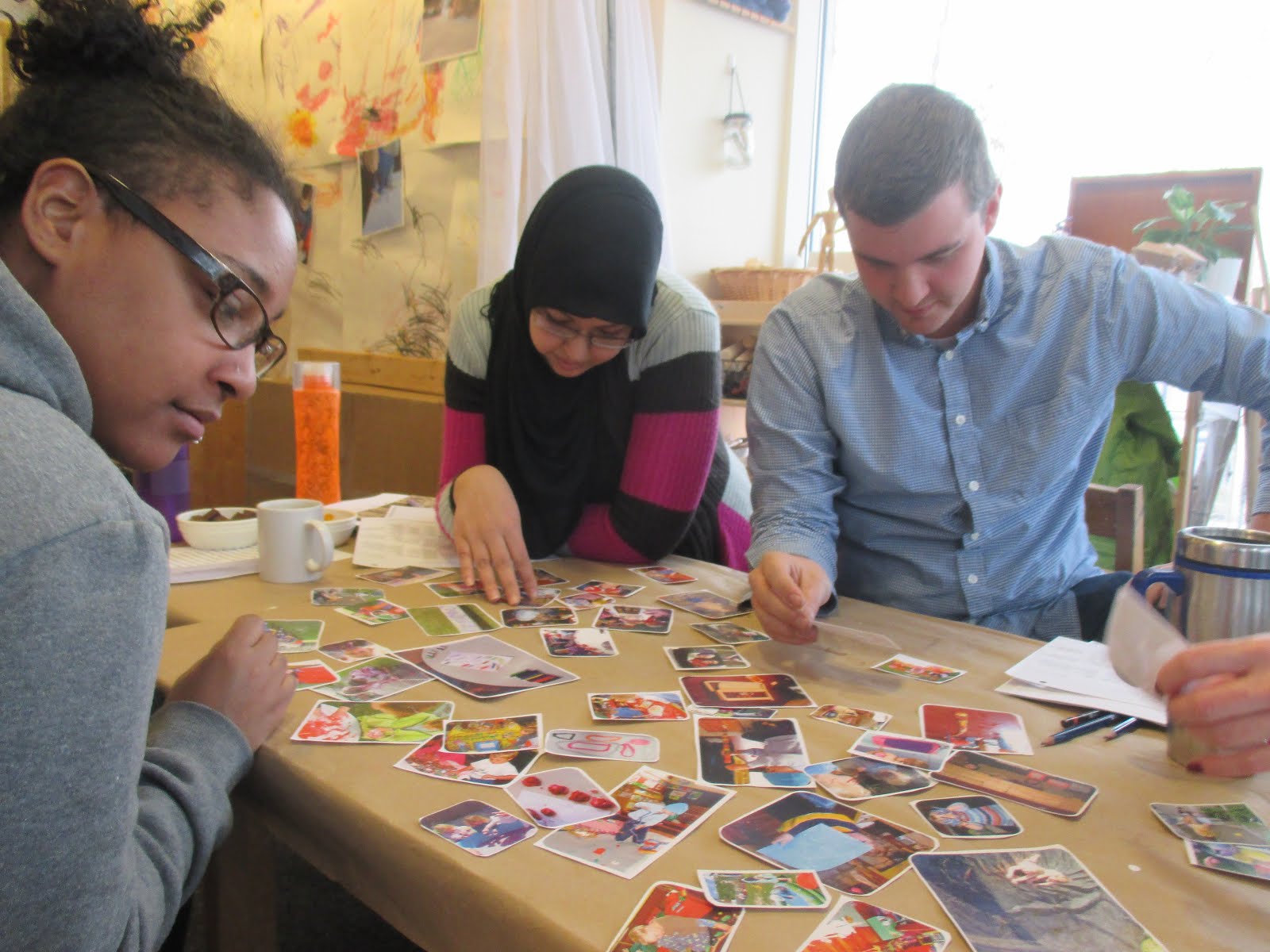
Unlike many topics we explore together, this one was, for the most part, an unfamiliar concept. We did some reading from Getting Started With Schemas by Nikolien van Wijk (a book I bought in New Zealand where schemas are more commonly used to understand children’s play and work), and from other sources. We sorted photographs of children’s play by schema, drew stories of schemas we see every day and as we worked, we talked.

Over four meetings, I began to see threads of common understanding in how teachers constructed this idea of schemas and how they fit into our work. I think that some of these threads may be abstract schemas, habitual ways of considering new ideas. I don’t have enough evidence from these meetings to identify the repeated patterns for individuals but overall I heard teachers folding this new information into their existing expertise in a variety of ways. I’ve grouped them here to demonstrate the many different ways to consider new ideas about our work, and to demonstrate the parallel tracks our professional development and our teaching of young children can take.


Analyzing: Some teachers took apart the theory of schemas, looking at it from different angles.


“How does adult... interest or [action] impact a child’s schema? How does the child react to being seen this way?”


“I sometimes wonder, is that [repeated behavior] keeping them from doing other things? But I guess that is the thing, actually.”


“I’m becoming very aware of children’s and adult’s agendas.... I’m not attuned enough yet to see a pattern, but I see how schemas could help me see children’s agendas more clearly.”


Considering development: Some teachers fit the concept of schemas onto their preexisting knowledge of how children change and grow.


“It’s hard for me to see a schema NOT as something that naturally comes after one stage and before the next.”


“As kids get older it’s easier for me to see how much attention they can give to one thing.”


“How do I learn a child’s schema without being influenced by stages of learning?”


Self-reflecting: These teachers thought a lot about how their emotions connect with what they learned about schemas.


“Why does this behavior bother me? Why does it matter if he fills a bucket every day?”

“This helps me to reframe what I take for granted in children’s play.”

“Developing curriculum in this way challenges me to think about why I say no, make rules.”

“When I can put myself in a child’s shoes, I’m better able to teach. This is another way to do that.”


Questioning: These teachers tend toward big questions, and their learning about schemas catapulted their thinking into philosophical directions.

“What makes different kids develop different schemas?”

“What is the nature of learning?”

“So... schemas are always patterns but patterns are not always schemas, right?”


Strategizing: Some teachers rolled up their sleeves and immediately considered how this theory would function.
“This is a way of watching a child’s focus; not on one idea or activity but across themes, across materials and activities.”

“What a wonderful way to think about redirection... and about continuing in a direction!”

“Kids in my class are fighting, are being powerful and dominating one another. I’m not sure what schemas they’re exploring but I’ll take notes.”

“It’s a way of saying yes, which my team is trying to do right now. We notice and then say "Let’s find a way to make these things happen”.

“It’s a helpful way of getting to know new children.”


It’s important for me to note that these are not transcriptions of conversations. I sifted four different 90 minute conversations into these categories. I looked for patterns in the same way that a teacher looking for schemas will. Sometimes two people with different threads spoke to one another. It was challenging, but teachers here are used to communicating despite differences. Just as children with different schemas can be invited to play together by carefully designing provocations, adults with different approaches to new ideas can be invited to talk about them through careful provocation. The variety of activities (group text study, conversation prompted by quotations, illustrating a narrative, collaboratively sorting photos by schema) provided allowed folks with different preferred threads of investigation to connect.

Self-reflection is a teaching skill. The more we can see our own thread, the better we can find them in the work and play of others. Which of the above resonates with your way of wondering?

How do you see this kind of work happening with the third protagonists, families? What threads of habitual thinking do they hold through a variety of different experiences?