Showing posts with label curriculum. Show all posts

Thursday, October 12, 2017

Our first Umbrella Project!


Investigating Together:

Exploring the Charles River as a Center

“Learning and teaching should not stand on opposite banks and just watch the river flow by; instead, they should embark together on a journey down the water. Through an active, reciprocal exchange, teaching can strengthen learning how to learn.”
-       Loris Malaguzzi


The idea of embarking on an umbrella project came from work that is done in both Reggio Emilia, Italy and in the Sabot School at Stony Point in Richmond, Virginia. It is a center-wide investigation undertaken by children & teachers that continues throughout the year, in various forms both big and small. Together as a center, we defined what the topic of an umbrella project might be:

“A compelling, enticing, accessible, physical thing, event, place or idea (a noun) that elicits a emotional and metaphysical response between people. A catalyst with opportunities for investment in deep, dynamic connections, new ideas (growth).”

 For our first umbrella project (which we investigated during our 2016-2017 school year), we chose the subject of the Charles River – a unique and beautiful piece of nature in the midst of our urban surroundings. The river has always been a part of our school’s landscape – it can be seen through the Studio and T2North windows, and it is a location for occasional walks – and this year we sought to strengthen our relationship with and understanding of it through this investigation. For many classrooms, even the act of allowing children to get out of the buggy by the river was a revelation in itself. For others, the process of returning again and again led children to ask for and recognize just what a “river walk” meant. In addition, our attention and consciousness of the river opened our eyes to the way in which it changed over the course of the year – from the blooming flowers in summer, to the falling of the leaves in autumn, to the freezing of the water in winter, to the appearance of goslings in the spring. 


In order to share just a fragment about what I found to be a powerful center-wide experience, I used some of the headings from Ann Pelo’s book, TheGoodness of Rain: Developing an Ecological Identity in Young Children : walk the land, learn the names, embrace sensuality, explore new perspectives, create stories, and create rituals. Pelo describes these as ways in which we can foster children’s relationship with and stewardship of the natural world, and I believe they were all present in our investigation this past year. 

Walk the Land ------------------
Returning again and again to the river throughout the year allowed us to broaden our knowledge of its terrain. We learned the best places for children to throw rocks and sticks, or to look out over the river, to collect, to watch boats, or to gather flowers. Children grew familiar with the landmarks they would pass on the walk to and from the Charles. Teachers marked the evolution of children’s ability to traverse the challenges of uneven ground, long grass, mud, and tree roots.

At the beginning of the year, the prospect of walking along the river was a bit daunting for some. Many classrooms began with buggy and stroller rides, not yet venturing to let the children down to explore. However, over time, both teachers and children became more comfortable with the river and its banks, finding places where they felt safe to investigate beyond the buggy. Even our youngest infants spent time sitting, laying down, or crawling near the river. Building a relationship with this place allowed us to broaden our comfort zones  and place more trust and autonomy in children.

Create Rituals --------------------

Over our year of visiting and revisiting the river, many classrooms developed rituals to help build community and to strengthen children’s connections with place. In some cases, this took the form of finding a “spot” that a group would visit during each trip to the river. A gated ledge that allowed children to view the river up close without fear of actually entering the water became a favorite place for many to search for sticks to throw in on each walk. One classroom always stopped to look at the “turtle stone” that they passed on the walk to and from the river. For some children, it was important that everyone have a turn to push the crosswalk button as we waited a the juncture of memorial drive and DeWolfe street.

Embrace Sensuality --------------------
The sound of waves lapping after a boat has passed… the honking of geese… the feel of wind against your face or the sun on your back… the smell of autumn leaves, of chamomile buds, of daffodils… the softness of milkweed seeds… the prickle of burdock and sweet gum pods....  the sour taste of sorrel … the spicy taste of wild chives…

The river invited us to explore with all of our senses. We opened our ears to the sounds(after hearing a jet ski zoom back and forth, one child remarked, “It’s like a motorcycle!), and our skin to the feel of the  river’s offerings. Our eyes took in the many delights on display – the colors of autumn and spring, the ice and snow of the winter. We searched out opportunities to smell and taste where we could. Each visit became so much more than a walk – it was a full-body experience.

Explore new Perspectives ---------------
Our commitment to the Charles River led us to witness its beauty through a variety of lenses and from a variety of places. We watched it through windows, through the pillars of the John Weeks footbridge, and up close on its banks. We represented it in multiple media, and we took note of the ways the river itself changed through the seasons.

Visiting the river also offered teachers an opportunity to take on a child’s point of view. Infant teachers wondered at the view of the trees a baby might see lying on their back. Toddler teachers noticed how a seemingly small hill provided a real challenge to children still learning to walk. Preschool teachers shared the joy of being able to gather flowers without the restrictions of more manicured environments. The sight of a goose on its nest or a snail on the path brought as much excitement and interest to the adults as to the children.

Learn the Names ---------------------
As we move beyond the generic names of nature – bird, flower, leaf – into the specific, we are building our relationship with the natural word, just as we would a person. Over the course of the year, children and teachers across our center developed a greater intimacy with many of the things we encountered near the river.

Young toddlers came to know the difference between a goose and a swan, while older children (and teachers!) grew knowledgeable about some of the plants that grow on the riverbanks (“Watch out for burdock – it’s so sticky!”). We revisited these things in a variety of ways – not only on the walks themselves, but by bringing remnants into our rooms through photographs, collections, drawings, and field guides.

Create Stories ----------------------------
As we build relationships with a place, we begin to collect stories about it. We remember the things that we have seen, the special encounters we have had, and the changes we have noticed as a result of our kinship with this landscape. Through our documentation, teachers remind children of these stories and share them with those who were not present.

One example of the development of a story came early on in the year. Many children spent time painting under a large oak tree near the footbridge. Then, one day, some other children discovered that part of the tree had cracked and fallen. Over the next few days, children from many different classrooms encountered the tree in various stages of removal –from branches being cut to a stump in the ground, to an empty patch of dirt. This is a story that many preschoolers still remember and will reminisce about as we cross Memorial Drive.

----------------------------------------
This year, we are exploring sound as a center. Stay tuned - I'm sure there will be posts about it as the year progresses!

- Katie 

Monday, December 19, 2016

The Power of Loose Parts

What is a “loose part”?
Loose parts are essentially materials that can be moved around and manipulated in many ways, and which don’t necessarily have a single assigned “job” or use.

Why should we play with them?
In the 1970s, the Theory of Loose Parts was developed by architect Simon Nicholson in response to what he saw as a lack of opportunity for children (and adults outside the realms of architecture) to play around with concepts of building and construction in their daily lives. The principle of the theory is as follows:

“In any environment, both the degree of inventiveness and creativity, and the possibility of discovery, are directly proportional to the number and kind of variables in it.”[1]

In other words, when people interact in a given space, the more options they are offered, and the more the available options can be combined and recombined, the more interesting and diverse the results. The repercussions of this idea for the early childhood classroom are clear – when we offer children more materials that are unscripted, hold multiple possibilities, and can be put together and taken apart in numerous ways we see more creativity, engagement, and discovery on the part of students (and I would argue on the part of the teachers and parents as well!). And these benefits are not limited to the realm of building and spatial thinking, but can extend far beyond, into the realms of dramatic play, artistic expression, literacy , and mathematical thinking… to name a few.

Below are just a few instances of children at work with loose parts in our center. Where do you see inventiveness and creativity at work through these materials?


Tubes of varying sizes inspire Alec and Grace to investigate stacking them and trying to fit them inside each other. Grace tried to cover one long tube with several smaller ones, while Alec tried to see if he could nest two tubes of the same size. 


Atom discovers that these small plastic containers stack one on top of the other very nicely. He builds a tower, taller, taller, taller, until it begins to wobble. When it falls down - crash! - he picks up the pieces and begins to build again. 


J and F investigate the structural integrity of this "house" made of carpet squares. It was able to hold several heavy blocks for its "roof" before it finally collapsed. 


Julius and Quinn examine a tube stuffed with mylar together. The mylar is crinkly, sparkly, and noisy, and the tube is tricky for small hands to manipulate. It rolls and tips as they try to angle it just so, searching for the best way to look in and pull out the mylar. 


Leon and Cathy found some pieces of sheer fabric in the movement studio while they watched a projection of some Riverdance performers. They used the fabric as costumes, as something to hide behind, and, finally, as something to hold behind their backs, the same way some of the dancers held their hands behind their backs. 


Jihye and Emmett discovered a wooden place-mat and a piece of bumpy, translucent plastic in the Studio. Looking through them, they noticed that their view of the world changed! The other children in the Studio also noticed that it changed the way Jihye and Emmett looked, making it hard to see all of Jihye's face, and making Emmett look "foggy." 


[1]Nicholson, S (1972). The Theory of Loose Parts: An important principle for design methodology. Studies in Design EducationCraft & Technology 4, (2), 6. 

Monday, November 28, 2016

Professional Development For Teachers/ By Teachers/About Teaching

At 9:00 AM, on our annual Day of Learning, 58 educators gazed around a circle expectantly, wondering about how they’d spend their day.
At 9:01 AM, a teacher stepped forward to write a question she wanted to discuss on a big piece of paper. Then another teacher stepped into the circle, then another, each sharing an issue that needed attention. Soon our agenda was full and teachers were off to their first session. No one told them what to do, where to be, or what to work on for the next three hours.

How did this come to be? First,  a little background:
For seven years, our teachers gather with educators from other centers for workshops and a keynote. We appreciate meeting and eating together, being inspired and celebrated. We’ve had some great workshops and a few incredible speakers. We’ve been satisfied, but we’ve also heard that teachers wish they had gotten more out of the day for a variety of reasons. Simultaneously, our directors are trusting teachers more to influence our shared pedagogy and share expertise with one another and others.

This year, we tried something different. We spent our morning in Open Space and our afternoon implementing the plans we’d made. We trusted teachers to co-create their learning the way that we trust children. We had already begun planning this Day of Learning, when I encountered Laurie Calvert's white paper "Moving From Compliance to Agency; What Teachers Need to Make Professional Learning Work." and I was encouraged by her words:
"constructivist theories are grounded in a body of research  that shows people
gain knowledge and meaning from the interaction between their experiences
and beliefs... for real learning to take place, the adult learners must be
both decision makers and the subjects — and agents — of their own learning. "

Harrison Owens invented Open Space Technology  by  to make workshops more like the coffee breaks in conferences, where he saw the most excitement. Open Space has facilitated whole school systems, corporations, unions, NGO’s, neighborhoods and other communities answering questions or solving problems that are big and urgent. Sometimes over a whole week! We sampled hour-long Open Space sessions at past Days of Learning with success and were ready to unleash the power of teacher’s hearts and minds making them the decision makers.
Generally, Open Space organizers propose a broad theme and then participants spontaneously co-create the agenda. Meetings are composed only of people who feel passionately about the topic, so conversations are energetic and lively, and the learning is deep.
Our theme was  “What Would Mr. Roger’s Do?”
In a world of learning standards, digital distractions and injustice…
How do we make room for play?
How do we nurture children's interior lives?
How can we model challenging bias and building a fairer world?
How can we offer children the compassion, humor, attention to detail and radical respect that Mr. Rogers did?”

We shared some of his work with attendees in advance, to whet appetites and educate some of our international staff's who were unfamiliar with Rogers. He and his work were our point of departure and inspiration for the day.

Here are a few of the sessions that teachers convened:
How can we advocate for peace in our classroom while honoring conflict and struggle?

How do we encourage self worth and positive body image in a world that’s constantly telling kids that they are cute?

How should we facilitate and make room for weapon play?

Given the bazillion necessary transitions in ECE classrooms how do we realize rich curriculum?

How can we become collaborators in children’s learning (rather than dictators, playmates, or silent observers) and still do everything we need to do everyday?

Sessions were filled with thoughtful teachers leaning across tables, talking quickly and excitedly or thoughtfully and deliberately, laughing, crying and creating new solutions and ideas. It was incredible to witness and it was facilitated by a very simple structure.

Open Space has One Law and Four Principles. Here's how they looked for us:
“The Law of Mobility” (AKA “The Rule of Two Feet”)
You can come and go at any time. You are obliged to move if you aren’t contributing or benefitting from the session. Pairing freedom and obligation has powerful results:
[In one session about racial justice, children and families] “I felt like I immediately messed up, and I really felt so raw and uncomfortable and I was like, ‘Oh my god, I have to leave because I don’t think I can challenge myself on this right now.’ But then I was like, ‘No no no, you’re staying.’ I could change my mind about that.”

“Usual PD, you have to sit there and keep your eyes open even when it’s boring.. The first session, was a hard topic to talk about. If I wanted to bail for any reason, I could leave and go somewhere else... but I didn’t, actually. I stayed.”

In a group of care-givers, this mandate to take care of oneself and one’s own learning was radical.

Whoever comes are the right people.
A preschool teacher and an infant teacher decided to bring their children together. Our center values cross-class collaboration, but a series of scheduling emails can’t generate the same level of excitement as an unstructured conversation. Instead of working to find commonality, two teachers wondered about the same question and shared inspiration which will inform their shared work.

Whatever happens is the only thing that could have.
Our Day of Learning was three days after the 2016 presidential election. Many teachers were worried about the outcomes for education, their health care, the safety of their bodies or the bodies of their loved ones. They’d been balancing their feelings with the crucial and absorbing work of care-giving. They needed to balance bringing their whole selves to work and leaving some of their strong emotions outside the classroom.

The group grieved, told stories,  shared worries and fears. They took turns witnessing and  supporting one another. When the hour long session was “over”, they knew that another group would be arriving to have a new session, but they were not even close to done. They trusted in the principles and moved their session outside for at least another thirty minutes. After exploring their feelings, the conversation became more solution-oriented.The group named ways to care for themselves and have a healthy boundary and then shared those with the larger group.

When it starts is the right time.
Only two teachers showed up for one session about how to ground curriculum in the natural world. Their talk ranged to a general discussion of the Reggio Emilia approach and both figured they wouldn’t get to the topic that brought them together. Three other teachers arrived twenty minutes later, and it was suddenly clear that the moment was right and their work was more powerful because it started when the conditions were right.

When it's over, it's over.
During our agenda creation, one teacher asked a great question, and others were interested. Later, those interested teachers must have chosen other conversations because the convening teacher stood by her question looking eagerly around. After about ten minutes, she left to find another session that interested her; and she brought the lens of her question with her to other discussions throughout the day. This flexibility comes naturally to many teachers who adapt throughout their work day.

Three hours after that first brave teacher stood up and picked up a marker to begin creating our agenda,  we heard from teachers about the day:
“This felt much more productive and thought provoking than other professional development.”

“This is the best day in my history of Day of Learning.”

“This validates what we do.”

“It felt great to navigate my own learning. There’s usually one agenda, and I could choose my learning today.”

“I really needed this today.”

“I’m grateful to be surrounded by so many people who are thinking critically, and reflecting and questioning and acting.”

After reflecting on our process and offering gratitude and appreciation for one another, we examined the next steps that each session offered. We indicated which we would be willing to spend our time and energy pursuing by adding checks and stars. (Each person got three checks and one star to “spend” to communicate their enthusiasm.) Some of the next steps were:

Creating a “family shelf” tradition to emphasize the idea that “Everyone has a culture.”

A new practice of “refreshing” morning provocations, or offering a new provocation in the middle of the morning.

Developing a habit of trying a few different approaches to offering materials to children.

Writing to legislators about our priorities for families, teachers and children.

Teachers from three different centers will create a blog whose audience will be the general public in order to raise awareness about the importance of social emotional learning in the early years.
Initiating a preemptive conversation about aggressive play styles and narratives with toddler families and teachers BEFORE their children enter preschool.

Each of these next steps COULD have been the outcome of a particularly moving workshop, but organizers would have to choose specifically the right presenters for the sixty teachers in attendance. Our humble, open-hearted director said “My question was “What do teachers really need?” and we answered it; You need time and space to process....” With Open Space, each teacher had the opportunity to grow and learn about whatever was most exciting (or upsetting, or curious...) to them. Staff alumni attended as collaborators and co-thinkers, not “presenters” . Everyone (directors too!) inhabited the roles of learner, witness and teacher flexibly. Teachers were given the afternoon to follow up on their initiatives in their teams, and they spent lunchtime sharing stories of their mornings together.
I recently had the pleasure of seeing James Noonan speak about his dissertation, and his words from a blog post entitled "Professional Development (and Teacher Agency) As We Know It" rang in my head as teachers departed at the end of the day:

"In my research, I asked teachers to tell me about their most powerful professional
learning experience and about a corresponding professional learning experience
that they “would like never to have again.” ... Among good and bad experiences I
found ones that were both expert-led lectures and decentralized learning communities,
school-based and external, content-focused and more cerebral, years-long and hours-long, pedagogically experiential and didactic.... I am increasingly convinced that agency is one
of the most salient distinguishing features of powerful professional learning. Indeed, of the
25 powerful learning experiences I studied, 21 involved some degree of teacher agency. Of
15 corresponding negative learning experiences, 13 were mandated. The contrast, while
certainly not conclusive, was striking and suggests to me that instead of carefully balancing
the scales between agency and compliance it is preferable to tip them toward agency."


Tuesday, February 16, 2016

Schema Theory; Following The Threads of Children and Teachers

“There’s a thread you follow.
It goes among things that change.  
But it doesn’t change.
People wonder about what you
are pursuing.


You have to explain about the thread.
But it is hard for others to see.
While you hold it you can’t get lost.”


From The Way It Is by William Stafford


January’s teacher provocations unpacked Schema theory. This theory recognizes repeated patterns in children’s play as threads that connect children’s learning over time. Most of us have encountered a child who throws everything they can, who spends lots of time on the swings learning how to jump off, and who watches an airplane move across the sky. This child might have a “ trajectory” schema. Children who fill buckets or bags and make deliveries may have a “transporting” schema. These two examples are physical presentations of schemas, but someone with a circular or rotational schema may enjoy spinning things (and themselves) and enjoy drawing circles and thinking about how a jet engine, a bicycle pedal or a Ferris wheel works. For some depth on schema theory, look here. For a practical chart to help you start identifying and planning for schemas, check out this chart and remember this is NOT a comprehensive list. There are as many schemas as there are children.


Thinking about children’s play and work this way helps teachers and parents take a new look at repeated play behaviors and see them as constructive, engaged learning actions. (Sometimes adults find themselves stumped or irritated by repeated behaviors and this perspective can help us identify the learning taking place even as the child is pulling all the toilet paper off the roll, or covering their arms and hands with paint.) Teachers can use our knowledge of individual children’s schemas to carefully prepare our provocations to support the ways our children are learning. Story cubes can help a child with a trajectory schema in co-creating a narrative, adding pieces of fabric to the block area might intrigue a child who has an enveloping schema.


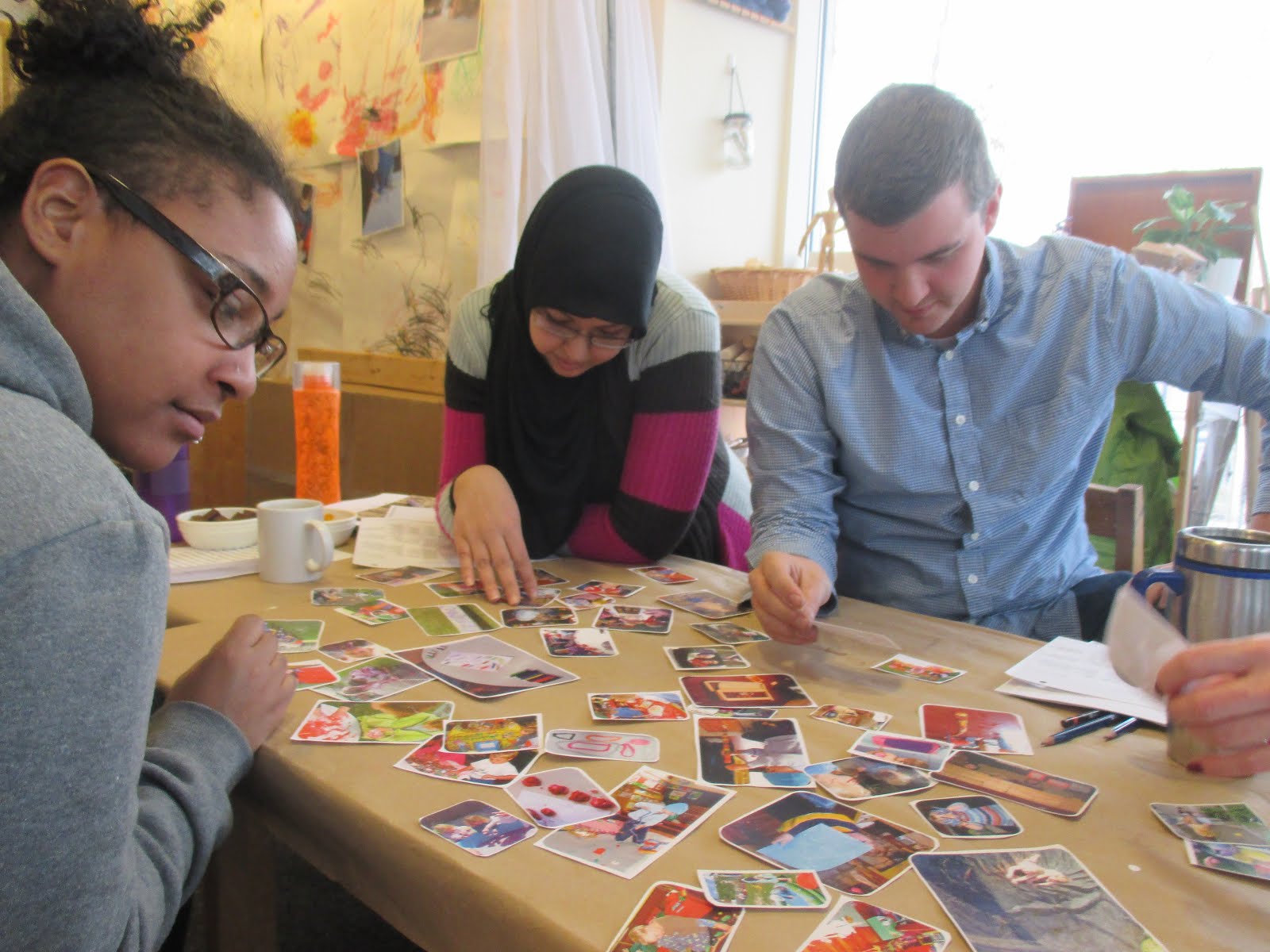
Unlike many topics we explore together, this one was, for the most part, an unfamiliar concept. We did some reading from Getting Started With Schemas by Nikolien van Wijk (a book I bought in New Zealand where schemas are more commonly used to understand children’s play and work), and from other sources. We sorted photographs of children’s play by schema, drew stories of schemas we see every day and as we worked, we talked.

Over four meetings, I began to see threads of common understanding in how teachers constructed this idea of schemas and how they fit into our work. I think that some of these threads may be abstract schemas, habitual ways of considering new ideas. I don’t have enough evidence from these meetings to identify the repeated patterns for individuals but overall I heard teachers folding this new information into their existing expertise in a variety of ways. I’ve grouped them here to demonstrate the many different ways to consider new ideas about our work, and to demonstrate the parallel tracks our professional development and our teaching of young children can take.


Analyzing: Some teachers took apart the theory of schemas, looking at it from different angles.


“How does adult... interest or [action] impact a child’s schema? How does the child react to being seen this way?”


“I sometimes wonder, is that [repeated behavior] keeping them from doing other things? But I guess that is the thing, actually.”


“I’m becoming very aware of children’s and adult’s agendas.... I’m not attuned enough yet to see a pattern, but I see how schemas could help me see children’s agendas more clearly.”


Considering development: Some teachers fit the concept of schemas onto their preexisting knowledge of how children change and grow.


“It’s hard for me to see a schema NOT as something that naturally comes after one stage and before the next.”


“As kids get older it’s easier for me to see how much attention they can give to one thing.”


“How do I learn a child’s schema without being influenced by stages of learning?”


Self-reflecting: These teachers thought a lot about how their emotions connect with what they learned about schemas.


“Why does this behavior bother me? Why does it matter if he fills a bucket every day?”

“This helps me to reframe what I take for granted in children’s play.”

“Developing curriculum in this way challenges me to think about why I say no, make rules.”

“When I can put myself in a child’s shoes, I’m better able to teach. This is another way to do that.”


Questioning: These teachers tend toward big questions, and their learning about schemas catapulted their thinking into philosophical directions.

“What makes different kids develop different schemas?”

“What is the nature of learning?”

“So... schemas are always patterns but patterns are not always schemas, right?”


Strategizing: Some teachers rolled up their sleeves and immediately considered how this theory would function.
“This is a way of watching a child’s focus; not on one idea or activity but across themes, across materials and activities.”

“What a wonderful way to think about redirection... and about continuing in a direction!”

“Kids in my class are fighting, are being powerful and dominating one another. I’m not sure what schemas they’re exploring but I’ll take notes.”

“It’s a way of saying yes, which my team is trying to do right now. We notice and then say "Let’s find a way to make these things happen”.

“It’s a helpful way of getting to know new children.”


It’s important for me to note that these are not transcriptions of conversations. I sifted four different 90 minute conversations into these categories. I looked for patterns in the same way that a teacher looking for schemas will. Sometimes two people with different threads spoke to one another. It was challenging, but teachers here are used to communicating despite differences. Just as children with different schemas can be invited to play together by carefully designing provocations, adults with different approaches to new ideas can be invited to talk about them through careful provocation. The variety of activities (group text study, conversation prompted by quotations, illustrating a narrative, collaboratively sorting photos by schema) provided allowed folks with different preferred threads of investigation to connect.

Self-reflection is a teaching skill. The more we can see our own thread, the better we can find them in the work and play of others. Which of the above resonates with your way of wondering?

How do you see this kind of work happening with the third protagonists, families? What threads of habitual thinking do they hold through a variety of different experiences?