Thursday, June 4, 2015

Building Skills, Building Confidence, Building Comraderie

Too tricky, or not too tricky,
that is the question.

Nathan, Kevin, and Kai are builders extraordinaire. They build on the floor and on tabletops. They build amazing cities using blocks both big and small.

When Seana told me about the city-building these three were working on, it immediately sparked an idea – a observational “city drawing” walk around Cambridge.  We would bring sketchbooks and thinking markers as we walked around in search of interesting buildings and other pieces of architecture that might inspire them. Observational drawing walks are some of my favorite things to do with children – I love opportunities to connect with our greater community – so I was pumped!

For our first walk, it was just me, Nathan, and Kai, because Kevin was out that day. As we began walking, one of the first things the boys noticed was the footbridge that crosses the Charles River near our school. We sat down on a bench so we could observe and draw. While Kai began work on the bridge right away, Nathan did not even take the cap off of his marker. Instead, he pointed out things about the bridge, especially the lights.

“The bridge has lights on it. Did you know at night it’s dark, so the red lights show you when not to go and the green lights show you where you should go… look, see the lights? Do you have room for the lights?”
Do you want to draw the lights of the bridge?” I asked Nathan.
He shook his head, “That’s too tricky for me.  I want to draw something easy.
What makes it tricky?” 
Look there are so many parts to it. I can’t do all of those.”
“What if we started with just one part? Which part would you do first?”
“Nah, it’s too tricky.”

Similar conversations occurred at several other points on our walk. While Nathan was comfortable drawing street signs and other “easy” things he saw, when it came to drawing something as complex as a building, he felt overwhelmed. As a teacher and an artist, I felt an internal struggle. Nathan was clearly drawn to the different street signs we saw –he was constantly pointing them out – so should I let him keep drawing these without pushing him to take on one of the “tricky” things? My finer feelings rebelled against this. After all, isn’t it part of my job, as a teacher, to challenge my students, and to help them through those moments of frustration in surmounting that challenge? The question then became, “How can I help Nathan to move out of his comfort zone with his drawing and find confidence in taking on a “tricky” task?”

The opportunity came when we crossed a second footbridge over a road. As we sat down on some concrete benches, Kai immediately pointed out a building he wanted to draw and set to work. Nathan looked around, considering a construction site in view. He began to make some strides as he started to draw parts of the site with prompting from me – a ladder first, then some of the beams around it. After this, however, he returned to drawing the signs he saw, including one that pointed to the bridge we had walked over.

Maybe you could draw the bridge, too?” I suggested.  Nathan shrugged, “It’s too tricky.” “It might seem very tricky now, but as we get more and more practice, drawing tricky things gets easier and easier,” I said. “I know that,” he said.  I smiled and turned around to face the bridge, “So let’s try it! I will help you think about what you need to do to draw that bridge.”

We sat side by side, looking at the bridge. “What is the shape of that bridge? That might be a good place to start,” I suggested.  Nathan drew an arching line to represent the bridge. I looked at his drawing, then back at the bridge. “Yes, that shape looks a lot like the part that we walked down,” I said pointing at the bridge’s curve.  "Let’s see, what else does the bridge have on it? What helped us as we walked over?” Um, the railings?”He added these, too, as well as another section of the bridge that we had walked on.  “What else do you see?” I asked, to which he answered, “I don’t know.” I looked again, saying, “Whoa, I see something under the bridge that I wouldn’t expect to be there.” Nathan followed my gaze, exclaiming, “Doors! That’s so weird! And a window in between!” He began to add these to his drawing. Kai, who was still hard at work adding multiple windows to his own drawing, looked over at Nathan’s work in progress, then at the bridge. “You need some stairs,” he suggested.  Nathan added some lines on one side for the steps. “How about that?” Kai nodded, “That’s good. You’re doing it!” Nathan looked back at his work, “It’s kind of like a ladder. Done!”  “Wait, the other side, too!” Kai reminded him. “Oh yeah!
I held up Nathan’s finished bridge so he could see it in comparison to the real thing. “What do you think?” I asked. “Good,” he said, smiling.


. . . . . .


Kai's drawing of the "100 Building"

We went on a second walk a little over a week later, with Kevin and Seana joining us this time. Instead of venturing along the river, this walk took us into the neighborhoods along Banks Street and down Mt. Auburn Street.  Our first stop was to draw the area around what Kevin called, “the 100 building.” Kevin and Kai both set out to draw the building itself, while Nathan once again demurred, returning to his old saying, “That might be tricky, I might look for something easier for me.” 

However, rather than simply choosing a street sign, he decided to draw the garage that was next to us, with its large doors and emergency light. After he finished, he decided to move on to drawing a street sign, which he identified as a “no parking” sign. Rather than just drawing a line and a rectangle, as he had on our last trip, he began to add some details of the sign itself – an arrow and the words “NO PARKING.” Unfortunately, his first sign was too small to hold all of the letters, so he started over on a fresh page, making use of Seana’s suggestion that he write the words first and draw the sign to fit them. As he worked to decipher the order of the letters, Kevin and Kai both began to chime in to help him. “Is the next one an R?” Nathan asked, “Yep, it is an R, and then a K, like my name,” Kevin replied. 

We saw many other interesting sights along the way, including a church with a crucifix on the front, which Nathan described as a man “made of stones, holding a bridge, and dancing.” But our final stop was one of the most interesting. It was the Harvard lampoon building, which is not only situated on its own in the middle of the street, but is also architecturally very striking, with a rounded front, stained-glass windows, and flag poles protruding above the door. Nathan’s first remark upon seeing it was, “What a beautiful door!” As Kevin described it, “It’s funny to me, because it’s not very high. That’s a short building (next to it), but this one is even shorter, and it’s right in the middle of that road.”


All of the children recognized that drawing this building was going to be a challenge. There were so many parts! And what an odd shape! I sat next to Nathan, wondering what would happen as he tried to draw it – would he refuse, denouncing it as “too tricky?” Would he limit himself to drawing just the door, window, or some other small “easy” part? After looking at the building in silence for a moment, he asked, “Can I draw just the round part? With the door and the little window and those poles?” He was referring to the front of the building, which was rounded in shape. I was elated.  “That sounds like a great plan. Where do you want to begin?” He moved from the base upwards, adding in one piece of the building’s façade after another, until he came to the “flamenco” at the top. “I don’t know how to draw it, can you help me?” Before I could even offer, Kevin, who had already finished his drawing of the building, jumped in. Using his hands, he illustrated the lines that Nathan should make to construct the body, neck, and beak of the bird. “Like this,” he would say, pointing his hand up, then slowly bending it forward into a curve. Nathan watched Kevin’s hands carefully, mimicking them with his marker on the paper. Once he had finished, we packed up our notebooks and markers, and began the walk back. Almost immediately, the three of them joined hands and Nathan declared, “Let’s sing ‘Fly me to the moon!’” They walked joyfully back to school, with Nathan leading them in singing the song continuously the whole way. 
. . . . . . .
I am so proud of Nathan for taking on my initial challenge of drawing the “tricky” bridge, as well as for continuing to broaden his drawing skills in the second visit. At one of our most recent professional development day, we talked about how everyone can struggle with a “little hater” inside our heads, telling us that what we do is not, and never will be, good enough. I know that I often have to guard against just such a voice, pushing through moments of creative self-criticizing that prevent me from trying anything, success or failure. I think Nathan was struggling with his own “little hater” during these walks, and I appreciate that he was willing to fight back against this voice in his head, with the help of his teachers and his peers. I also appreciate that the process of helping Nathan in these moments allowed me to reflect on the type of teacher I want to be - a support and a sounding board who nonetheless will hold you accountable to your own best abilities - and what I hope for the children I am teaching – self-confidence and a willingness to take risks. I hope that I can continue to be this type of teacher for Nathan and the other children I work with throughout the center.

Kevin's drawing of the Harvard Lampoon
I am also proud of Kai and Kevin, who both found the time and energy to not only work on their own drawings, but to provide Nathan with the support he needed to finish his. From offering him ideas for his bridge, to helping him with the letters for his sign, to describing how to draw the bird on his building, they showed genuine interest and investment in his work, as well as in his skills as an artist. Their walk back together felt like a celebration of their collective successes, as well as for their friendship and care for one another as individuals.

Nathan's drawing of the Harvard Lampoon
This experience has also given me a chance to reflect on what it is we offer children when we invite them to think about things through multiple media. As I said at the beginning, these children are all very comfortable working with the three-dimensional and geometric material of blocks as a way to create cities and buildings. In some ways, this might be easier than drawing a city or a building, because, with the blocks, they are creating something three-dimensional with something three-dimensional. It was clear that trying to represent real, physical buildings (and bridges, etc.) through the medium of drawing presented some real challenges. I really was asking the children to think about the buildings in a different way, stretching not only their drawing skills, but also their understanding of perspective, scale, and proportion, to name a few. They were expanding their repertoire, using the dispositions of builders, architects, artists, and designers, all at once.

Kai's drawing of the Harvard Lampoon
One of the next steps I am eager to try (and which Nathan himself suggested) is to try to recreate their drawings using three-dimensional materials. As we return to a material that these three children feel like “experts” with, I wonder how we can continue to challenge and support each other in our work? Will these buildings still feel tricky? Or will they be easy to build? I can’t wait to see!


How do you silence your “little hater” and take on something you thought was “too tricky”?             

Tuesday, January 6, 2015

Everybody Knows; Working with Our Commitment to Anti-Bias Curriculum


In the month of November, we recommitted ourselves to our anti-bias curriculum and teaching for liberation. Four years ago, our staff started a two year exploration into what it meant to create anti-bias curriculum in our classrooms. Teachers examined our biases and our privilege. We looked closely at systems and materials in our center and how they worked to support or counter the biases of our dominant culture. It was a deep, emotional collaboration and those of us here at that time will not soon forget what we learned. There are certain practices, norms and materials at our center that support this kind of teaching, but more important are teacher attitudes, habits and knowledge, so we worked on those in teacher provocations.

We have had some staff turnover since our first investigation of anti-bias curriculum. Many of our newer staff see the word “anti-bias” on our
website, see the poster of Louise Derman-Sparks’ Four Anti-Bias goals (letterpress printed by our atelierista, Katie Higgins-White!) that hangs in every room of our center, and they like the idea of teaching for justice.  None of this helps  these teachers know what to DO. This month we worked to see our work in the context of oppression so that we can make choices that lead to liberation. 

In many ways, teaching for liberation means questioning the things that we “know”.

An example; everybody “knows” it feels good to receive a complement. Complements are a way that many adults greet young children and build a relationship. When we begin to see how we broadcast our own biases, and learn how they affect the identities of children in our care, we want to counter some messages in our work with children. After we learn more we see how we are reinforcing stereotyped messages about gender. 

Suddenly, if we pay attention, we hear our complements differently.  We notice that we may respond to even the smallest babies with complements about their appearance when they think they are female babies and about their actions if we think they are male babies. (A most telling example of this occurs when an adult accidentally misunderstands a child's gender, and makes the "wrong" kind of complement.) We see that we are telling a story to a child about who they are when we complement them for being pretty, having a “cool dress” or being strong or funny. In fact, we’re colluding with most of the media that they’ll consume in telling them this story.

Our anti-bias practice requires teachers to notice these kinds of actions, to think about them, talk about them and try to build a new habit. Now we know that we can greet a child without a complement at all and wait to see what we’d like to say. We know that we are co-constructing children’s world with them, that we have tremendous power and that we can counter the dominant “story” in our culture that girls’ and women’s worth depends on our aesthetic value and that boys’ and men’s worth depends on what they do. We know that we must work to counter this stereotype and that it’s worth doing because it helps children grow up with a sense of worthiness connected to how they are in the world, what they think and what they do rather than how they look or behave.

At the end of the week, I’ll post about our provocations and describe how teachers defined anti-bias curriculum, we practice it at our center, and how we reacted to some stories of teachers and parents dealing with issues of difference and bias.

If you want to follow along, we listened to the firstchapter of an episode of This American Life about classroom discipline entitled "Is This Working?" And read “Holding Nyla” from the endlessly helpful text about doing education for liberation with young children, Rethinking Early Childhood Education, edited by Ann Pelo.

Where is your center on your anti-bias journey? What are you still working on?

Thursday, December 11, 2014

Conversations with Nature: Preschool One Explores Natural Materials

“We often forget that WE ARE NATURE. Nature is not something separate from us. So when we say that we have lost our connection to nature, we’ve lost our connection to ourselves.”
                                                                                   ― Andy Goldsworthy

Autumn in New England is full of natural beauty – from golden leaves floating to the ground to acorns nestled in the grass to branches blown free by the winds.  These objects call out to be touched, gathered, collected, and children often do just that. Pockets that were empty before the trip to the playground return crammed full of bark and twigs and stones. Long sticks are brandished like swords and left unwillingly beside the door until they can be used again. These things entice us, draw us in, and call to our creativity. They are one of the hundred languages, and, if we make space, we can speak through them. This is Preschool One’s story.  

Rivers and Tides
We began our work with natural materials in the Studio by watching pieces of the documentary, Rivers and Tides.  This documentary features the work of artist Andy Goldsworthy, who creates beautiful installations – some in museums, but many of them outside – using entirely natural materials. I love this documentary because it not only showcases Goldsworthy’s breathtaking creations, it also shows his process. You can see his attention to detail in finding the perfect piece to add to his creation, as well as his frustration when one of his projects collapses midway.

I projected the video on the wall without sound, occasionally prompting children’s conversation with questions, such as “What does that remind you of?” or “What do you think he is using?” Here are some of their thoughts about what they witnessed*:


Alisa – It’s a snake.
Y. – Did you know there’s paths like that?
N. – Maybe it’s a drawing.
Justin – Maybe it’s lava.


E. – Hey all those are blowing away from the snake.
Justin – There’s something inside them – a sea snake.


A. – We see ice.
F. – His hands are cold.
Y. – What is he making? He’s eating it. Ew.
E. – It’s cuz all the other pieces are just like it and he can stick the pieces to the pieces.
All – BRAVO (when he finally sticks his last piece of ice).
N. – It’s a snake tree.


Justin – Maybe he’s making a nest.
Arnaud – Maybe he’s making a nest out of trees.


A. – I think he is making a house for him. He’s using stone.
Justin – Looks like a pile of rocks.
Gus – Maybe it’s melting – now.


Alisa – It’s a web.
Y. – You know why it’s not a web, because there’s a hole on a stop sign.
F. – Why is there a hole there?
Y. – Maybe so it can be a stop sign.

The Building Process
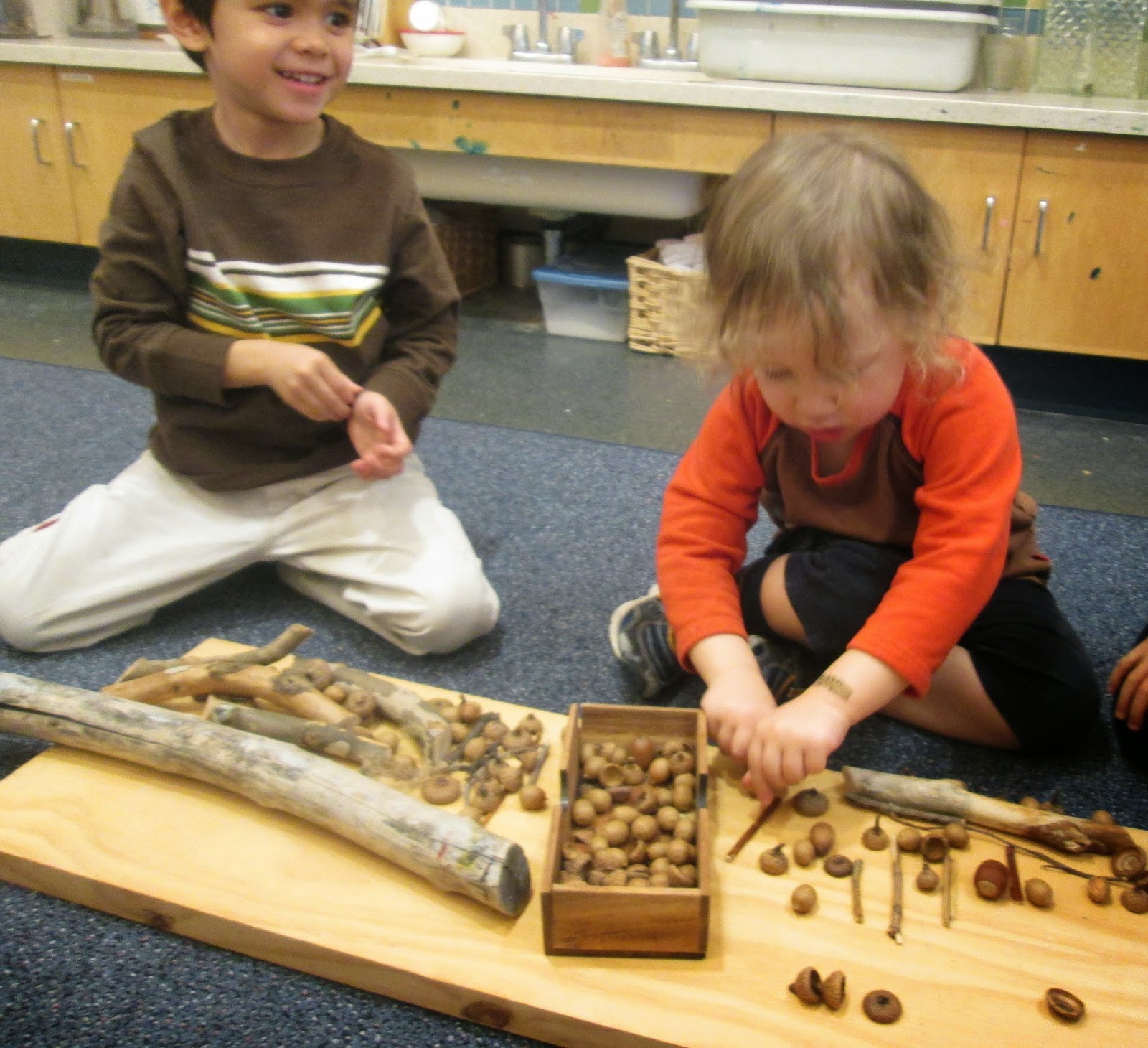
Following the video clips, I moved away the projector, spreading out several work surfaces on the floor, as well as baskets filled with many of the same materials that the artist had used. As children began building, I could see ways in which Goldsworthy’s work directly influenced their designs and their methods. Their great care in building creations using sticks, rocks, pine cones, acorns, and leaves seemed to echo the deliberation and concentration we had witnessed in the video.


As Gus surveyed the materials, he asked, “Can I make like he did?” beginning to collect sticks for a “nest.” Later, when he wanted to make one of the sticks stand up, “like a tree,” he made use of a glass jar as a stabilizing device. When A. laid out a small circle of rocks, she said, “I made what he made. I saw he made a hole with rocks, so I made a hole with rocks.” El. created a long line using all of the rough-edged rocks available. Arnaud and Justin built intricate traps, where each acorn cap or stick had a job to do.  N. enjoyed making matching stacks of things, such as a series of tree ring towers. Phineas overlapped a series of sticks, which he described as “just a design.”  E. worked to cover the entire surface of the different squares of wood set out alongside the materials. She would search for the perfect rock to fill each space, creating an orderly mosaic of materials.

Questions of Scarcity
I noticed that order and space became very important for many children over the course of the visit – lining up a series of sticks that were big enough to stretch across two other sticks like a bridge, filling a small square with only smooth stones… This meant that many conversations arose around the issues of scarcity – not having enough to finish a project you had begun – and stockpiling – holding on to many things in order to use them for future projects. Such conversations are part of the preschool milieu – how do you share space and resources with 15 (or, in this case, 4) other kids? The unique piece of this Studio experience was that this was a space dedicated to using just these particular materials, leaving more room for these discussions to happen. In many cases, the children discovered that their worries about someone else taking “all” or “too many” of something were unfounded, or that they really did not need all of the pieces they had been fighting to keep. For instance, when Gus was working to create his “tree,” the glass jar he wanted was full of sticks. He quietly sat down by the jar and began to empty it out. A. and E., who were working nearby, watched him.

A.: Oh no, he’s taking everything!
E.: Oh no, and I need sticks!
At this point, Gus left with the jar, leaving a pile of sticks on the floor.
E.: Oh, he just took that jar.
Katie: Did he take everything?
A.: No, he left those.
Katie: All he needed was the jar, so he left the sticks for you.
E.: That was nice of him. I guess I only need a few sticks.

Where the River Meets the Sea: The Big Picture
Through this experience, the children gained practice in appreciating, using, and re-using these natural materials. Treated as loose parts, the possibilities of sticks, rocks, and leaves multiplied, while children’s concerns over quantity and ownership gradually diminished. My wish is that this way of being can extend beyond the classroom into the greater natural world, where we can recognize forests, mountains, rivers, and more as treasures held in common, worth defending to be appreciated again and again by generations, rather than used up for the sake of one. We are the stewards of the earth, and we are charged with the task of passing that stewardship on. The best way I can think to do this is to help children engage with nature, cherish it, and not merely preserve, but share it in good faith. 

*The pictures featuring Goldsworthy's work are screenshots from Rivers and Tides.

Thursday, November 20, 2014

Open Studio Snapshots - Exploring Paper


Last month, I invited families to join their children here for our first Open Studio of the year. Seeing as paper was the first material that children used in the Studio, it only seemed fitting that this be the subject of this initial Open Studio. Here are some photos of an evening spent exploring this remarkable material (with some tape thrown in). 


Simon and his mama, Kendra (our pedagogista), spent a long time playing with really big pieces of transluscent mylar and white paper. Simon summed up some differences he learned: "This one (the white paper) doesn't make any sound and this one does. This one (the mylar) is fast and this one is slow."


Maddy and her dad, Justin, worked with colored cardstock. Maddy made the snowflake decorations you see on the table by layering strips of blue paper over each other and taping them together. She went on to make many other creations, such as a phone made entirely out of paper. 


Anna and Julie, two sisters, played with the paper hanging from the ceiling. After much pulling and tugging, they finally managed to pull down a thick rope of brown packing paper.


O. brought pieces of colored acetate and tissue paper over to sticky contact paper taped to the window. She carefully arranged each piece, beginning with a series of vertical lines, then adding some horizontal ones. 


Harlan and his mom, Sky, worked with tape and paper. Harlan created a three-dimensional haunted house, with many curving pathways. Sky used black tape to collage a black tree against a blue background.


It really is beautiful to see so many children and parents from across the classrooms of PTCC join together, creating and exploring side by side, in one room. Thank you to everyone who participated in making our first Open Studio a huge success! 


Thursday, October 23, 2014

Starting off the Studio: Ruminations and a Paper Investigation

How will we use the Studio? 
Which material will we use to begin our Studio journey?

These questions are constantly on my mind, not only at the beginning of each school year, but during all the months that follow. Each year, the use of the Studio shifts a bit as we try to navigate the ideals we hold as a Reggio-inspired center and the realities of serving 90 children, infants through preschoolers, spread throughout three separate buildings. Now that we are settling comfortably into the routines of the year, I want to take some time to reflect on the questions that have driven these shifts, to share some thoughts about what I do and why, and to tell a little about the subject of our first Studio adventure - paper.

How will we use the Studio?

Right now, children's visits to the Studio are primarily centered around getting to know a few key materials one at a time, building a repertoire of expertise that will serve them throughout the year. A few groups have also started visiting together to explore particular themes of interest, such as ramps and balls, music and movement, and building train tracks. This really points to the fluid and flexible nature of the Studio - it is an art room, a laboratory, a meeting room, a dance floor, a recording studio... and the list goes on. However, throughout all of these pieces, it is a place for focused work of one form or another. This focus may come from the side of the materials ("We're going to explore wire today! How can we change this piece of wire?") or it may come from the side of ideas ("Today is about building our animal sculptures together! What parts do we need? What materials should we use?") - but in either case, the focus is there.

This is a practice that has taken me several years to develop, and it is something I am still working on. When I first took on the job of atelierista, this element of focus was already partly in place, but there was also a sense of "free play" - of doing whatever you wanted with any of the materials. At first I went along with this, knowing that this is how things had been done, but I felt that there was something missing - something that I believed was at the heart of the Studio. I saw a lot of children using materials for the sake of having them - gluing piles of beads and glitter to paper or wrapping sticks with a mile of tape simply for the sake of taking them home to their mommies and daddies. There is nothing wrong with this, of course, but, as my fellow atelierista, Anna Golden from Sabot at Stony Point, writes, "... that's not what studio thinking is all about."

So what is studio thinking about? It can be stated as a framework, a set of eight habits of mind, such as "envisioning," "developing craft," and "engaging and persisting."  For me, it is about learning about materials in order to use them to create the things you want to create and to follow through on your ideas with success. It is also about developing a practice of using materials intentionally and respectfully. It is about recognizing that every material has potential that is worth exploring. These are the ideas that I strive to embody through our use of the Studio, whether the children who are using this space are 5 months or 5 years.

Which material will we use to begin our Studio journey?

In the same blog post, Anna asks three important questions regarding materials for a Studio:

How do children use materials? 
Which materials serve children, considering Gardner's multiple intelligences?
Which ones have most potential for creative thinking?

The Studio is home to a variety of materials - paint, clay, glue, yarn, cardboard, tape, fabric, markers, wire, wood, and more. I feel that all of these can be used in multiple ways, can serve as outlets for sensory experiences as well as expression, and have a lot of potential for creative thinking and problem solving. The question is, where should we begin this year's journey in developing the "studio thinking" already mentioned?

This year, I chose paper as our starting place.

Paper is a material with a huge amount of potential. It is extremely malleable, yet it also has structural integrity - it can hold the shape into which it is twisted or folded. It comes in a variety of colors, weights, sizes, and textures. It is also very accessible - it is my go-to material for infants at the start of the year. A fellow teacher, Lise White, and I once followed an extensive investigation of young toddlers and paper. As one of the proverbial hundred languages for creative expression, paper is one with a wide and fascinating vocabulary.

Paper also offers a challenge. It is a material that we often use as a surface only - a place to draw and write. We don't often use it on its own, for its own unique properties. In offering paper to children, I was beginning the year by asking them to look at things - this material specifically - in a new way.

In order to really get at this idea of learning a material's own unique vocabulary, I initially offered paper to the children entirely on its own. No drawing utensils; no scissors; no tape; no glue. Just paper. Granted, the paper itself did not take just one form. For visual simplicity, all of the paper was either white or black, but some of it was small, and some was big; some was hanging from the ceiling, while other pieces were spread on the floor or arranged on a table; some pieces were flat and untouched, while others were already wrinkled from being crumpled; the weights of the paper ranged from thick watercolor paper to very lightweight tracing paper. In order to invite children to start thinking about the many possibilities of this material, it seemed important to offer up a variety of possibilities as to what this material could look and feel like to begin with. 

At first, many children asked, "Where are the markers? We need scissors!" Even some very young toddlers entered with the question, "Markers? Draw?" The challenge I had foreseen was clearly there - these children were used to acting on paper in a two-dimensional way. I was interested in seeing what they could do when they started to think more three-dimensionally. I gave them one question as further provocation: "How can we change this paper using just our hands and bodies?" Here are just a few answers from children across the center ...

Sam shook and waved the paper, sometimes wrapping it around his body into a big "mountain." 

Phineas, Harriet, and Alisa used a big piece as a house. "Come through the door in the front, not the back."  

Morgan ripped the paper into smaller and smaller pieces. She found that if she pulled it in one direction, it ripped easily, but if she pulled it in the other, she couldn't rip it at all.

Raphael scrunched different papers next to his ear. "This one sounds different. This one sounds soft. This one sounds loud."
Alvida and Lundy pulled down the paper from the ceiling. "Reach up," Alvida said, encouraging Lundy to help her try to pull down the pieces that remained. 

Justin ripped a piece of paper into small scraps. Arranging theses careful, he announced, "This is my control station. These are the controls." Each piece of paper became a button or a lever. 

"You can make shadows on it," Jone said of a big piece of paper lying on the floor.
E. folded the paper as she explored the different textures of its two sides.

Through this experience, the children learned a great deal about the properties of the different papers. For instance, some were easy to rip, while others were nearly impossible. The diaper table paper was flexible enough to  tie together, while the cardstock and watercolor paper could actually stand on their own if they were folded the right way.

I love that the Studio can be used as a place to not only build on children's interests, but to challenge them to build new skills and try on new perspectives. By investigating paper on its own, in this focused environment, children across our center discovered so many more uses for it than merely drawing or painting on it - they began to appreciate it as a unique material in its own right.

Do you see "Studio thinking" at work elsewhere in our center? 

What memories do you have of being introduced to art materials - of getting to know these "languages" ?

Friday, September 12, 2014

Teachers are Learners: Illustrating a Year of Project Work, Part 3

The following is the third and final part of a series of posts illustrating the ways our teachers took on the different principles of project work last year. Click here to find the first part and the second part.

Bring the small group work  back to the larger group and find ways to integrate the work into larger classroom life.


From the early stages of her group’s music project, Serena encouraged the budding musicians to share their work with their classmates (and our resident musician, Wayne). In the beginning, their experience of performing a song in progress allowed them to get some feedback to help them improve. Later, they worked to catalog important vocabulary words and use them to write new songs, one of which they also performed for their classmates and parents. As their vocabulary became more nuanced and consistent, Serena encouraged them to share their new system as useful tool for other songwriters in the classroom. Through this practice, the work of denoting and writing new songs has spread into the greater culture of the classroom, adding new focus to a general interest in music making.


Choose your small groups carefully, thinking about their relationships to the concepts and with one another.

When Tracy was considering the composition of her sea monster group, she took into account the different possibilities that the project held for each child. For some children, the experience would help them practice listening to others’ ideas and integrating them into their own. For others, it offered the possibility of a leadership role – getting to speak up and gain confidence as an “expert” on sea monsters. In her careful formation of the group, Tracy brought together children who had normally not played together much before, but who shared an interest in sea monsters and could benefit from each others’ strengths.  Among the group, there were storytellers, artists, safety advocates, and trap-builders, each working to make the lore of the sea monsters richer through their contribution. In bringing together this diverse group of children, Tracy not only helped build a successful project group - which they collectively named Team Blueberry Pickle - but also helped to foster new friendships and a greater sense of community throughout her classroom.

Stay curious about what you observe.
We were unsure what project work would be like for babies and young toddlers, but we were certain that our teachers would find ways to collaborate with some of our youngest citizens. While Cathy watched how babies played with balls and ramps for inklings of understanding, Eileen studied friendship, reflecting upon the demonstrations of empathy and fondness that she saw to draw her conclusions. Brae thought long and hard about how babies communicate with sign language and then with speech. She wondered why children chose one mode of communication over another. This team had deep, thoughtful conversations about their projects, and how they could continue to explore side-by-side with babies. On the other hand, when Henna joined the Toddler Two North team in the middle of the year, she had to build new relationships with the children in her class, while also listening for that special spark of interest that indicates that a topic might be worthy of deeper investigation. She knew that food held a special fascination and offered a number of different ways for the children in her class to relate to it. She was persistent in her study of the children in her care and their relationship to food, and offered a number of different and delicious provocations to her class.  


Celebrate and honor the children’s work by ending it in some meaningful way.

As our year (and our projects) come to an end, we are excited to see what celebrations unfold for these many projects. Clearly these children and teachers will continue to learn more, about the workers in their community, about how buttons influence the world around us or how to communicate with one another. However, one way that we honor children's collective exploration is by following the waxing and waning of their interest - by helping their work together form a shape with a beginning, middle and an ending. Part of the practice of progettazione in Italy, and the projects that happen elsewhere in Boston and all over the US, is to recognize the work that's happened, look at it as a whole, and celebrate it with families and children. In the final weeks of our school year, teachers, families and children marked this moment, honoring the learning they did and relationships they built. Seana planned a plane-decorating party for her paper airplane group, Carmel and Aline invited families to co-create a bird guide that will live on in our center, and Miwako’s group invited their classmates and parents to the final performance of the play they created, to name a few. What a wonderful end to an amazing year!